



Ventilator Accessories for Maintaining PEEP During Closed Suction


Mechanical ventilation patients with poor clearance of secretions require suctioning to aid ventilation. Suctioning helps to clear secretions to ensure that an airway is open and unimpeded.
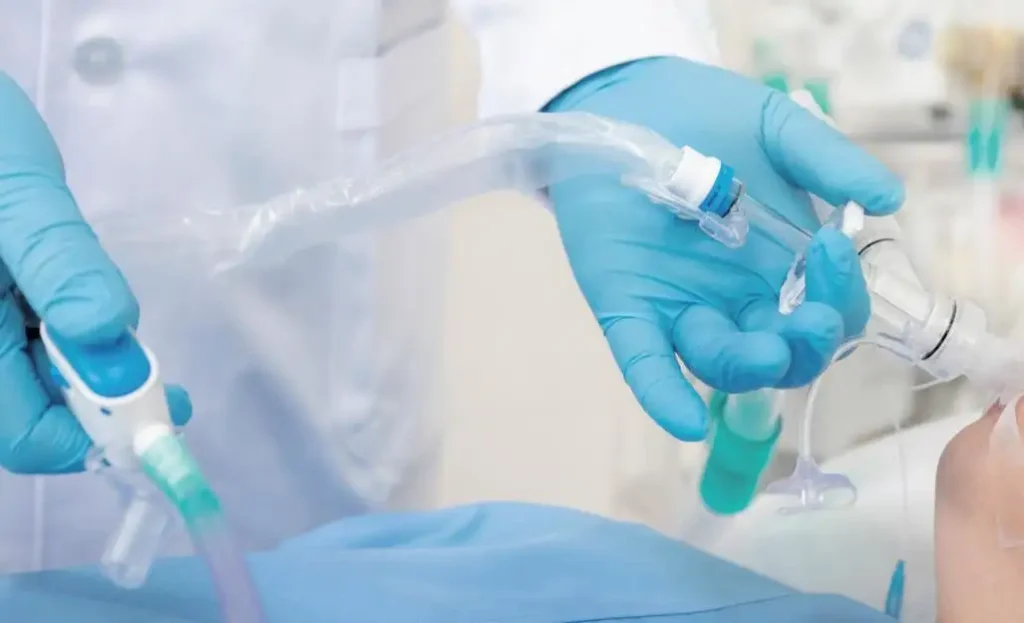
In an open suction system, the patient is temporarily removed from the ventilator, which removes the airway pressures, as well as the delivery of oxygen and lung volume. However, suctioning can be performed using closed systems for ventilator accessories to remove secretions without the need to remove the patient from the ventilator. This system maintains the constant level of PEEP.
What is PEEP?
Positive end-expiratory pressure is the level of pressure within the airways at the end of a breath. During mechanical ventilation, PEEP is used as a pressure sustain to keep the alveoli open and facilitate oxygenation while preventing atelectasis. The appropriate level of PEEP is a clinical decision dependent upon an individual patient's respiratory status.
A disconnection in the circuit of a mechanical ventilator will temporarily eliminate airway pressure. Possible consequences include:
•Loss of end-expiratory lung volume
•Temporary interruption of oxygen delivery
•Reduced alveolar recruitment
•Changes in oxygen saturation
•Additional exposure of the circuit to the surrounding environment
Clinical research indicates that closed suction can preserve lung volume and oxygenation more effectively than open suction in some mechanically ventilated patients, although results depend on the patient, ventilator settings, catheter size, and suction technique.
Open Suction vs. Closed Suction Ventilator Accessories
| Comparison | Open Suction | Closed Suction |
| Ventilator disconnection | Usually required | Usually unnecessary |
| PEEP continuity | May be interrupted | Helps reduce pressure interruption |
| Oxygen delivery | May pause temporarily | Circuit remains connected |
| Catheter exposure | Exposed during use | Enclosed in a protective sleeve |
| Repeated suction | New catheter commonly used | Repeated use within the specified period |
| Secretion exposure | Greater potential for direct contact | Enclosed design reduces direct contact |
Closed suction is therefore more than an airway suction catheter. It is an integrated set of Ventilator Accessories combining a catheter, protective sleeve, suction valve, airway connector, and optional functional ports.
How Closed Suction Ventilator Accessories Support PEEP
Suction Without Routine Circuit Disconnection
A closed suction catheter enters the artificial airway with the ventilator circuit still connected. During the procedure, ventilation continues and the pressure releases associated with disconnecting the circuit are minimized.
This design may provide more stable PEEP, end-expiratory lung volumes, and arterial O₂ saturation. However, closed suction does not ensure that hypoxemia and pressure loss will not occur. Reduced airway pressure and impaired ventilation may still occur due to improper suction pressures, too large of a suction catheter, excessive suction time or improper ventilator settings.
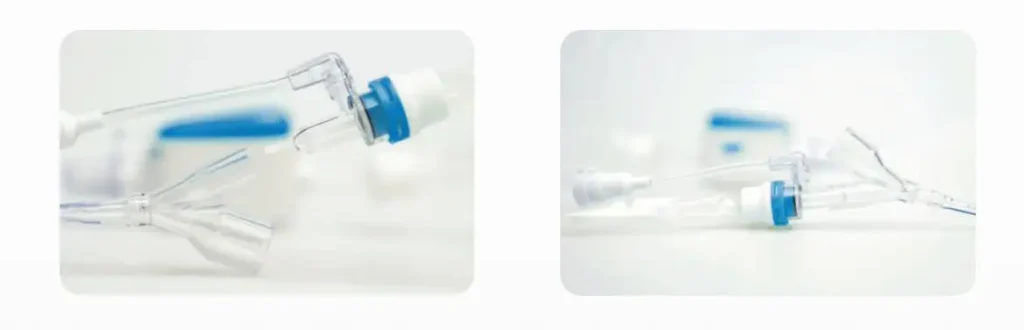
Closed Suction Catheter with Protective Sleeve
The protective sleeve allows the catheter to advance and retract without exposure to the external environment. A clear sleeve allows the clinician to visualize the movement of the catheter and any secretions.
The enclosed design reduces exposure to the staff and direct contact with sputum. It also allows for a more orderly infection control process. The use of closed suction does not eliminate the risk of ventilator-associated pneumonia.
Controlled Suction
The design of the suction valve allows for negative pressure to be activated only when needed, which can be improved by a large press switch and a clear locking mechanism to reduce unintentional activations.
Main Features of Closed Suction Systems for Ventilators
The following features help maintain PEEP and improve the usability of Closed Suction Systems for Ventilators:
•Catheter Tip: Rounded design to help reduce irritation to the trachea.
•Depth Control Markings: Allow the suction process to be controlled and maintained according to the recommended depth.
•Double Swivel Elbow: Design to allow a rotation of the circuit to reduce pulling, kinking, and twisting of the circuit.
•120 Degree Design: Help to reduce the pathway to the catheter and provide a more open space for operation.
•MDI Port: Optional connection to metered-dose inhalers compliant with clinical protocols may be supported.
•Isolation valve: Available on selected 72-hour systems to provide controlled separation between the catheter and breathing circuit.
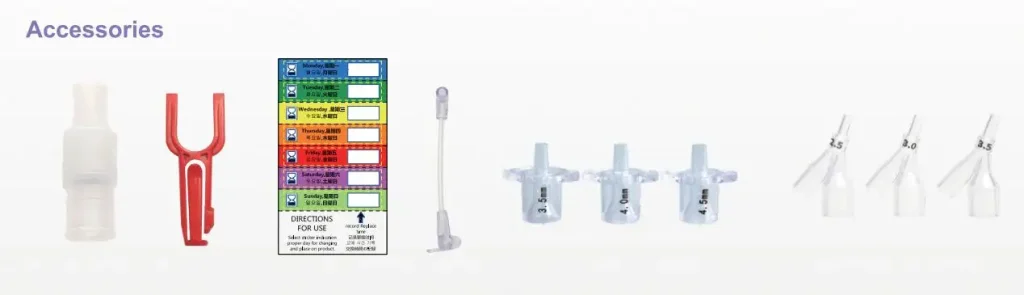
Selecting Ventilator Accessories for Closed Suction
Clinical teams and buyers should evaluate the complete system rather than catheter size alone.
| Selection Factor | Evaluation Point |
| Catheter specification | Diameter, length, and artificial-airway compatibility |
| Usage duration | 24-hour or 72-hour configuration |
| Protective sleeve | Transparency, flexibility, and integrity |
| Catheter tip | Smoothness and softened distal design |
| Suction valve | Activation, return, and locking function |
| Circuit connector | Rotation, angle, fit, and resistance to kinking |
| Optional components | MDI port and isolation valve |
| Documentation | Sterilization, labeling, registration, and instructions |
An airway suction catheter should not excessively obstruct the artificial airway during suction. Catheter selection, suction pressure, duration, and frequency must follow institutional protocols and the product's Instructions for Use.
Greetmed Closed Suction Catheters
When evaluating Ventilator Accessories, performance depends on the interaction between the catheter, valve, sleeve, connector, markings, and respiratory circuit.
Greetmed closed suction catheters are designed to remove sputum, secretions, or vomit without routinely disconnecting the breathing circuit. Available product features include:
•Highly transparent TPU protective sleeves for observation and isolation
•Softened catheter tips to help reduce mucosal irritation
•Clear scale markings for insertion-depth monitoring
•Double swivel elbows that facilitate circuit movement
•Ergonomic press valves with locking devices
•MDI ports and 120-degree connector designs
•Isolation valves on selected 72-hour configurations
The closed system can support repeated suction within its specified usage period, potentially reducing catheter consumption, bedside preparation, and medical waste. Actual replacement intervals must follow the Instructions for Use and hospital infection-control requirements.
Safety and Use Considerations
Closed suction Ventilator Accessories should only be used by trained personnel. Catheter size, insertion depth, suction pressure, procedure duration, and frequency must be selected according to the patient and clinical protocol.
Do not use a product with damaged packaging or beyond its expiry date. Configurations, accessories, and registered specifications may vary by market and model. Contraindications, precautions, MDI-port use, and isolation-valve operation should always be confirmed in the applicable Instructions for Use.
Final Thoughts
Closed suction systems reduce the frequent removal of a patient from a ventilator. This results in less disruption to PEEP and oxygen delivery. The addition of soft tips, protective sleeves, depth markings, swivel connectors, and locking valves assists in suction and circuit control.
Greetmed has integrated a variety of sizes of catheter options and varying durations of use for their Ventilator Accessories. A variety of connectors and integrated features are also part of their offerings. Greetmed encourages potential buyers to reach out to their sales team for any inquiries pertaining to airway integration, engineering specifications, packaging, regulatory documents, and any product requirements specific to a target market.
FAQs
Q1. What are the applications of Greetmed closed suction Ventilator Accessories?
Greetmed closed suction catheters remove pathological secretions, including sputum, from an artificial airway while the patient is still on the ventilator. This is critical to keep the airway open while ensuring the patient continues to receive ventilatory support.
Q2. Are Greetmed closed suction catheters able to function with the ventilator in place?
Greetmed closed suction Ventilator Accessories enable suction to occur with the breathing circuit connected. Avoiding disconnection of the breathing circuit will minimize the interruption to PEEP and the provision of oxygen due to suction.
Q3. How does Greetmed Ventilator Accessories maintain PEEP?
Due to the closed suction system, the ventilator circuit remains connected when the catheter is inserted into the artificial airway. This system reduces the rapid loss of pressure that is experienced when the breathing circuit is disassembled.
Q4. What does the TPU protective sleeve do?
The protective sleeve, which is made of TPU, is suction catheter and allows for forward and reverse movement. It enables visualization while minimizing the risk of medical personnel coming into contact with respiratory secretions.
Q5. What is the purpose of the tip being softer on the Greetmed suction catheter?
A softer, distal tip is used to decrease the risk of injury to the mucosal lining of the trachea. This still carries some risk, so consideration of catheter size and suction technique is still critical.
Submit Your Request
Recent Posts

Tags
- Adult Diapers
- Are custom medical devices safe
- Baby Diapers
- Can respiratory anesthesia be used
- Digital Healthcare
- Do you offer customized consumables
- European Market
- How do you take care of a skin wound
- Industry Trends
- Lady Sanitary Napkins
- Medical Devices
- OEM Medical Devices
- Product Introductions
- Protective Equipment
- Under Pads
- What are custom-made medical devices
- What are diagnostic products
- What are hospital dressing products
- What are medical tube catheters
- What are some common protective equipment
- What are the appropriate applications for hospital dressing products
- What are the appropriate uses for protective equipment
- What is a gynecological examination
- What is a medical consumable
- What is an anesthesia kit
- What is an OEM in medical devices
- what is an wound skin care
- what is can disposable ultrasonic diagnostic
- What is good manufacturing medical devices
- What is hospital-grade protective equipment
- what is medical equipments hospital furniture
- What is medical sterilization wrapping
- What is rehabilitation equipment device
- What medical consumables do you supply
- Where can I find laboratory consumables wholesale
- where can I find medical protection device
- where to buy hypodermic accessories
- where to buy medical apparel
- where to buy medical consumable accessories
- where to find OEM medical device supplier
- where to find rehabilitation equipment supplier
