



AVF Needle With Back Eye: Explaining the Flow Feature and Selecting a Suitable Configuration


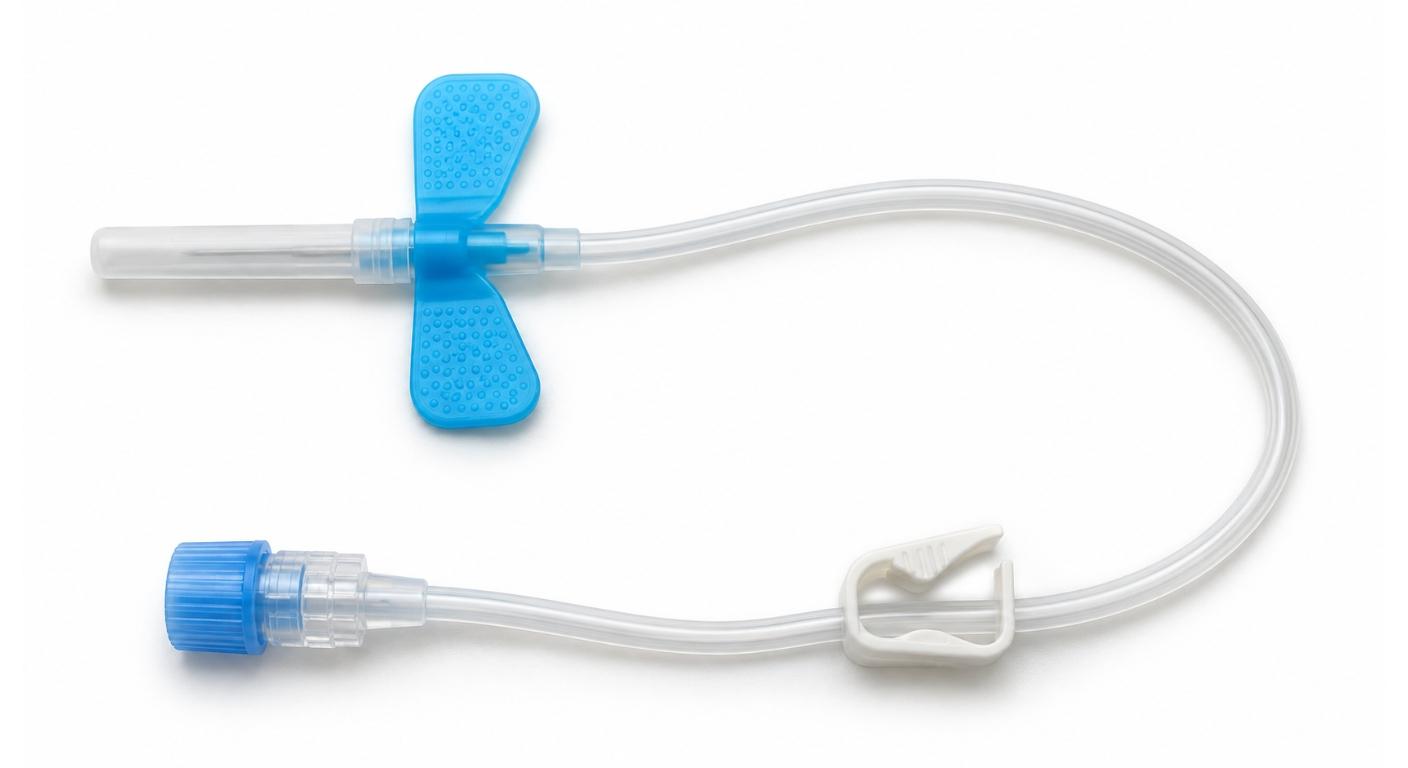
It is possible to miss this small opening in a product photograph, located near a fistula needle's tip. But it's a detail that should be considered during the review process when considering a new needle range by a dialysis center. The back eye is in the blood flow pathway and the wings, tubing and packaging are for the various components of the working set-up.
To dialysis procurement teams and renal care distributors, the AVF Needle With Back Eye is about assessing each of those functions individually and then combining them. The goal should be a configuration that is clearly defined and can be evaluated by the clinical team and not one specific feature that prompted the purchase.
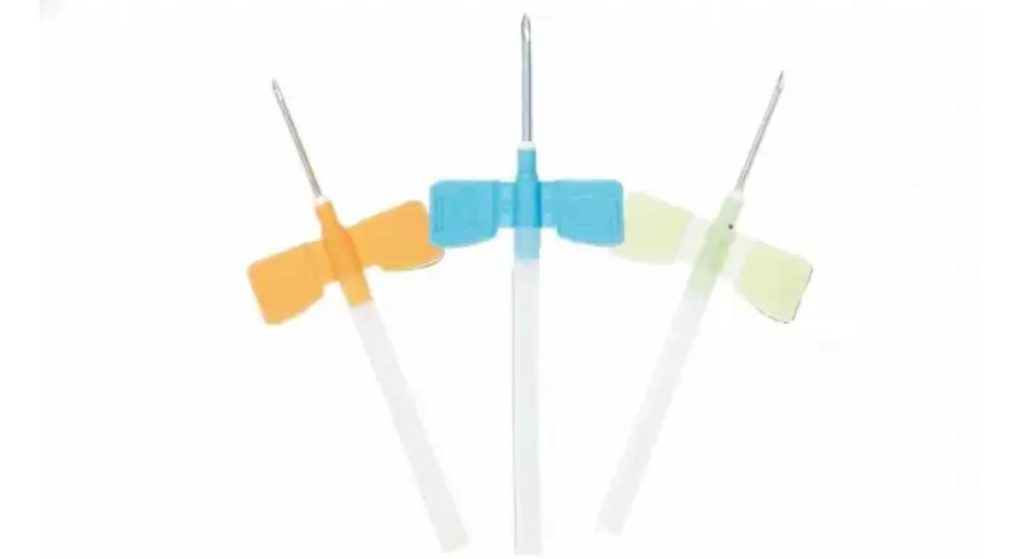
What Back Eye REALLY does
An opening found on the back of the needle, opposite the bevel opening, used to thread the needle. It offers an alternate pathway to allow blood to get into the lumen. This feature is especially important when considering access to the main opening, e.g., blood withdrawal, and the position of the main opening relative to the vessel wall.
Needle position is not disregarded in the opening. Nor is it a prescription for flow rate across the board for all patients or treatments. However, it should be taken into account in the context of the internal diameter, the entire needle assembly and the status of the vascular access.
Why Wall Thickness and Tip Finish Matter Too
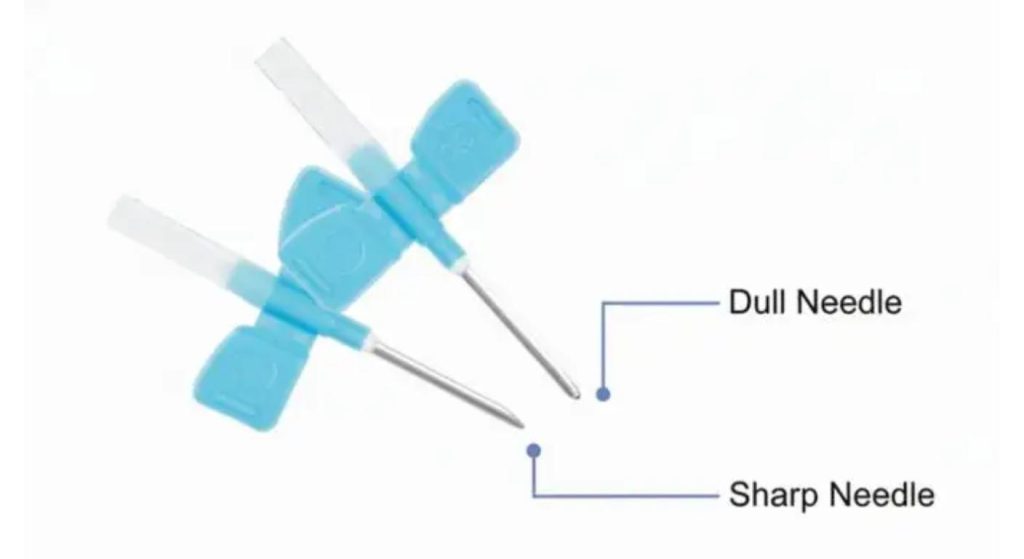
Greetmed's AV fistula needle manufacturing overview includes a fine polishing of the blade as well as an additional thin wall with a back eye. The blade finish, lumen and additional opening refer to various aspects of the device: the former to the entry characteristics and the latter two to the flow pathway.
Smaller wall thickness can be used for a larger inside diameter for a specific outside diameter. But buyers shouldn't go so far as to assume that percentage increase in flow corresponds to the same design. All claims of a numerical performance should be backed up with model-specific evidence and specify test conditions.
Likewise, polishing cannot be said to be a guarantee of painless cannulation. The access, the procedure and the individual are also factors in patient experience. Product language that offers more information about the manufacturing feature, and not the guaranteed clinical outcome is more useful.
Remove Clinical Selection from Flow Design
Clinical judgment for gauge and needle length and access suitability. Back eye is not an indicator of needle size and a nominal gauge does not indicate the full flow characteristics of the completed product.
Dialysis team—Before asking for samples, define configurations that they want to evaluate. Procurement can then match that to product that is available. This prevents the assumption that a gauge which was used with a needle assembly is adequate proof a needle assembly can be used interchangeably with a different one.
It also has a significance in the context of arterial or venous lines. They are used in different ways in the extracorporeal circuit, and the clinical team must be certain of the product to be used in the circuit. Review of a product appearance is not superseded by a shared product appearance.
Select Wing Independent of the Back Eye
Needle feature: the back eye, handling interface: the wing. So attached/rotating wings should be in another section of product comparison. A back-eye spec does not indicate anything about what wing configuration(s) will arrive.
Greetmed's guide to fixed & rotatable fistula needle wings provides information on the options available. On sample evaluation staff will be able to compare the feel of wings and the position of the tubing in the planned setup. This should be in accordance with the assessment process within the facility and the product instructions.
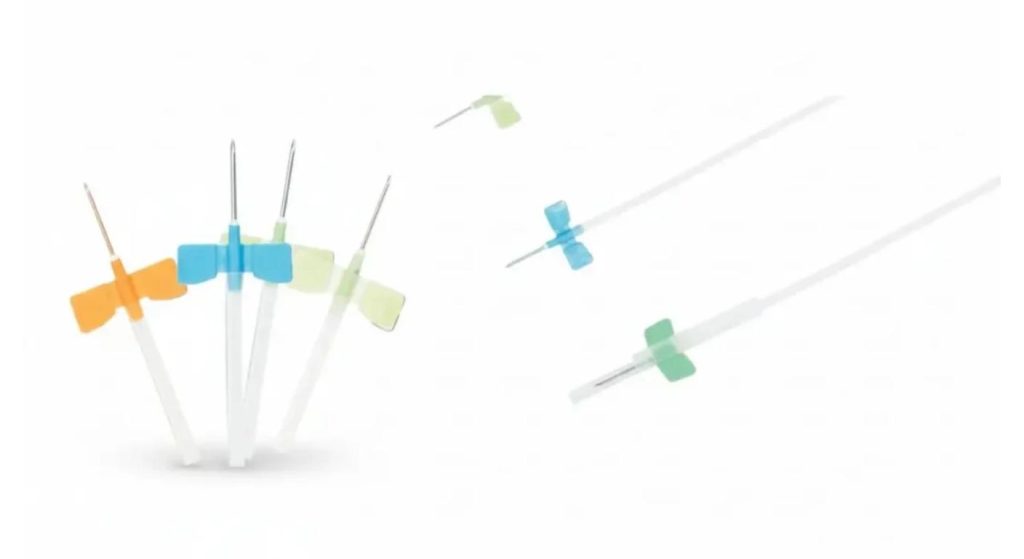
A rotatable wing should NOT be given as a teaching point to turn a needle in the wing. Product configuration/allowed handling, clinical technique are different questions. Follow the directions for the model you chose and define the capabilities of the model.
Inspect Assembly beyond needle tip
The desired assembly may be dependent on the extension of the tubing. If it doesn't reach far enough, it can limit the layout and any extra reach can be confusing to organise. Discuss the proposed sequence with the clinical team, don't automatically opt for the longest sequence.
Look at the clamp, connector and protective cap on the actual sample. Request the type of connector and proof of compatibility with the intended bloodline. An interface that looks like it will fit is not enough to approve the full interface.
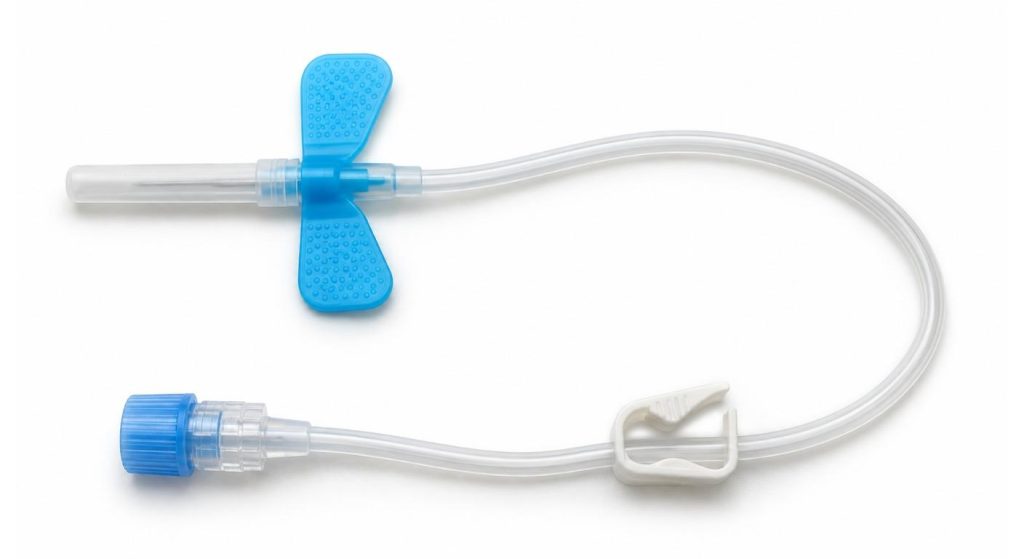
Greetmed has a number of different specification options, which are summarised in a separate reference table. These just outline a range and do not indicate that all the combination will be provided. Always find the precise product code before requesting a quotation and/or ordering.
| Parameter | Published options |
| Gauge | 15G, 16G, 17G |
| Needle length | 25 ± 2.0 mm; 32 ± 2.0 mm |
| Tube length | 150 ± 2.0 mm; 300 ± 2.0 mm |
| Wing configurations | Fixed; rotatable |
| Pack formats | Single pack; twin pack |
Know the meaning of What Safety Type Means.
Staff will not be protected from the exposed sharp by a back eye. If there is a requirement for a safety configuration, evaluate the safety mechanism as a separate feature (along with the instructions and training requirements and the disposal compatibility).
Greetmed mentions safety type options, in addition to other types of fistulas. Verify the ability of the requested safety model to meet the requested back-eye and dimensions. Keep in mind that a photo of a standard needle does not necessarily indicate that it is safe or that all are made with the same parts.
Packaging must be properly labelled. Determine if quantities are for individual needles, pairs, boxes or cartons. This ensures that you are not misled in the event that price quotes are in different pack formats.
Create an Evaluation based on the Exact Model
Utilize the product catalogue resources provided by Greetmed to assist with the initial conversation; then get the present specification and directions for the proposed code. Don't assume that a general certificate from a company will suffice for all configurations – ask for documentation on materials, sterilisation, shelf life and destination market requirements.
Write down the product code, configuration, label and packaging reference approved in one place. When reporting a discrepancy hold on to lot identification to enable the supplier to investigate the delivery. An informal substitution of the approved assembly should not be made as a result of a change to the assembly.
Start with document review and specified samples to evaluate. All evaluations to be conducted that involve patient care should be conducted in accordance with the facility's approved clinical evaluation procedure.

Conclusion
An AVF Needle With Back Eye is to be considered as a complete assembly, with a well-defined flow feature. Take into account the tip finish, wings, connection requirements, opening and lumen. Request the clinical team to provide a configuration to contact Greetmed to verify a suitable model and the information that will be required to assess the suitability of that model.
FAQ
Q1. What is Back Eye in AVF Needle?
It's another bevel opening towards the end of the blade, across from the main opening. It's another way to get into the needle lumen.
Q2. Does a back eye ensure a higher blood flow through the dialysis?
No. Actual flow will be subject to complete assembly, vascular access, needle position and conditions of treatment. Make comparisons between recorded performance for specified conditions.
Q3. Must a needle with a back-eye be a safety needle?
No. A safety mechanism is a feature that is separate. Be sure to verify the specific model and protective design.
Q4. Are there any published sizes that can't be combined together?
Not necessarily. Published options are the range and availability varies according to the product code. Verify the combination ordered with supplier.
Q5. Are there any gauge choices that should be made without clinical input, by the procurement?
No. The clinical needs should be decided by the dialysis team. However, procurement verifies that the provided configuration is same as the above.
Submit Your Request
Recent Posts
Tags
- Adult Diapers
- Are custom medical devices safe
- Baby Diapers
- Can respiratory anesthesia be used
- Digital Healthcare
- Do you offer customized consumables
- European Market
- How do you take care of a skin wound
- Industry Trends
- Lady Sanitary Napkins
- Medical Devices
- OEM Medical Devices
- Product Introductions
- Protective Equipment
- Under Pads
- What are custom-made medical devices
- What are diagnostic products
- What are hospital dressing products
- What are medical tube catheters
- What are some common protective equipment
- What are the appropriate applications for hospital dressing products
- What are the appropriate uses for protective equipment
- What is a gynecological examination
- What is a medical consumable
- What is an anesthesia kit
- What is an OEM in medical devices
- what is an wound skin care
- what is can disposable ultrasonic diagnostic
- What is good manufacturing medical devices
- What is hospital-grade protective equipment
- what is medical equipments hospital furniture
- What is medical sterilization wrapping
- What is rehabilitation equipment device
- What medical consumables do you supply
- Where can I find laboratory consumables wholesale
- where can I find medical protection device
- where to buy hypodermic accessories
- where to buy medical apparel
- where to buy medical consumable accessories
- where to find OEM medical device supplier
- where to find rehabilitation equipment supplier
