



Types of Medical Guide Wires | Definitive Clinical Guide


Understanding the various types of medical guide wires is fundamental for ensuring successful vascular access and precise device delivery during interventional procedures. These thin, flexible wires act as the primary track for catheters, stents, and balloons. By selecting the right wire based on core material, tip flexibility, and coating, clinicians can navigate tortuous anatomy while minimizing the risk of vessel perforation or trauma.
What Are the Primary Types of Medical Guide Lines and Their Uses?
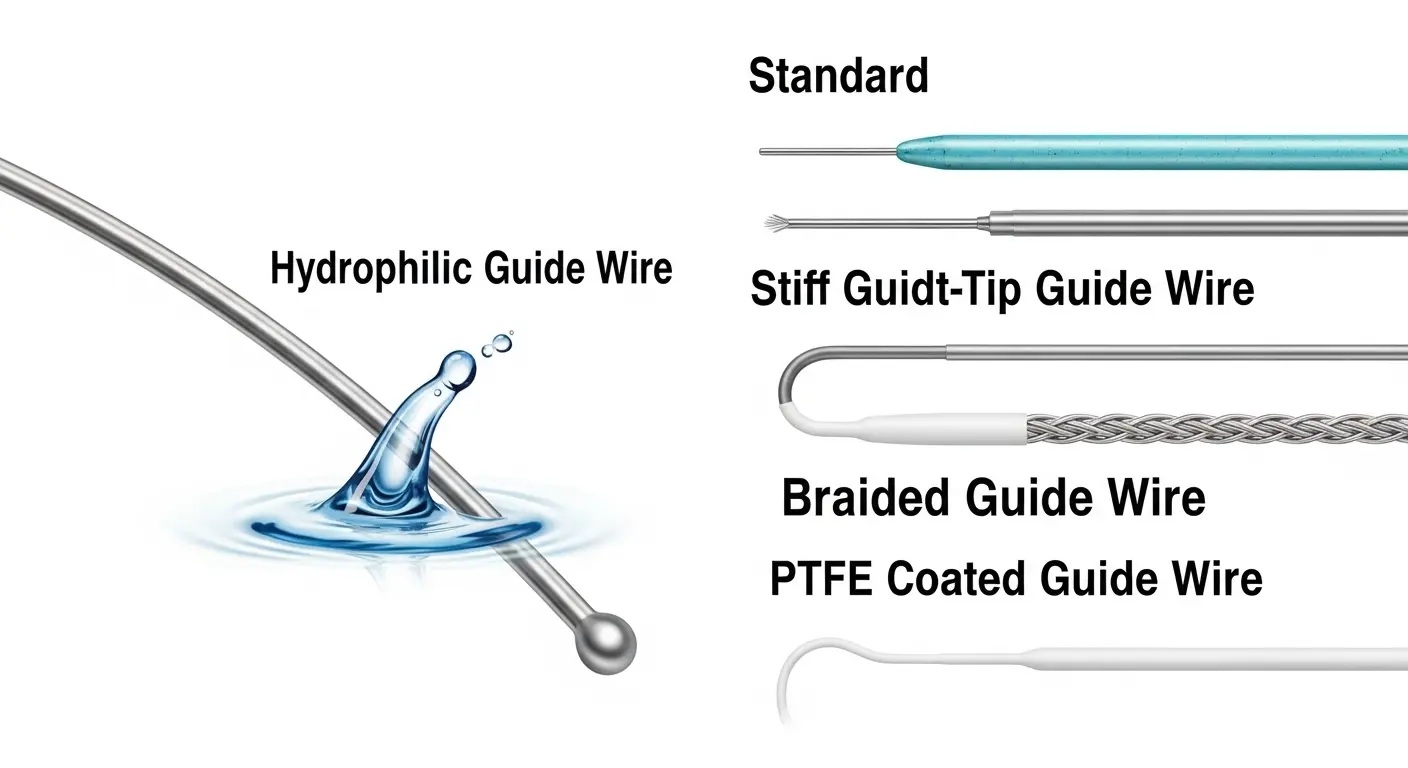
The main types of medical guide wires include stainless steel wires, nitinol (nickel-titanium) wires, and specialized hybrid wires. Stainless steel provides excellent support and pushability for straightforward anatomy. Nitinol offers superior kink resistance and "shape memory," making it ideal for navigating twisty vessels. Hybrid wires combine these materials to provide a supportive body with a highly flexible, steerable tip.
In the catheterization lab, the choice of wire often determines the flow of the entire case. I have seen complex procedures move quickly simply because the operator chose a nitinol wire to get past a sharp vascular bend. If you start with a wire that is too stiff, you risk "dissecting" the vessel wall. Success lies in matching the wire's mechanical properties to the patient's specific anatomy.
Comparison of Guide Wire Core Materials
| Core Material | Key Property | Best Use Case |
| Stainless Steel | High Support | Straight vessels; delivering heavy stents. |
| Nitinol | Kink Resistance | Tortuous anatomy; long procedures. |
| Platinum/Gold | Radiopacity | Enhancing visibility under X-ray at the tip. |
| Hybrid | Versatility | Complex cases requiring both support and flexibility. |
How Does Core Diameter Affect Clinical Performance?
Core diameter is a critical specification among different types of medical guide wires, as it dictates the wire's "pushability" and "trackability." Common diameters range from 0.014 inches for coronary work to 0.035 or 0.038 inches for peripheral and general vascular access. A thicker core provides more backup support but is less flexible, while a thinner core navigates small branches easily.
When preparing a tray, you must ensure the wire diameter matches your other tools. For instance, an introducer sheath or a medical hypodermic syringe needle must be compatible with the wire size. If the wire is too thick for the catheter lumen, it will jam. Practitioners often use the 0.035-inch "J-tip" wire as a workhorse for initial access before switching to specialized wires.
What are the Different Tip Configurations and Their Functions?
Guide wire tips come in several configurations, most notably straight, J-shape, and angled. The J-tip is designed to be atraumatic; the curved shape prevents the wire from entering small side branches or poking through the vessel wall. Straight tips are used when precise steering into a specific branch is required, often by manually shaping the tip before insertion.
- J-Tip: The standard for venous access. It "bounces" off vessel walls rather than digging in.
- Angled Tip: Provides a directional edge that helps the clinician steer the wire at bifurcations.
- Floppy Tip: An extremely soft distal segment that minimizes trauma in delicate vessels.
- Stiff Tip: Used when the wire must serve as a rigid rail for a heavy device.
Working with a floppy-tipped wire requires patience. If you feel resistance, you stop. Forcing a wire is the fastest way to cause a complication. This is why having a variety of what hospital dressing products are nearby is standard practice to manage any minor puncture site issues post-procedure.
Why are Hydrophilic Coatings Vital for Guide Wire Navigation?
Hydrophilic coatings are essential for reducing friction between the wire and the vessel wall or the inner lumen of a catheter. These coatings become "slippery" when wet, allowing the wire to glide through tight stenoses or long, narrow paths. Without these coatings, the wire might "chatter" or stick, making precise movements nearly impossible.
However, a "slippery" wire is a double-edged sword. While it navigates easily, it can also slip out of position or go too deep if not handled carefully. Experienced clinicians often keep a bowl of sterile saline on the table to keep the wire hydrated. They might also use medical cotton swabs to wipe down the wire and maintain a clean surgical field.
How Do You Choose Between a Stiff Wire and a Floppy Wire?
Choosing between stiff and floppy types of medical guide wires depends on whether you need "navigation" or "support." Use a floppy wire for the initial crossing of a lesion or navigating a vessel. Once the path is established, you may exchange it for a stiff "Amplatz" style wire to provide a stable rail for delivering a large malecot catheter or a bulky stent.
Decision Matrix for Wire Stiffness
- Initial Access: Floppy or J-tip (low trauma).
- Crossing a Blockage: Tapered, polymer-coated (low friction).
- Device Delivery: Stiff or Super-Stiff (high support).
- Tortuous Path: Nitinol core (kink resistance).
If a clinician asks for a specific wire "PRN," it usually means they are anticipating a challenge in the anatomy. Understanding what PRN means in medical terms helps the support staff anticipate these needs and have the right wire ready on the table.
What is the Significance of Radiopacity in Guide Wire Design?
Radiopacity refers to the wire's visibility under fluoroscopy (X-ray). Most guide wires have a radiopaque tip made of platinum or gold, allowing the clinician to see exactly where the tip is located in real-time. This is vital for preventing the wire from moving too far into a heart chamber or a small distal vessel.
Advanced wires may have "markers" at specific intervals. These help the doctor measure the length of a lesion or a vessel segment without needing a separate measuring tool. In a darkened lab, that glowing tip is the only guide the doctor has. If the tip visibility is poor, the risk of "losing the wire" or causing a perforation increases significantly.
How Does Torque Response Impact the Success of a Procedure?
Torque response is the ability of the wire to transmit a twist from the clinician's hand at the proximal end to the wire tip at the distal end. A "1:1 torque" means that if you turn the wire 90 degrees at the hub, the tip turns exactly 90 degrees. This precision is what allows a doctor to "steer" the wire into a specific vessel branch.
Stainless steel wires generally offer the best torque. Nitinol wires are good but can sometimes feel "mushy" or have a delayed response. When you are trying to enter a tiny renal artery, that 1:1 response is the difference between success and a two-hour struggle. It is a tactile skill that specialists spend years perfecting.
Frequently Asked Questions About Medical Guide Wires
Can guide wires be cleaned and reused?
No. All medical guide wires are single-use devices. The coatings can peel, and the core can develop micro-fractures after one use. Reusing them poses a major risk of infection and device failure.
What is a "mandrel-core" wire?
This is a wire where the core tapers toward the tip to provide a smooth transition from a stiff body to a flexible end. It is a common design for "workhorse" wires.
How long are medical guide wires?
Lengths vary greatly. A standard access wire might be 145cm, while an "exchange length" wire can be 260cm to 300cm. The extra length allows the clinician to remove a catheter while still holding onto the wire.
Are there "all-in-one" wires?
Some hybrid wires try to do everything, but most specialists prefer to have a "toolkit" of different types. They start with a versatile wire and switch to a specialized one if the anatomy requires it.
Summary and Next Steps for Sourcing Guide Wires
The variety of types of medical guide wires exists because no single wire can handle every anatomical challenge. For those in procurement or clinical roles, focusing on a mix of stainless steel support wires and nitinol navigation wires is the best strategy. Always ensure your wires are compatible with your catheters and introducers to maintain a smooth procedural workflow.
Submit Your Request
Recent Posts

Tags
- Adult Diapers
- Are custom medical devices safe
- Baby Diapers
- Can respiratory anesthesia be used
- Digital Healthcare
- Do you offer customized consumables
- European Market
- How do you take care of a skin wound
- Industry Trends
- Lady Sanitary Napkins
- Medical Devices
- OEM Medical Devices
- Product Introductions
- Protective Equipment
- Under Pads
- What are custom-made medical devices
- What are diagnostic products
- What are hospital dressing products
- What are medical tube catheters
- What are some common protective equipment
- What are the appropriate applications for hospital dressing products
- What are the appropriate uses for protective equipment
- What is a gynecological examination
- What is a medical consumable
- What is an anesthesia kit
- What is an OEM in medical devices
- what is an wound skin care
- what is can disposable ultrasonic diagnostic
- What is good manufacturing medical devices
- What is hospital-grade protective equipment
- what is medical equipments hospital furniture
- What is medical sterilization wrapping
- What is rehabilitation equipment device
- What medical consumables do you supply
- Where can I find laboratory consumables wholesale
- where can I find medical protection device
- where to buy hypodermic accessories
- where to buy medical apparel
- where to buy medical consumable accessories
- where to find OEM medical device supplier
- where to find rehabilitation equipment supplier
