



Medical Tubing Tolerances: Precision Engineering Guide


In the high-stakes world of medical device engineering, a single micrometer is never "just a micrometer." It’s often the thin line between a device that saves a life and one that fails during a critical procedure. When you’re specifying medical tubing tolerances, you aren't just filling out a spreadsheet. You're defining the safety, reliability, and functionality of a surgical tool.
Whether you're designing a neurovascular catheter or a simple IV line, the physical dimensions of your tubing dictate how it interacts with the human body. If the outer diameter is too large, it won't fit through the intended vessel. If the wall is too thin, it could burst under pressure. Let's break down why precision is the heartbeat of modern medical extrusion.
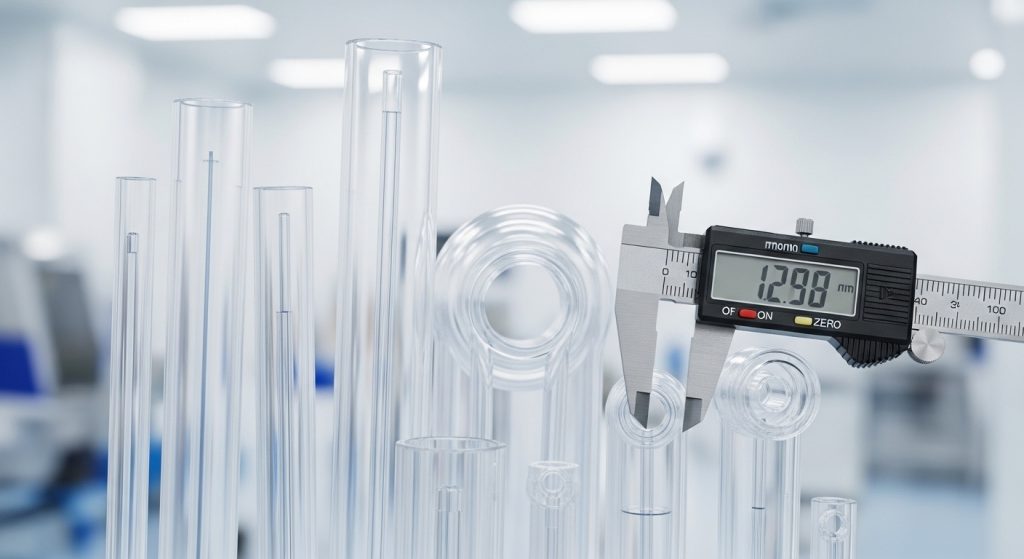
Why "Close Enough" Doesn't Exist in MedTech
Precision isn't just about making things small; it’s about making them consistent. A 1% variance in tubing diameter can lead to a 10% drop in flow rate. It can also cause a connector bond to fail. In medical manufacturing, we don't use the word "approximate."
Medical tubing tolerances are the allowable limits of variation in a tube’s physical dimensions. These limits ensure that every single meter of tubing from a 10,000-meter production run performs exactly like the first. Without strict adherence to these numbers, assembly lines would grind to a halt and patient risks would skyrocket.
The 3 Pillars of Tubing Metrology
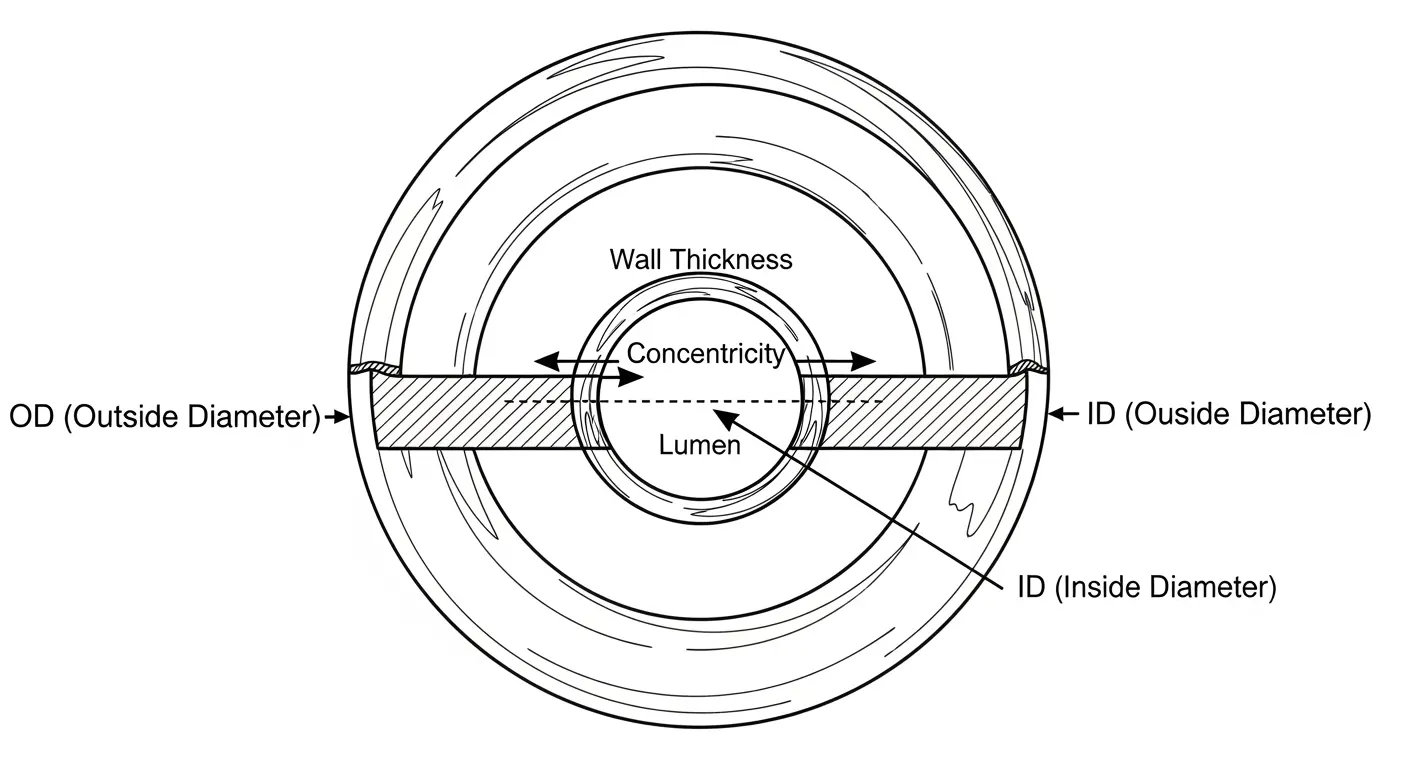
When an engineer looks at a technical drawing, they aren't just looking at one number. They’re looking at a relationship between several geometric factors. To truly understand tubing quality, you have to look at the "Big Three":
1. Outside & Inside Diameter (OD/ID)
These are your primary metrics. The OD determines how the tube fits into connectors or surgical ports. The ID determines the flow rate of fluids or the size of the secondary devices that can pass through it.
2. Wall Thickness & Concentricity
This is where many designs fail. You can have a perfect OD and ID, but if the hole isn't perfectly centered, you have an "off-center" tube. This results in thin spots that are prone to kinking or bursting. We measure this as "Eccentricity."
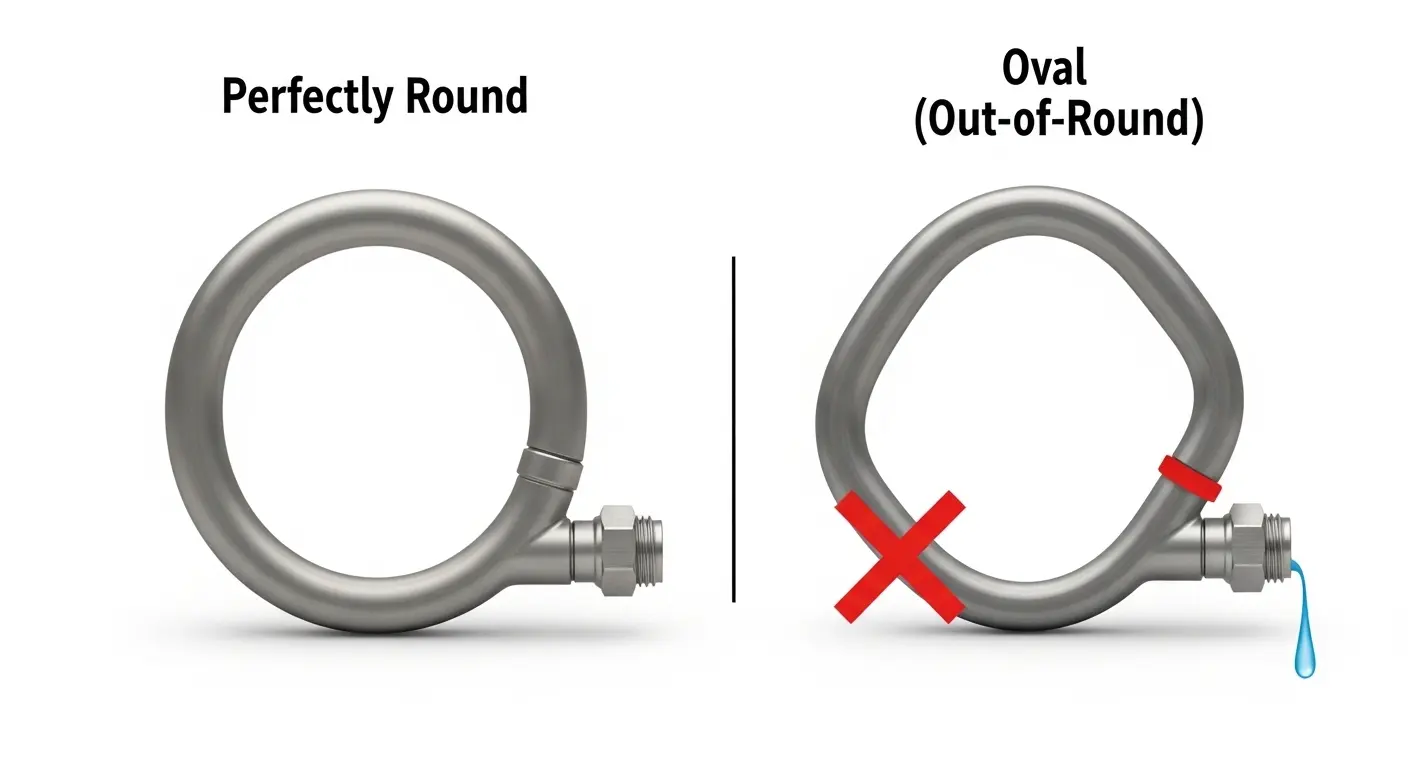
3. Ovality (Out-of-Roundness)
Tubing is supposed to be a perfect circle. However, during the cooling process, some tubes can become slightly egg-shaped. If a tube has high ovality, it won't create an airtight seal with push-to-connect fittings. This leads to leaks that can be catastrophic in a clinical setting.
The "Science of Stability": Factors Affecting Tolerances
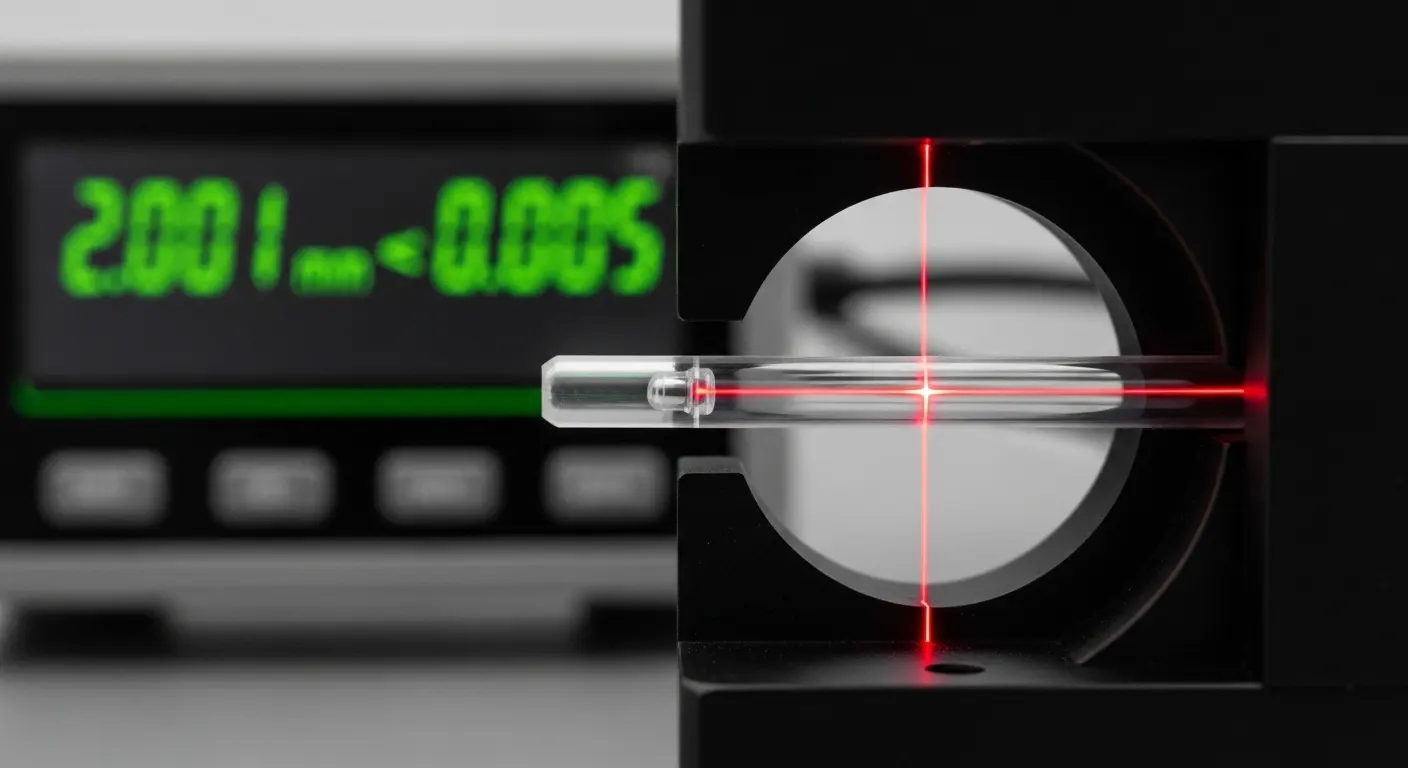
How do we keep a molten piece of plastic within a few microns of its target size? It’s a mix of advanced physics and real-time computing. Several factors influence the final dimensions of your tubing:
- Polymer Behavior: Different plastics shrink at different rates. For example, a TPU (Thermoplastic Polyurethane) behaves very differently than an FEP (Fluorinated Ethylene Propylene) when it hits the cooling tank.
- Drawdown Ratio (DDR): We usually extrude the tube slightly larger than the final size and then stretch it. This "drawdown" helps align the polymer chains for strength, but it requires perfect speed control to maintain the target diameter.
- Vacuum Pressure: As the tube exits the die, we use vacuum tanks to "lock in" its shape. If the vacuum pressure fluctuates even slightly, the OD will drift.
This level of precision is very similar to the dosing accuracy required in a medical hypodermic syringe, where even the smallest deviation in interior volume can lead to medication errors.
Engineering Trade-offs: Tolerance vs. Cost
Here’s a secret that most manufacturers won't tell you: tighter isn't always better. In engineering, there’s a "Law of Diminishing Returns."
If you specify a tolerance of $\pm 0.005$ mm when your application only truly requires $\pm 0.02$ mm, you might be doubling your manufacturing costs for no reason. Tight tolerances require slower production speeds, more frequent tool changes, and higher scrap rates.
When we work with clients on "Design for Manufacturability" (DFM), we help them find the "sweet spot." We look for the widest tolerance that still guarantees 100% safety. This approach helps keep projects within budget while ensuring the final product meets all ISO 13485 standards. This philosophy of balancing cost and quality is something we apply to all our products, from high-tech extrusions to bulk hospital dressing products.
Quality Control: The Greetmed Protocol
At Greetmed, we don't believe in "spot-checking." In the medical field, you can't just check the beginning and the end of a spool. You have to check everything in between.
We use In-Line Gauging. This involves dual-axis laser micrometers that sit right on the production line. They measure the tube's diameter thousands of times per second. If the computer detects a drift toward the edge of the tolerance limit, it automatically adjusts the puller speed or the vacuum pressure to bring it back to center.
We also focus on specialized geometries. For instance, a malecot catheter requires a very specific cross-section to ensure drainage channels stay open. Achieving this requires not just tight tolerances, but an understanding of how complex shapes behave during the extrusion process.
Frequently Asked Questions
What is the tightest tolerance Greetmed can achieve?
For micro-extrusion projects, we can often hold tolerances as tight as $\pm 0.0127$ mm ($0.0005$ inches). For larger, bulk disposables, the standard is usually closer to $\pm 0.05$ mm.
How does sterilization affect tubing dimensions?
Both EtO (Ethylene Oxide) and Gamma radiation can cause polymers to slightly shrink or expand. It’s vital to account for this "sterilization shift" during the initial design phase so the final, sterile product is still within its spec.
What is the difference between Concentricity and Eccentricity?
They are two sides of the same coin. Concentricity measures how centered the hole is. Eccentricity measures the variation in wall thickness. In a perfect tube, Concentricity is 100% and Eccentricity is 0%.
What does PRN mean in a clinical tubing order?
You might see "PRN" on a doctor’s order for a catheterized patient. If you’ve ever wondered what PRN means in medical terms, it stands for "pro re nata," or "as needed." This usually refers to as-needed flushing or replacement of the tubing.
How do you measure ovality?
We use a three-point or two-axis measurement system. By measuring the diameter at multiple angles, we can calculate the difference between the widest and narrowest parts of the tube.
Precision as a Promise
Choosing a partner who understands medical tubing tolerances isn't just a procurement decision. It’s a commitment to the person who will eventually use that device in a surgery. At Greetmed, we take that responsibility seriously.
We've invested in the latest metrology and extrusion technology to ensure that our "standard" is most people's "perfection." From simple medical cotton swabs to the most complex multi-lumen catheters, our focus on documented quality management is what sets us apart in the global market.
Ready to see how our precision can improve your next project? [Contact our engineering team today] to download our full Tolerance Capability Chart or to request a technical quote for your specific tubing requirements. Let’s build something safe together.
Submit Your Request
Recent Posts

Tags
- Adult Diapers
- Are custom medical devices safe
- Baby Diapers
- Can respiratory anesthesia be used
- Digital Healthcare
- Do you offer customized consumables
- European Market
- How do you take care of a skin wound
- Industry Trends
- Lady Sanitary Napkins
- Medical Devices
- OEM Medical Devices
- Product Introductions
- Protective Equipment
- Under Pads
- What are custom-made medical devices
- What are diagnostic products
- What are hospital dressing products
- What are medical tube catheters
- What are some common protective equipment
- What are the appropriate applications for hospital dressing products
- What are the appropriate uses for protective equipment
- What is a gynecological examination
- What is a medical consumable
- What is an anesthesia kit
- What is an OEM in medical devices
- what is an wound skin care
- what is can disposable ultrasonic diagnostic
- What is good manufacturing medical devices
- What is hospital-grade protective equipment
- what is medical equipments hospital furniture
- What is medical sterilization wrapping
- What is rehabilitation equipment device
- What medical consumables do you supply
- Where can I find laboratory consumables wholesale
- where can I find medical protection device
- where to buy hypodermic accessories
- where to buy medical apparel
- where to buy medical consumable accessories
- where to find OEM medical device supplier
- where to find rehabilitation equipment supplier
