



Medical Guidewire Manufacturing Process | Engineering Safety


The medical guidewire manufacturing process is a highly specialized sequence of engineering steps designed to produce the precise navigational tools used in vascular surgery. This process transforms raw medical-grade alloys into ultra-thin wires that balance flexibility, torque, and strength. Every stage, from core grinding to polymer coating, is strictly controlled to ensure these devices can safely enter a human vessel and guide life-saving treatments.
What Is the Core Sequence of the Medical Guidewire Manufacturing Process?
The medical guidewire manufacturing process begins with selecting high-performance core materials, followed by precision centerless grinding to create a tapered profile. Next, a distal coil is wound and attached to the tip, often using laser welding. Finally, the assembly undergoes chemical or UV-activated coating to reduce friction, followed by rigorous inspection and sterilization to meet global medical safety standards.
In my time visiting cleanroom facilities, I have seen how a single speck of dust can ruin a production run. The tolerances are so tight that even a microscopic flaw in the core grind can cause the wire to "jump" during a procedure. This level of detail is what separates a standard wire from an elite interventional tool. It ensures that when a doctor uses a medical hypodermic syringe to flush the system, the wire remains a stable and reliable track.
Typical Manufacturing Phases
| Phase | Objective | Critical Success Factor |
| Material Sourcing | Selection of Nitinol or Stainless Steel. | Purity and tensile strength. |
| Centerless Grinding | Creating the distal taper. | Dimensional accuracy (microns). |
| Coil Winding | Providing flexibility and radiopacity. | Pitch consistency and weld strength. |
| Surface Treatment | Applying PTFE or Hydrophilic layers. | Bond durability and low friction. |
Why Is Centerless Grinding Critical for Guidewire Performance?
Centerless grinding is the stage where the core wire is shaped to provide a transition from a stiff proximal end to a flexible distal tip. This part of the medical guidewire manufacturing process uses specialized abrasive wheels to remove material without holding the wire between centers. This allows for extremely long, thin tapers that would be impossible to achieve with traditional lathe methods.
A smooth taper is vital because it prevents "hinge points." A hinge point is a sudden change in stiffness where the wire is likely to buckle. I once observed a production line where the grinding wheels were off by just a few microns. The resulting wires felt "notchy" to the touch. In a patient's artery, that notchiness translates to poor control. Precision grinding ensures the wire behaves predictably, which is as important as knowing what PRN means in medical terms during a high-stakes procedure.
How Are Distal Coils Attached During Manufacturing?
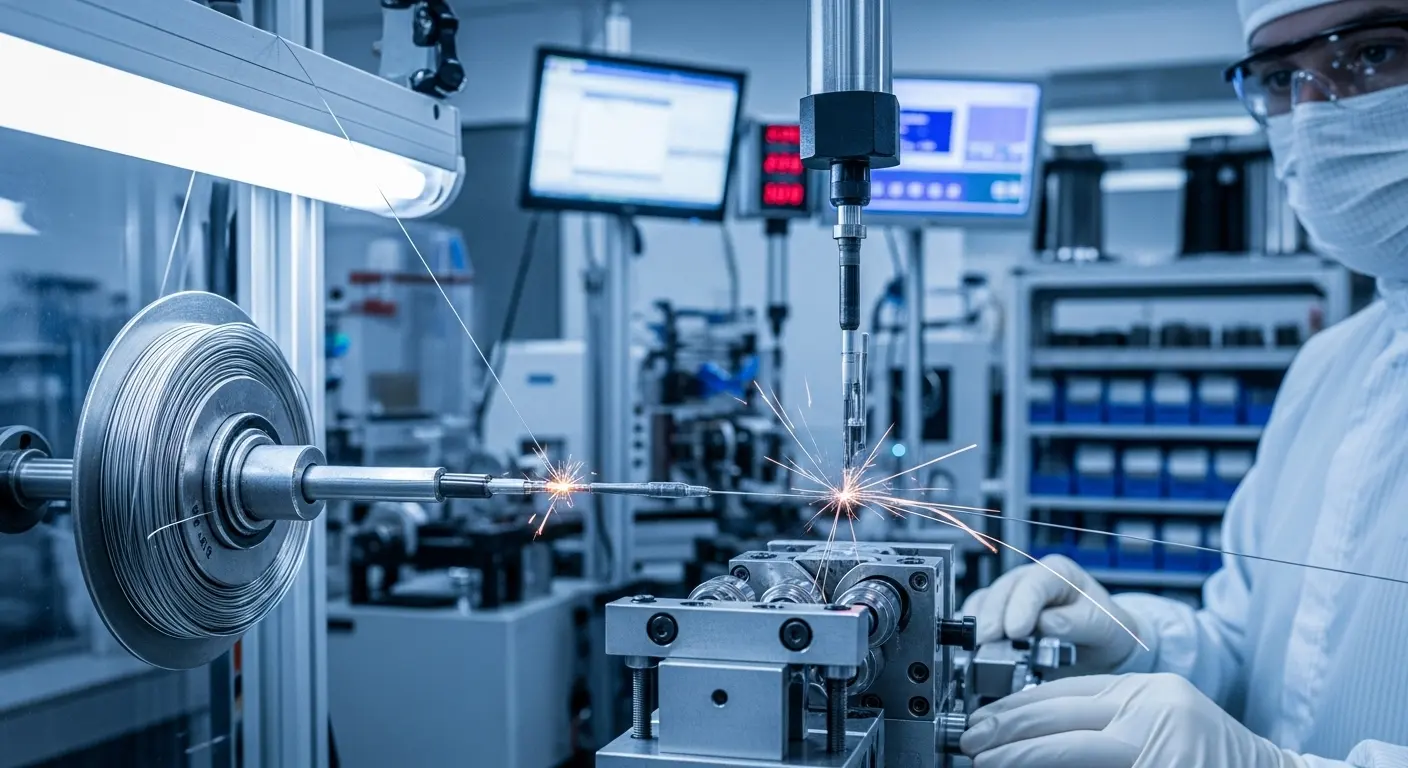
Distal coils are typically attached using laser welding or specialized soldering techniques to ensure a seamless bond between the coil and the core wire. In the medical guidewire manufacturing process, laser welding is the preferred method because it provides a high-strength joint with a very small heat-affected zone. This prevents the delicate core wire from becoming brittle or losing its mechanical properties.
The tip of the wire is often where the most complex engineering happens. Manufacturers may use platinum or gold coils to ensure the tip is visible under X-ray. If the weld fails, the coil could detach inside the patient—a catastrophic event. Because of this, every weld is tested for tensile strength. This level of security is why clinicians trust these wires to deliver a malecot catheter deep into the body.
What Role Do Coatings Play in the Final Manufacturing Stages?
Coatings are applied in the final stages of the medical guidewire manufacturing process to drastically reduce the coefficient of friction. Hydrophilic coatings, which attract water, are often applied by dipping the wire into a polymer solution followed by UV curing. PTFE coatings are typically sprayed and heat-cured. These layers ensure the wire glides through vessels and catheters without snagging.
Durability is the main concern here. If the coating flakes off, it can cause an embolism. I recommend looking for manufacturers who perform "rub tests" where the wire is passed through a tight loop multiple times. This proves the coating stays on the wire where it belongs. Maintaining a clean field with medical cotton swabs is standard, but the primary safety comes from the chemical bond of the coating itself.
How Does Quality Control Function in Guidewire Production?
Quality control involves 100% visual inspection under high magnification, laser micrometer measurements, and functional torque testing. Every batch must have full traceability back to the raw material heat lot. Manufacturers also perform "tip-load" testing to measure exactly how much force is needed to bend the tip, ensuring every wire in a box performs exactly like the last one.
- Dimensional Check: Ensuring the diameter is within +/- 0.0005 inches.
- Torque Testing: Verifying 1:1 rotation from the handle to the tip.
- Visual Audit: Checking for burrs, pits, or coating voids.
- Packaging Check: Verifying sterile barrier integrity.
Just as you need to know what hospital dressing products are to manage a wound, a manufacturer must know every data point of their wire to manage patient risk. A single failure is not an option in Class III medical device manufacturing.
What Are the Most Common Challenges in Guidewire Manufacturing?
The most common challenges include maintaining consistent grind profiles on long wires, preventing "kinking" of nitinol during assembly, and achieving a perfectly uniform coating thickness. Since wires can be over 200cm long but only 0.014 inches thick, managing the "sag" and vibration during high-speed grinding requires massive engineering investment.
I have spoken with engineers who spent months perfecting the "clamping" mechanism for the laser welder. If the wire rotates even a fraction of a degree during the weld, the tip can become crooked. This "eccentricity" makes the wire steer poorly. Solving these mechanical puzzles is what makes the medical guidewire manufacturing process so fascinating and difficult.
Frequently Asked Questions
Why is Nitinol harder to manufacture than Stainless Steel?
Nitinol is a "memory metal" that reacts strongly to temperature changes. Grinding it generates heat, which can change the material's properties if not cooled correctly. It requires specialized expertise and cooling fluids.
How is sterilization handled?
Most guidewires undergo Ethylene Oxide (EO) sterilization. This gas penetrates the packaging and the coils to kill all microorganisms without damaging the delicate polymer coatings or the wire's temper.
Can guidewires be made with custom stiffness?
Yes. By adjusting the length and angle of the taper during the grinding process, manufacturers can create "soft," "medium," or "stiff" versions of the same wire diameter to suit different clinical needs.
What is the typical shelf life of a manufactured guidewire?
Most manufacturers guarantee a shelf life of 2 to 5 years. This depends on the stability of the hydrophilic coating and the integrity of the sterile pouch.
Submit Your Request
Recent Posts

Tags
- Adult Diapers
- Are custom medical devices safe
- Baby Diapers
- Can respiratory anesthesia be used
- Digital Healthcare
- Do you offer customized consumables
- European Market
- How do you take care of a skin wound
- Industry Trends
- Lady Sanitary Napkins
- Medical Devices
- OEM Medical Devices
- Product Introductions
- Protective Equipment
- Under Pads
- What are custom-made medical devices
- What are diagnostic products
- What are hospital dressing products
- What are medical tube catheters
- What are some common protective equipment
- What are the appropriate applications for hospital dressing products
- What are the appropriate uses for protective equipment
- What is a gynecological examination
- What is a medical consumable
- What is an anesthesia kit
- What is an OEM in medical devices
- what is an wound skin care
- what is can disposable ultrasonic diagnostic
- What is good manufacturing medical devices
- What is hospital-grade protective equipment
- what is medical equipments hospital furniture
- What is medical sterilization wrapping
- What is rehabilitation equipment device
- What medical consumables do you supply
- Where can I find laboratory consumables wholesale
- where can I find medical protection device
- where to buy hypodermic accessories
- where to buy medical apparel
- where to buy medical consumable accessories
- where to find OEM medical device supplier
- where to find rehabilitation equipment supplier
