



Guidewire Core Wire Materials | Expert Guide to Medical Alloys


Selecting the right guidewire core wire materials is a fundamental decision that determines the success of minimally invasive vascular procedures. These materials form the internal skeleton of the guidewire, dictating its stiffness, torque transmission, and flexibility. Whether a clinician is navigating a simple vein or a calcified artery, the mechanical properties of the core wire ensure the device reaches its target safely.
What Are the Most Common Guidewire Core Wire Materials?
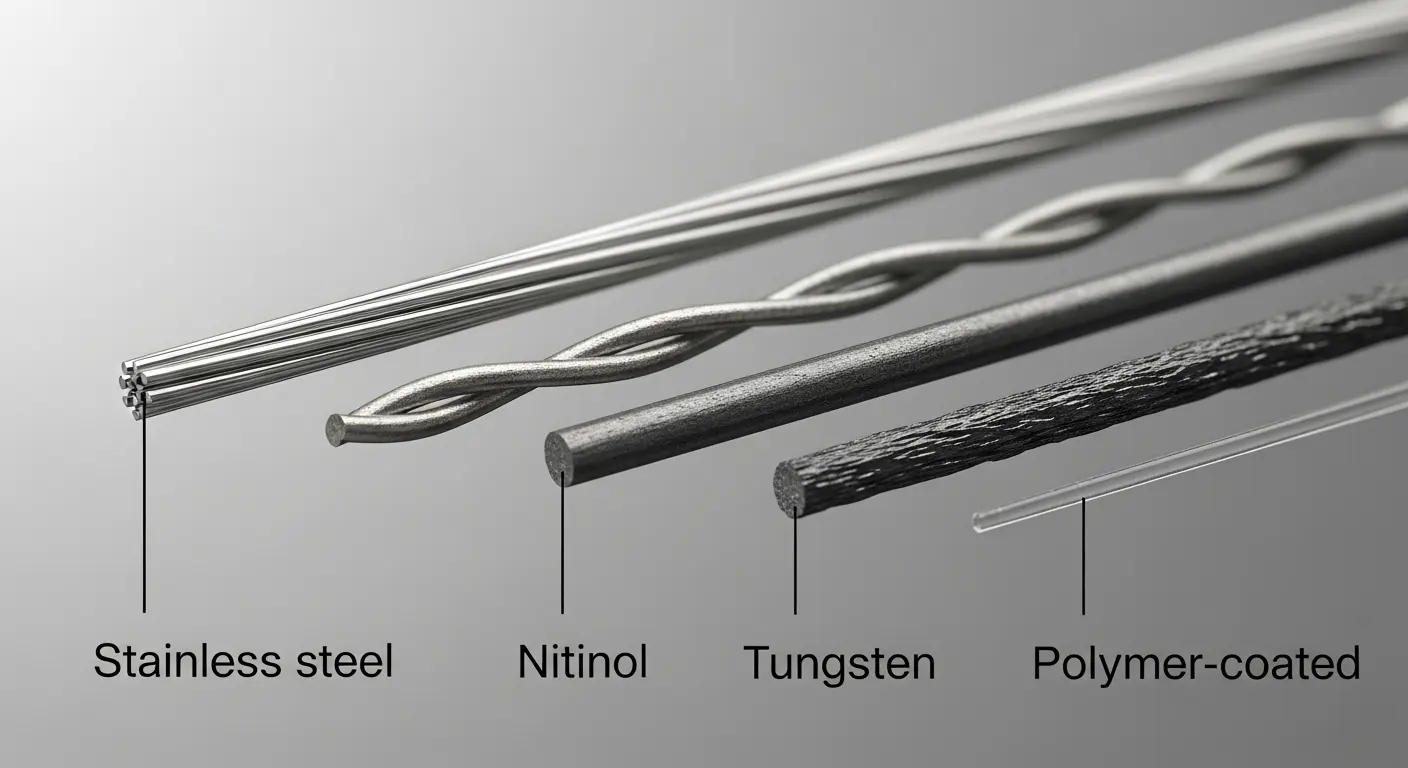
The most common guidewire core wire materials include stainless steel, nitinol (nickel-titanium), and high-tensile alloys like cobalt-chromium. Stainless steel is favored for its exceptional pushability and support. Nitinol is prized for its kink resistance and "shape memory." Cobalt-chromium alloys offer a balance of high strength and durability, allowing for thinner wires without sacrificing the structural integrity needed for complex cases.
In my time working with interventional tools, I have seen how the core material changes the "feel" of a procedure. A stainless steel core provides a direct, tactile response that many old-school surgeons prefer. Conversely, younger clinicians often lean toward nitinol because it handles tortuous anatomy with less risk of permanent deformation. Choosing between them is like choosing the chassis of a car; it defines the entire performance.
Material Comparison at a Glance
| Material | Primary Advantage | Best For |
| Stainless Steel | Superior Pushability | Heavy device delivery and straight access. |
| Nitinol | Kink Resistance | Navigating twisty, complex vessels. |
| Cobalt-Chromium | High Tensile Strength | Low-profile wires requiring high durability. |
| Platinum/Gold | Radiopacity | Enhancing tip visibility under fluoroscopy. |
Why is Stainless Steel Still a Standard Core Wire Material?
Stainless steel remains a standard among guidewire core wire materials because it offers unmatched backup support and 1:1 torque transmission. Its high modulus of elasticity means it does not stretch or compress easily under load. This allows a physician to push a heavy stent or a large malecot catheter through a vessel while the wire maintains its position and shape.
However, stainless steel is prone to "kinking." Once a stainless wire bends too far, it takes a permanent set. This can make removal difficult or trap other devices. To prevent this, manufacturers often use high-quality 304 or 316L medical-grade steel. These grades ensure purity and consistent performance. When a clinician uses a medical hypodermic syringe to flush the system, they rely on that steel core to stay rigid and reliable.
How Does Nitinol Improve Guidewire Flexibility and Safety?
Nitinol improves safety because its superelastic properties allow the wire to bend significantly without kinking or breaking. As one of the premier guidewire core wire materials, it "remembers" its original shape even after navigating sharp turns in the vascular system. This reduces vessel trauma and allows the wire to spring back to its straight profile once the tension is released.
The magic of nitinol lies in its atomic structure. It can undergo a phase transformation under stress. This makes it almost impossible to "whip" the wire, a common issue where a wire tip suddenly jumps forward. If a clinician needs to access a difficult branch "PRN," a nitinol-core wire is usually the first choice. Understanding what PRN means in medical terms helps teams prepare for these unpredictable anatomical challenges.
What Role Does Core Tapering Play in Guidewire Performance?
Core tapering is the process of grinding the distal end of the core wire to a smaller diameter to increase flexibility. While the base guidewire core wire materials provide the strength, the taper provides the "touch." A long, gradual taper results in a very floppy tip, while a short, abrupt taper creates a stiffer tip for crossing tough blockages.
- Long Taper: Excellent for safety in delicate vessels.
- Short Taper: Best for "penetrating" calcified lesions.
- Parabolic Taper: Provides a smooth transition of stiffness, preventing "hinge points" that could cause the wire to buckle.
The grind quality must be perfect. Any rough spots on the taper can lead to friction against the outer coil or coating. I have seen wires fail because of poor grinding. Precision is key to ensuring the wire doesn't snag inside an introducer or become a hazard during the procedure.
How Do Coatings Interact with Different Core Materials?
Coatings like PTFE or hydrophilic polymers are applied over guidewire core wire materials to reduce friction. Stainless steel cores bond well with PTFE (Teflon) coatings, which provide a dry, lubricious surface. Nitinol cores are often paired with hydrophilic coatings that become slippery when wet. This combination allows for a "frictionless" experience when navigating long vessel segments.
Maintaining a clean field is vital when using these coated wires. Clinicians often use medical cotton swabs to wipe down the wire and keep it free of blood or debris. If the coating is damaged, the mechanical benefits of the core wire are lost. Knowing what hospital dressing products are used to manage the access site post-procedure is part of the broader circle of care that starts with a high-performance wire.
What are the Trade-offs Between Different Core Alloys?
The trade-offs involve balancing pushability against kink resistance. A stainless steel core offers the best push but kinks easily. A nitinol core never kinks but can feel "spongy" or lack the "drive" needed to push a heavy device. Cobalt-chromium tries to find the middle ground but is often more expensive and harder to manufacture into specialized shapes.
Decision Matrix for Material Selection
- Straight Access / High Support: Choose Stainless Steel.
- Tortuous Anatomy / High Safety: Choose Nitinol.
- Ultra-Thin / High Durability: Choose Cobalt-Chromium.
- Maximum Tip Visibility: Use a core with a Platinum-Tungsten distal coil.
Frequently Asked Questions
Can guidewire core materials cause allergic reactions?
Nitinol contains nickel. While it is generally considered safe due to a protective oxide layer, patients with severe nickel allergies might require a stainless steel alternative.
How do manufacturers test core wire strength?
They use tensile testing to measure "break force" and torque testing to see how many rotations the wire can handle before failing. These tests ensure the wire won't snap inside a patient.
Is one material better for "J-tip" wires?
Stainless steel is common for J-tips in venous access. Nitinol is more common for angled or straight tips used in arterial navigation where steering is the priority.
Why do some wires have a "gold" tip?
Gold or platinum is often added to the tip of the core wire or the outer coil. This makes the very end of the wire highly visible on an X-ray screen.
Conclusion
When evaluating guidewire core wire materials, always ask for the specific alloy grade and the taper profile data. Testing a sample for tactile feedback is the best way to ensure the wire meets your clinical needs. Would you like me to help you draft a technical comparison of specific brand-name guidewire cores?
Submit Your Request
Recent Posts

Tags
- Adult Diapers
- Are custom medical devices safe
- Baby Diapers
- Can respiratory anesthesia be used
- Digital Healthcare
- Do you offer customized consumables
- European Market
- How do you take care of a skin wound
- Industry Trends
- Lady Sanitary Napkins
- Medical Devices
- OEM Medical Devices
- Product Introductions
- Protective Equipment
- Under Pads
- What are custom-made medical devices
- What are diagnostic products
- What are hospital dressing products
- What are medical tube catheters
- What are some common protective equipment
- What are the appropriate applications for hospital dressing products
- What are the appropriate uses for protective equipment
- What is a gynecological examination
- What is a medical consumable
- What is an anesthesia kit
- What is an OEM in medical devices
- what is an wound skin care
- what is can disposable ultrasonic diagnostic
- What is good manufacturing medical devices
- What is hospital-grade protective equipment
- what is medical equipments hospital furniture
- What is medical sterilization wrapping
- What is rehabilitation equipment device
- What medical consumables do you supply
- Where can I find laboratory consumables wholesale
- where can I find medical protection device
- where to buy hypodermic accessories
- where to buy medical apparel
- where to buy medical consumable accessories
- where to find OEM medical device supplier
- where to find rehabilitation equipment supplier
