



Guiding Catheter OEM Manufacturer Guide | High-Quality Sourcing


Partnering with a reliable guiding catheter OEM manufacturer is a foundational decision for medical device brands looking to scale their interventional cardiology or radiology portfolios. These manufacturers provide the technical backbone for complex vascular procedures by crafting catheters that balance torque control, backup support, and atraumatic tips. Success in this market requires a deep understanding of extrusion technology, braid reinforcement, and strict regulatory compliance to ensure patient safety and clinical performance.
Why Should You Partner with a Guiding Catheter OEM Manufacturer?
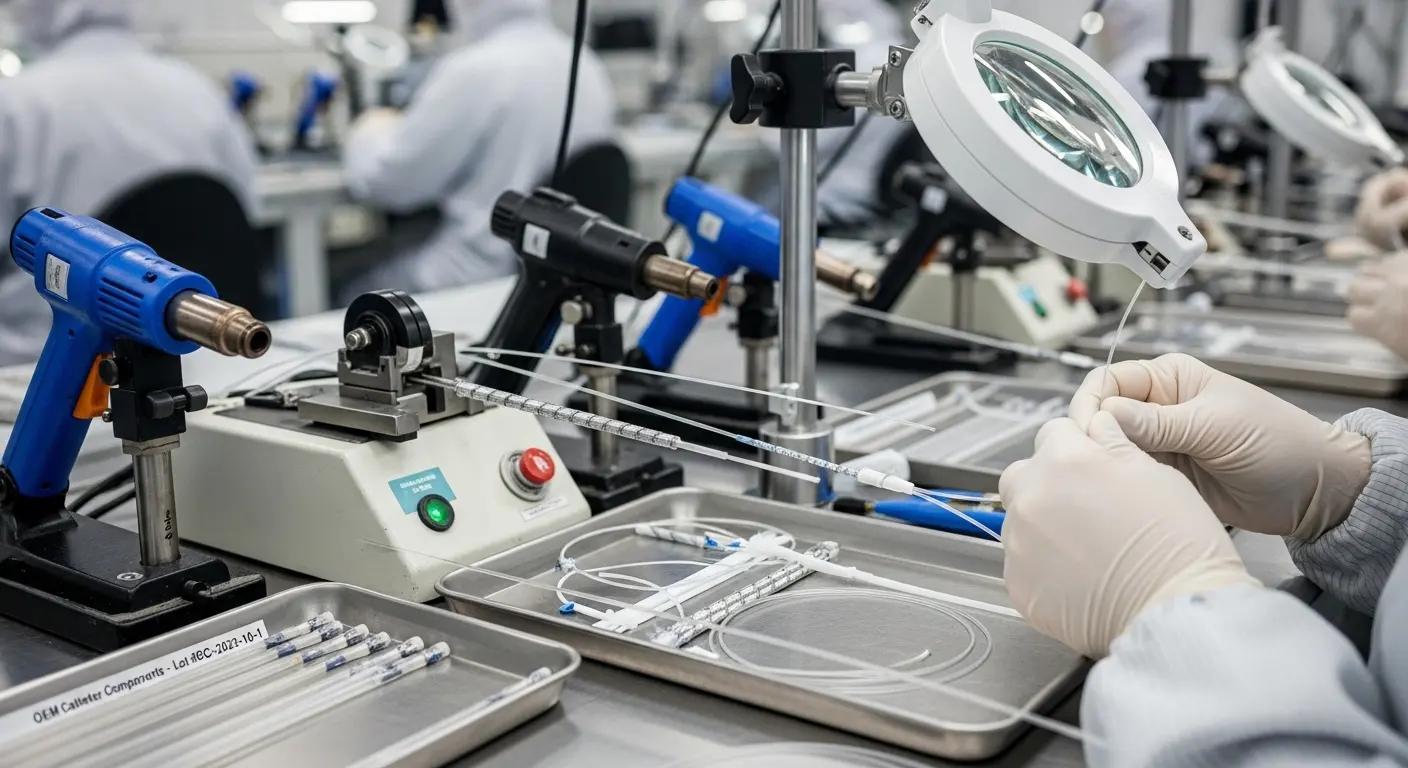
A guiding catheter OEM manufacturer allows medical device companies to bring high-quality vascular tools to market without investing millions in proprietary production lines. These partners provide specialized expertise in catheter construction, including wire braiding and multi-segment shaft bonding. By outsourcing production, brands can focus on clinical trials and market distribution while leveraging the manufacturer's existing ISO certifications and cleanroom facilities.
Selecting an OEM partner is about more than just a lower price point. It is about accessing advanced engineering. Most top-tier manufacturers use sophisticated materials like Pebax or Nylon to create varying levels of stiffness along the catheter shaft. This ensures the device is flexible enough to navigate the femoral or radial artery but stiff enough to support the passage of balloons and stents.
Benefits of OEM Partnerships
| Feature | Benefit to Your Brand |
| Speed to Market | Use pre-validated designs to shorten the development cycle. |
| Regulatory Support | Manufacturers often provide technical files for CE or FDA submissions. |
| Cost Control | Scale production up or down based on market demand without overhead. |
| Customization | Tailor the curve shapes and tip softness to meet specific physician needs. |
What Technical Specifications Define a High-Quality Guiding Catheter?
A high-quality guiding catheter must possess a large internal lumen, exceptional torque response, and a soft, radiopaque tip. The large lumen allows for the smooth passage of interventional devices, while the torque response ensures the physician can steer the catheter precisely. The tip must be soft enough to prevent vessel wall dissection during engagement.
When I talk to clinicians, their biggest complaint is "backing out." This happens when a catheter lacks the structural integrity to stay seated in the ostium when a stent is pushed through it. A top-tier manufacturer solves this by using stainless steel braiding within the catheter wall. This braiding provides the "backup support" needed for complex lesions.
Core Construction Elements
- Inner Liner: Usually made of PTFE (Teflon) to provide a low-friction surface for other devices.
- Middle Layer: A stainless steel braid that offers kink resistance and 1:1 torque transmission.
- Outer Jacket: Multi-durometer segments that transition from a stiff proximal end to a soft distal tip.
- Atraumatic Tip: A non-tapered or specially tapered end designed to minimize vessel trauma.
How Do You Evaluate the Quality Standards of an OEM Partner?
To evaluate a guiding catheter OEM manufacturer, check for ISO 13485 certification and a proven track record in Class III medical device production. Review their cleanroom protocols and testing capabilities, specifically for tensile strength, burst pressure, and tip attachment integrity. A trustworthy partner should offer full traceability for every raw material used in the extrusion process.
In the medical field, "good enough" does not exist. A small flaw in a catheter tip can lead to a serious complication during a procedure. Ask potential partners about their "in-process" inspection methods. Do they use automated vision systems to check for braid gaps? How do they ensure the medical hypodermic syringe hub connection is perfectly leak-proof? These details separate a basic factory from a true medical partner.
What Customization Options Are Available Through OEM Manufacturing?
OEM manufacturers offer extensive customization, including unique curve geometries (like Judkins, Amplatz, or Multipurpose), various French sizes (typically 5F to 8F), and specific shaft lengths. You can also request custom branding on the hub and specialized packaging. Some manufacturers even offer hydrophilic coatings to improve the catheter's trackability through tortuous anatomy.
Many brands start with standard shapes but soon find that specific markets need specialized tools. For example, if your clients frequently perform radial access procedures, you might need a catheter with a longer, more flexible "transition zone." Your manufacturer should be able to adjust the durometer of the outer jacket to meet this request. This level of detail is just as important as knowing what PRN means in medical terms when discussing patient care protocols.
Why is Large Lumen Design a Competitive Advantage?
Large lumen design is a competitive advantage because it allows physicians to use "6-in-7" or "double-buddy wire" techniques without friction. A guiding catheter with a thin wall but high strength provides more room inside for complex interventional tools. This allows for more options during difficult cases, such as treating bifurcated lesions or heavily calcified vessels.
Manufacturers achieve this through precision extrusion. If the wall is too thin, the catheter will kink. If it is too thick, the inner space is wasted. I’ve seen cases where a mere 0.002-inch difference in internal diameter determined whether a procedure was successful or had to be aborted. Ensuring your manufacturer masters this balance is key.
How Does Material Selection Affect Catheter Performance?
Material selection determines the catheter’s kink resistance, flexibility, and longevity. Pebax is the industry standard for the outer jacket because it allows for precise durometer (hardness) control. The inner PTFE liner is vital for reducing friction, ensuring that a malecot catheter or a stent delivery system can glide through without snagging.
Comparison of Catheter Materials
- PTFE (Teflon): Used for the inner lining; provides the highest lubricity.
- Stainless Steel (304/316): Used for braiding; provides structural support and torque.
- Pebax/Nylon: Used for the outer shell; provides the necessary "feel" and flexibility.
- Tungsten/Bismuth: Added to the tip material to make it visible under X-ray (radiopacity).
What Role Does Regulatory Compliance Play in OEM Sourcing?
Regulatory compliance is the "gatekeeper" for selling your medical devices. A guiding catheter OEM manufacturer must maintain a Quality Management System (QMS) that survives rigorous audits. They should provide you with a Device Master Record (DMR) and support your efforts in documenting biocompatibility (ISO 10993).
When you source components like medical cotton swabs or complex catheters, the paperwork is as important as the product. If your manufacturer changes a raw material supplier without telling you, your entire regulatory filing could be at risk. Clear communication and a "Change Control" agreement are non-negotiable when signing an OEM contract.
Frequently Asked Questions About Guiding Catheter Sourcing
What is the typical lead time for custom OEM catheters?
Lead times usually range from 8 to 16 weeks. This includes time for material procurement, extrusion, braiding, assembly, and sterilization. Prototype runs for new designs might take longer.
Can I get samples for clinical evaluation?
Most manufacturers offer "off-the-shelf" samples for initial testing. For custom designs, you will likely need to pay a tooling or development fee to produce a small batch for bench testing.
How is the catheter sterilized?
The standard method is Ethylene Oxide (EO) sterilization. This ensures the device is sterile without damaging the sensitive polymers or coatings used in the catheter construction.
Do they help with packaging design?
Yes, many OEMs provide "turnkey" solutions. This includes the inner sterile pouch, the outer box, and the IFU (Instructions for Use) manual. They can also advise on what hospital dressing products are best for inclusion in a procedural kit.
Next Steps for Your Catheter Development Project
Your first step should be to define your "Target Product Profile." List the specific French sizes, lengths, and curve shapes you need. Once you have this, reach out to a guiding catheter OEM manufacturer to discuss their technical capabilities and request a facility audit.
Submit Your Request
Recent Posts

Tags
- Adult Diapers
- Are custom medical devices safe
- Baby Diapers
- Can respiratory anesthesia be used
- Digital Healthcare
- Do you offer customized consumables
- European Market
- How do you take care of a skin wound
- Industry Trends
- Lady Sanitary Napkins
- Medical Devices
- OEM Medical Devices
- Product Introductions
- Protective Equipment
- Under Pads
- What are custom-made medical devices
- What are diagnostic products
- What are hospital dressing products
- What are medical tube catheters
- What are some common protective equipment
- What are the appropriate applications for hospital dressing products
- What are the appropriate uses for protective equipment
- What is a gynecological examination
- What is a medical consumable
- What is an anesthesia kit
- What is an OEM in medical devices
- what is an wound skin care
- what is can disposable ultrasonic diagnostic
- What is good manufacturing medical devices
- What is hospital-grade protective equipment
- what is medical equipments hospital furniture
- What is medical sterilization wrapping
- What is rehabilitation equipment device
- What medical consumables do you supply
- Where can I find laboratory consumables wholesale
- where can I find medical protection device
- where to buy hypodermic accessories
- where to buy medical apparel
- where to buy medical consumable accessories
- where to find OEM medical device supplier
- where to find rehabilitation equipment supplier
