



Co-extrusion Medical Tubing: Multi-Layer Design Guide


Why choose between a tube that’s easy to glue and one that resists harsh chemicals when you can have both in a single wall? If you’ve ever struggled with a medical device design where a single material just wouldn’t cut it, co-extrusion medical tubing is the solution you’ve been looking for.
It’s the engineering equivalent of having your cake and eating it too. By layering different polymers into a single integrated structure, you can solve contradictory design needs. Whether you’re protecting a sensitive drug from sticking to the tube wall or ensuring a catheter is visible under X-ray, co-extrusion makes it happen.
The Multi-Layer Solution to Design Conflict
A single-material tube is almost always a compromise. If you choose a material for its flexibility, it might be too porous. If you choose it for chemical resistance, it might be impossible to bond to a hub or connector.
Co-extrusion removes this compromise. It is the process of extruding two or more materials through the same die at the same time. These materials fuse together to form a single, high-performance wall.
What is the main benefit of co-extrusion in medical devices? It allows engineers to combine chemical resistance, lubricity, and bondability in one profile without the risk of layers peeling apart. It’s a seamless way to upgrade the functionality of everything from high-pressure lines to a malecot catheter used in drainage applications.
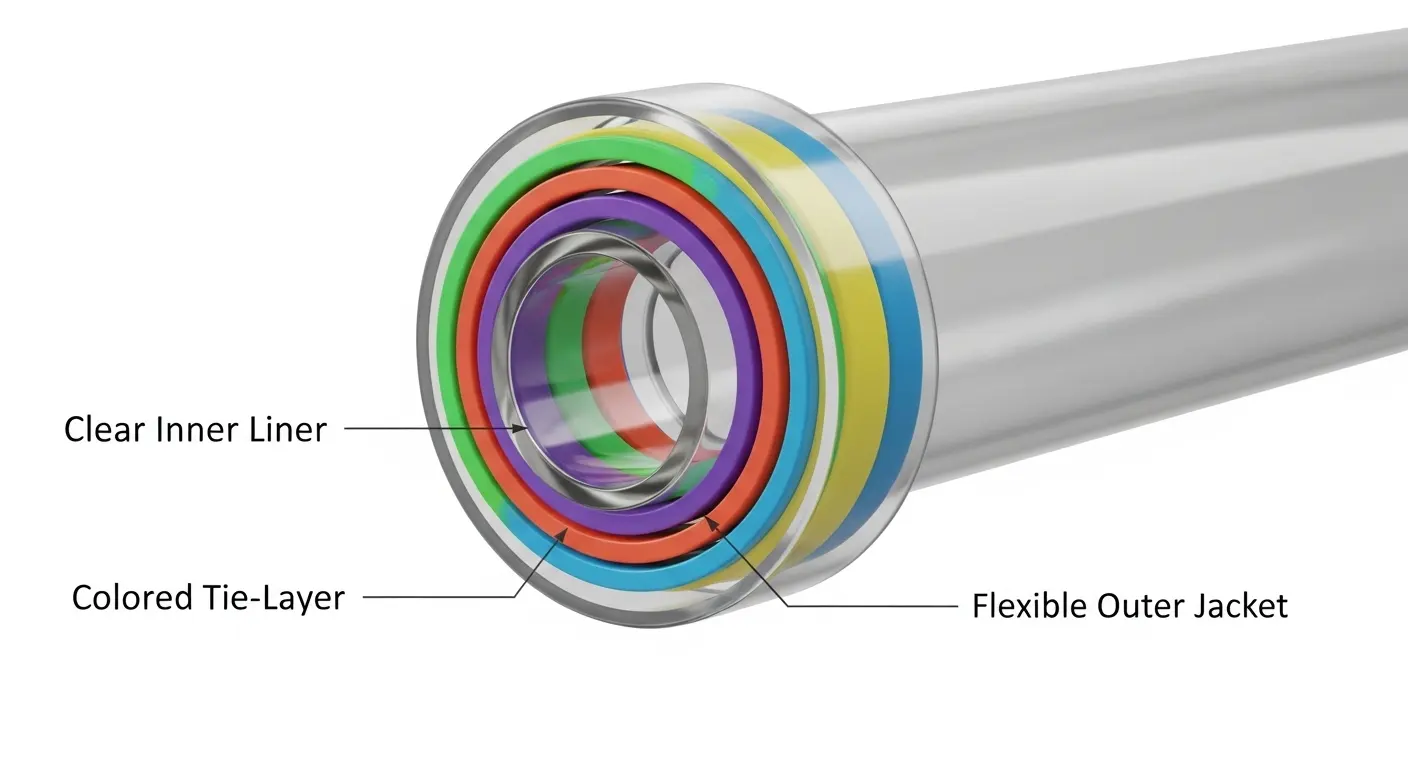
Common Co-Extrusion Medical Tubing Configurations
Most people think of tubing as a simple straw, but co-extruded designs are much more sophisticated. Here’s how we usually break down the layers:
The Standard 2-Layer Build
This is the workhorse of the industry. We often use a lubricious inner layer, like Polyethylene (PE), so fluids flow easily. Then, we add a bondable outer layer like TPU or PVC. This makes it easy for assembly teams to glue connectors onto the tube.
The 3-Layer "Sandwich" with Tie Layers
Sometimes, two plastics just don't like each other. They won't bond naturally. In these cases, we use a "Tie Layer." This is a very thin middle layer that acts as a bridge, chemically bonding the incompatible inner and outer plastics together.
Striped Co-Extrusion
You don't always need a full layer. Sometimes you just need visibility. We can co-extrude radiopaque stripes (usually filled with Barium Sulfate) into the tube wall. This allows surgeons to see the device on an X-ray while keeping the rest of the tube clear so they can monitor fluid flow.
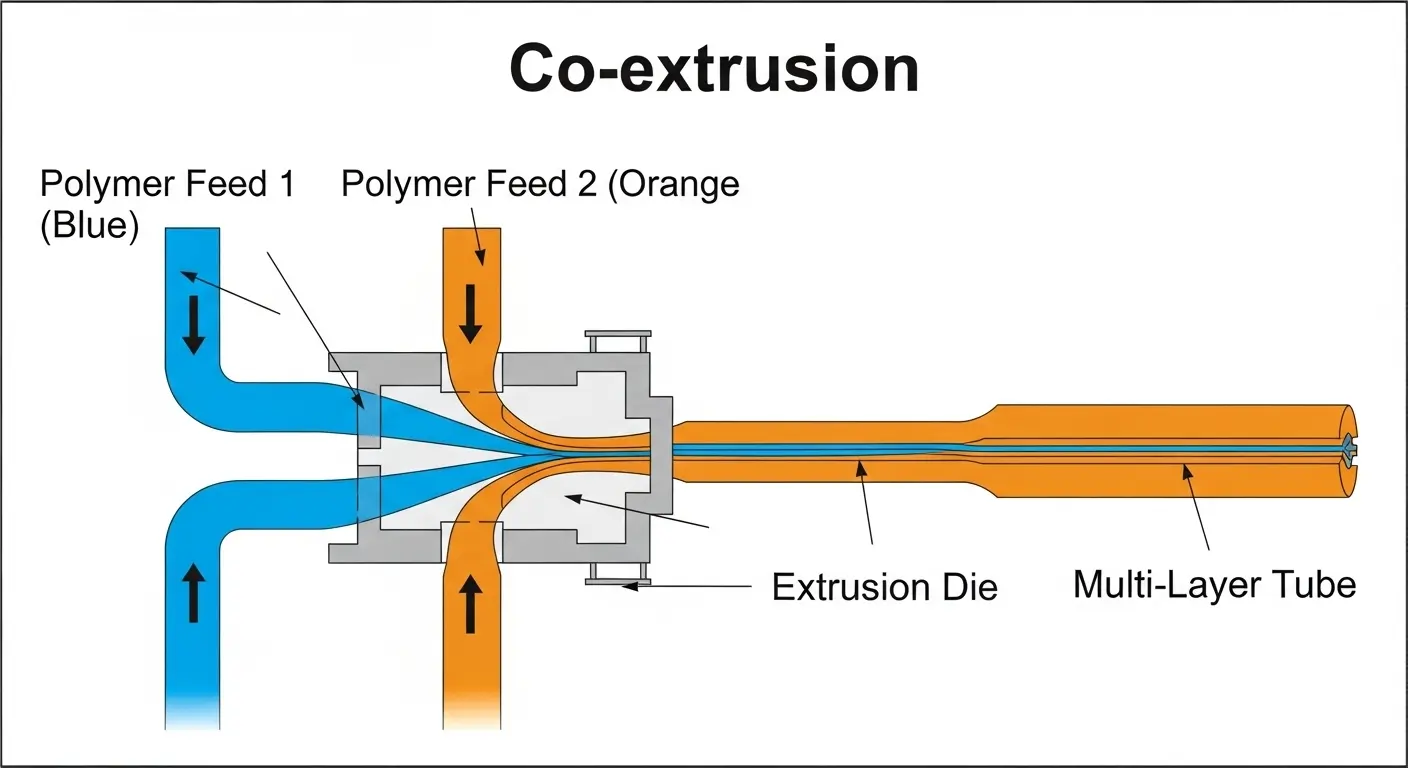
Material Compatibility: The Chemistry of Bonding
Successfully creating co-extrusion medical tubing isn't just about pushing plastic through a machine. It’s about chemistry. Some materials form a "chemical bond" because their molecules interlock while they are molten. Others only form a "mechanical bond," which is much weaker.
If you are designing a device that requires precise dosing—much like the requirements for a medical hypodermic syringe—you cannot afford for the layers to delaminate (peel apart).
| Inner Layer | Outer Layer | Compatibility |
| PE (Polyethylene) | PVC | Low (Requires Tie Layer) |
| PEBAX® | TPU | High (Natural Bond) |
| Nylon 12 | PEBAX® | High (Natural Bond) |
| FEP | Polyurethane | Low (Requires Etching or Tie Layer) |
Industry Applications: Where Layers Save Lives
You’ll find co-extrusion in almost every corner of the hospital. It’s particularly vital in drug delivery and minimally invasive surgery.
Insulin and Oncology Delivery
Certain drugs are "sticky." They tend to adsorb, or cling, to the walls of standard PVC tubing. This means the patient might not get the full dose. By using a co-extruded tube with a PE liner, we ensure the drug reaches the patient exactly as intended.
High-Pressure Injection
In cardiology, tubes must withstand high pressure without bursting. A co-extruded design can have a high-strength core for pressure resistance and a soft, atraumatic outer jacket to protect the patient’s arteries.
Light-Sensitive Medications
Some medications degrade when exposed to UV light. We can co-extrude an opaque outer layer to block light while keeping the inner layer clear and drug-compatible. This level of protection is just as critical as choosing the right hospital dressing products for post-surgical care.
Engineering Design Guide: Avoiding Delamination
If you're in the R&D phase, you'll want to avoid the common pitfalls of multi-layer extrusion. Here are three tips to keep your project on track:
- Match Your Melt Temperatures: We extrude all layers at the same time. If one plastic melts at 150°C and the other at 250°C, the cooler plastic will freeze before the layers can bond.
- Watch Your Wall Ratios: It’s tempting to make the expensive inner liner as thin as possible. However, if the layer is too thin, it can become "choppy" or inconsistent. We usually recommend a minimum layer thickness of 0.002".
- Sterilization Matters: Ensure both (or all three) materials can handle the same sterilization method. Some plastics handle Gamma radiation well, while others become brittle.
The Greetmed Precision Advantage
Why do engineers work with Greetmed for their co-extrusion medical tubing needs? Because we bridge the gap between high-end specs and cost-effective manufacturing.
We maintain tolerances as tight as $\pm 0.01$ mm in our Class 100,000 cleanrooms. Whether you are ordering a bulk supply of medical cotton swabs or a complex tri-layer catheter shaft, our quality control remains the same. We understand that in the medical field, there is no room for error.
FAQ: Common Questions About Multi-Layer Extrusion
How many layers can you co-extrude?
While 2 and 3 layers are most common for standard medical needs, advanced setups can handle up to 5 or 7 layers. This is usually reserved for very complex barrier requirements.
Can you co-extrude different colors for identification?
Yes. This is a great way to color-code lines (e.g., a blue stripe for venous, red for arterial) without needing to print on the tube, which can sometimes rub off.
How do you prevent the layers from peeling?
We use a combination of temperature control, specialized die designs, and tie-layer resins. We also perform "peel tests" to ensure the bond strength exceeds the requirements of the application.
What does "PRN" mean when referring to these tubes in a clinical setting?
In a hospital, you might hear a nurse say a line is for "PRN" use. If you've ever wondered what PRN means in medical terms, it stands for "pro re nata," or "as needed." Co-extruded tubes are often used in these "as needed" access lines because of their durability.
Ready to Build a Better Tube?
Co-extrusion isn't just a fancy manufacturing trick; it's a way to make medical devices safer, more effective, and often more affordable. By putting the right material exactly where it’s needed, you optimize every millimeter of your design.
If you’re ready to move past the limitations of single-layer tubing, let’s talk. Our engineering team can help you select the right materials and layer configurations to bring your device to life.
Submit Your Request
Recent Posts

Tags
- Adult Diapers
- Are custom medical devices safe
- Baby Diapers
- Can respiratory anesthesia be used
- Digital Healthcare
- Do you offer customized consumables
- European Market
- How do you take care of a skin wound
- Industry Trends
- Lady Sanitary Napkins
- Medical Devices
- OEM Medical Devices
- Product Introductions
- Protective Equipment
- Under Pads
- What are custom-made medical devices
- What are diagnostic products
- What are hospital dressing products
- What are medical tube catheters
- What are some common protective equipment
- What are the appropriate applications for hospital dressing products
- What are the appropriate uses for protective equipment
- What is a gynecological examination
- What is a medical consumable
- What is an anesthesia kit
- What is an OEM in medical devices
- what is an wound skin care
- what is can disposable ultrasonic diagnostic
- What is good manufacturing medical devices
- What is hospital-grade protective equipment
- what is medical equipments hospital furniture
- What is medical sterilization wrapping
- What is rehabilitation equipment device
- What medical consumables do you supply
- Where can I find laboratory consumables wholesale
- where can I find medical protection device
- where to buy hypodermic accessories
- where to buy medical apparel
- where to buy medical consumable accessories
- where to find OEM medical device supplier
- where to find rehabilitation equipment supplier
