



Why Multi-Lumen Tubing Is Critical for Complex Medical Devices


Medical device innovation is a concept that constantly challenges the limits of possibilities in the healthcare field, where the current environment is highly dynamic and fast-changing. Multi-lumen tubing is among some of the key factors that have facilitated this change, a complex technology that facilitates the creation of many internal lines running through one tubular profile. Multi-lumen designs are the future of medical device design as it brings together several functional pathways in a single compact design. This has a radical impact on the functionality of devices, workflow, and clinical outcomes in a broad spectrum of minimally invasive procedures.
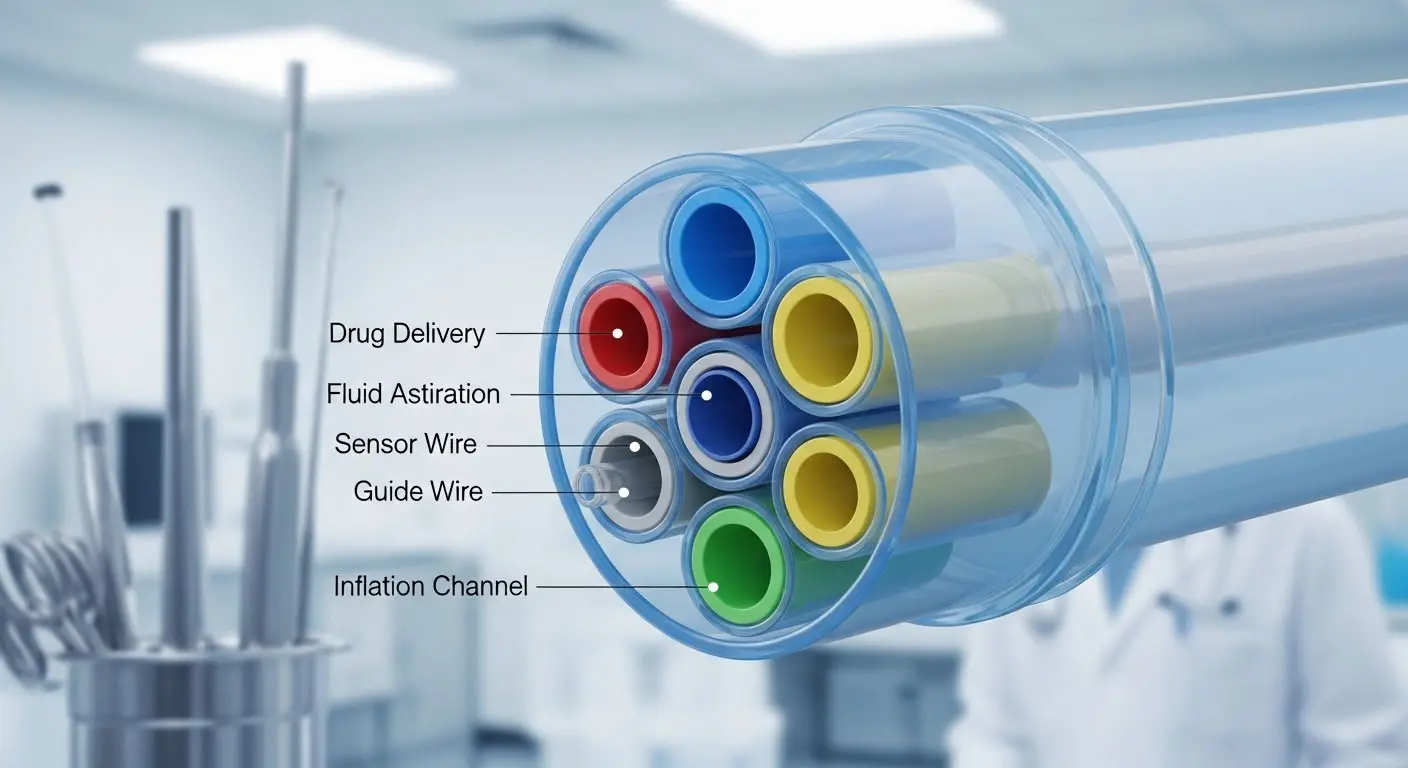
What Is Multi-Lumen Tubing?
Multi-lumen tubing Multi-lumen tubing are the extruded tubes, which are designed with two or more hollow passages (or lumens) that extend the length of the device. These can carry fluids, gases, sensors, wires or guidewires simultaneously and can be used to conduct a variety of purposes, formerly having to be handled by individual components. Multi-lumen tubing materials are often made with biocompatible polymers such as polyurethane (PU), polyethylene (PE), and fluoropolymers such as FEP or PTFE - each of which is chosen on specific mechanical and biocompatibility specifications.
Clinical Advantages: Efficiency, Safety, and Precision
Among all the most concrete clinical benefits of multi-lumen tubing, one can identify decreased device insertions during procedures. In the traditional catheter-based interventions, clinicians often were required to use several distinct devices to carry out various tasks such as injecting contrast, measuring pressure, and guiding wires. All this is possible with multi-lumen designs, which minimizes the complexity of procedures, reduces the time they take, and helps to reduce the discomfort and risk of patients.
As an example, cardiac electrophysiology would be a case where one lumen of a double-lumen catheter would deliver contrast agent, and the other would provide guidewire access. Four- or even five-lumen structures are available to provide energy to ablation, thermal monitoring, and irrigation processes at the same time, to simplify the workflow and increase the accuracy of the work.
Multi-lumen tubing enables parallel pathway-based monitoring and therapeutic roles in the course of interventions because it consolidates numerous pathways. It does not only enhance efficiency, but also enhances better in-procedure decision making through real time data without the need to change the extra devices.
Applications in Modern Medical Devices
Multi-lumen tubing is integral to many advanced medical technologies:
-
Catheter Systems: Multi-lumen configurations enable diagnostic monitoring, drug infusion, pressure sensing, and guidewire navigation within a single catheter pathway.
-
Endoscopic Instruments: The integrated lumens support illumination, irrigation, and instrument guidance concurrently — essential for minimally invasive endoscopic procedures.
-
Dialysis Equipment: These tubes facilitate simultaneous blood inflow and outflow processes that are fundamental to renal replacement therapies.
-
Multifunctional Surgical Tools: Complex surgical platforms often incorporate multi-lumen tubing to manage fluid lines, suction, and tools within confined anatomical spaces.
Across these applications, the flexibility and precision offered by multi-lumen designs elevate device capabilities beyond what single-channel tubing can achieve.
Design Challenges & Engineering Excellence
Although it has some obvious clinical advantages, the engineering of multi-lumen tubing is a difficult matter. Extrusion precision is needed to make sure that every channel has a similar dimension and integrity during the production. The distance between lumens needs to be strictly regulated to avoid cross-talk or leakage and wall thickness and materials should be highly biocompatible as well as sustainable.
The multi-lumen extrusion in a single tube is also a very challenging process that requires sophisticated equipment and real time monitoring to control internal geometry. Each added lumen adds complexity to the manufacturing process that needs effective process controls otherwise the lumen may be deformed or distort internal features.
Why This Matters for Healthcare Providers and Patients
Multi-lumen tubing makes a difference to the clinicians in the operating room with reduced device changes, shorter procedure time, and less complex work processes. These enhancements do not only increase efficiency but also cut down the total costs and resource requirement in the procedures.
Under patient consideration, minimum number of insertions translates to less tissue trauma, less chances of complications and in most cases a quicker recovery. Reducing the number of device changes may be clinically significant especially in patients with high risk or in operations that are long like cardiac operations or other complicated endoscopic or vascular surgeries.
Looking Ahead: Future Innovations and Opportunities
Innovation in the next-generation medical devices is being driven by the further development of multi-lumen tubing. New designs are looking at variable lumen designs, asymmetrical cross-sections and even built-in sensor pathways that both deliver therapeutic and diagnostic capabilities in a single device footprint. With the expansion of the minimally invasive procedures to more clinical settings, the use of multi-lumen technology will be at the forefront of facilitating new types of patient-centered care.
Our pledge to improve healthcare at Greetmed is to adopt technologies such as multi-lumen tubing which will enable clinicians and improve patient outcomes. We collaborate with the most advanced manufacturers and have access to high-precision extrusion to provide our solutions with the requirements of the most sophisticated medical tasks of the present time. Multi-lumen tubing, be it of the catheter systems used, be it of the surgical tools of use, or the diagnostic platforms, is a pillar of modern medical devices innovation - and a road-to-healthier patients the world over.
Submit Your Request
Recent Posts

Tags
- Adult Diapers
- Are custom medical devices safe
- Baby Diapers
- Can respiratory anesthesia be used
- Digital Healthcare
- Do you offer customized consumables
- European Market
- How do you take care of a skin wound
- Industry Trends
- Lady Sanitary Napkins
- Medical Devices
- OEM Medical Devices
- Product Introductions
- Protective Equipment
- Under Pads
- What are custom-made medical devices
- What are diagnostic products
- What are hospital dressing products
- What are medical tube catheters
- What are some common protective equipment
- What are the appropriate applications for hospital dressing products
- What are the appropriate uses for protective equipment
- What is a gynecological examination
- What is a medical consumable
- What is an anesthesia kit
- What is an OEM in medical devices
- what is an wound skin care
- what is can disposable ultrasonic diagnostic
- What is good manufacturing medical devices
- What is hospital-grade protective equipment
- what is medical equipments hospital furniture
- What is medical sterilization wrapping
- What is rehabilitation equipment device
- What medical consumables do you supply
- Where can I find laboratory consumables wholesale
- where can I find medical protection device
- where to buy hypodermic accessories
- where to buy medical apparel
- where to buy medical consumable accessories
- where to find OEM medical device supplier
- where to find rehabilitation equipment supplier
