



Wearable Health Monitoring Devices: How They Work, Benefits, and Future Trends


Wearable health monitoring devices have rapidly transformed from consumer fitness gadgets into essential tools for healthcare management, preventive care, and clinical decision support. From smartwatches that track heart rate to advanced biosensors that monitor chronic conditions, wearable technologies are reshaping how patients, clinicians, and health systems interact with health data.
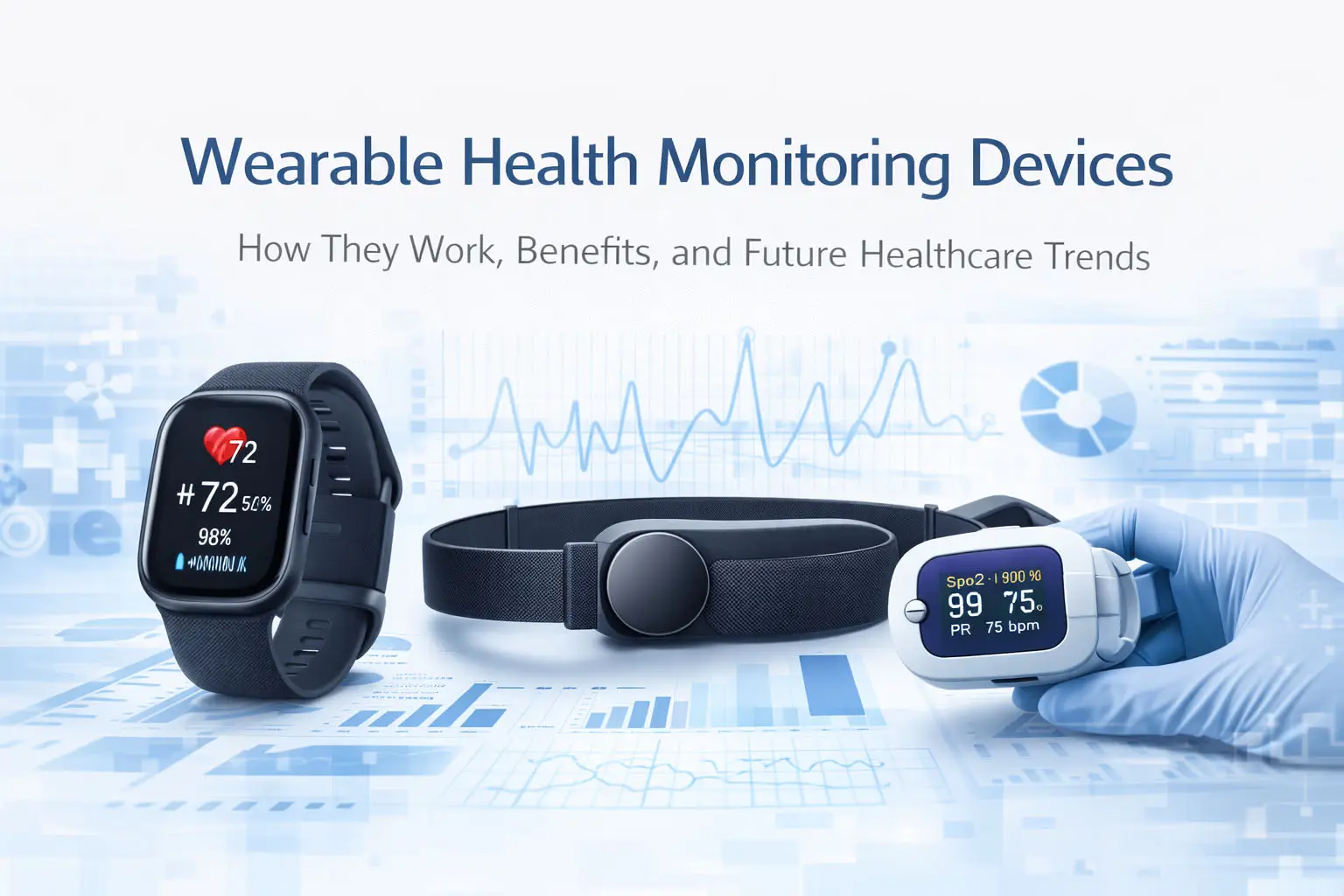
This article provides a deep dive into wearable health monitoring devices — what they are, how they work, key benefits, regulatory considerations, and where this dynamic industry is heading.
What Are Wearable Health Monitoring Devices?
Wearable health monitoring devices are portable electronic systems worn on the body to collect, analyze, and transmit physiological data. They can measure a wide range of health metrics, including:
-
Heart rate and heart rhythm
-
Blood oxygen saturation (SpO₂)
-
Temperature
-
Respiratory rate
-
Activity levels and sleep patterns
-
Glucose levels and metabolic indicators
Unlike traditional medical devices used in clinical settings, wearables are designed for continuous or frequent use during daily activities, making them ideal for long-term monitoring and early detection of health changes.
How Wearable Health Devices Work
Wearable devices integrate multiple technologies to capture and process biological signals:
Sensors and Biosensing Technologies
Wearables use a variety of sensors to detect physiological signals:
-
Photoplethysmography (PPG): Uses light to measure blood volume changes, commonly used in heart rate monitors and pulse oximeters.
-
Electrocardiography (ECG): Records electrical activity of the heart, helping detect arrhythmias.
-
Accelerometers & Gyroscopes: Detect movement and orientation, allowing activity and sleep pattern analysis.
-
Temperature Sensors: Monitor skin or core temperature changes indicative of health status.
These sensors collect raw data that are transmitted to embedded processors for signal conditioning and feature extraction.
Data Processing & Connectivity
After sensing, the data is often transmitted via Bluetooth, Wi-Fi, or 5G to a companion smartphone app or cloud platform. Cloud-based analytics use algorithms — often powered by machine learning or AI — to interpret signals, detect trends, and deliver actionable insights.
Secure connectivity and interoperability with electronic health record (EHR) systems support remote patient monitoring (RPM) and integration into broader health IT ecosystems.
Key Benefits of Wearable Health Monitoring Devices
Wearables provide advantages across multiple stakeholders — from individuals to healthcare providers.
1. Continuous and Real-World Data Collection
Unlike occasional clinical measurements, wearables provide ongoing monitoring that captures health trends in real-world contexts. This continuous stream of data enables early detection of changes in physiological status and supports proactive care.
2. Enhanced Chronic Disease Management
Chronic conditions such as diabetes, cardiovascular disease, and respiratory disorders require close monitoring. Wearables can:
-
Track glucose levels over time
-
Alert to abnormal heart rhythms
-
Monitor blood pressure variations
-
Support medication management
These functions empower patients and clinicians with insights that can inform treatment adjustments and reduce hospitalizations.
3. Personal Empowerment and Preventive Care
Wearables encourage individuals to take an active role in their health. Metrics like steps taken, sleep quality, and stress indicators motivate lifestyle changes and promote preventive wellness — helping individuals avert conditions before they become severe.
4. Supports Telehealth and Remote Monitoring
With the expansion of telehealth services, wearable devices play a critical role in providing clinicians with consistent patient data between appointments. Remote monitoring is especially valuable for aging populations, postoperative care, and high-risk patients.
Regulatory and Quality Considerations
Wearable health devices exist at the intersection of consumer electronics and medical technology. Depending on their intended use and claims, they may be regulated as medical devices by authorities such as:
-
U.S. FDA (e.g., classification as medical device vs wellness product)
-
EU MDR — Medical Device Regulation in the European Union
-
China NMPA — Medical registration in China
-
Health Canada, TGA, PMDA — Other national regulatory bodies
A device that claims to diagnose, monitor, or support treatment is more likely to meet medical device definitions and require regulatory submission, such as 510(k) clearance in the U.S.
Manufacturers must also implement robust quality management systems, such as ISO 13485, to ensure consistent design, production, and post-market surveillance.
Design and Usability Challenges
Wearable devices must balance technical performance with user experience. Critical design considerations include:
Form Factor and Comfort
Since wearables are worn for extended periods, comfort, weight, and aesthetics affect adoption. Flexible materials, ergonomic components, and adaptable bands help improve wearability.
Battery Life and Power Management
Continuous monitoring consumes energy. Efficient power management — such as low-power sensors, adaptive sampling, or smart synchronization — extends battery life and improves user retention.
Data Accuracy and Validation
Sensor algorithms must deliver reliable measurements across diverse populations and environments. Rigorous verification and validation — including clinical and real-world testing — ensures the device meets both accuracy standards and clinical expectations.
Security and Privacy
Wearables generate sensitive health data. Manufacturers must implement data encryption, secure communication protocols, and privacy safeguards to protect users and comply with regulations such as HIPAA, GDPR, and other regional data protection laws.
Trends Driving Future Wearable Health Monitoring
The wearable health device landscape is rapidly evolving, driven by advances in technology, data science, and healthcare needs.
1. Integration With AI and Predictive Analytics
Artificial intelligence enhances the value of wearable data by:
-
Detecting patterns linked to early disease onset
-
Identifying anomalies before clinical symptoms emerge
-
Personalizing health recommendations based on individual baselines
AI-driven analytics will continue to unlock new insights from longitudinal data.
2. Multi-Modal Monitoring Platforms
Future wearables will integrate multiple sensors — such as ECG, PPG, temperature, and biochemical sensors — in a single platform, providing a holistic health picture rather than single metrics.
3. Biochemical Sensing and Non-Invasive Glucose Monitoring
Non-invasive or minimally invasive biochemical sensors are a major research frontier. Glucose monitoring without finger sticks — if perfected and validated — promises huge benefits for diabetes care.
4. Wearables in Clinical Trials
Pharmaceutical and MedTech companies increasingly use wearables in clinical trials to collect objective, continuous data, improving study fidelity and reducing reliance on episodic clinic visits.
Challenges and Barriers to Adoption
Despite rapid growth, the wearable market still faces challenges:
Data Overload and Interpretation
Large volumes of continuous data require robust analytics and clinician workflows that can interpret and act on insights without overwhelming care teams.
Regulatory Complexity
Variations in regulatory frameworks across regions complicate global product launches.
User Engagement and Long-Term Use
Sustained user engagement depends on how meaningful users perceive the device metrics and whether insights translate into actionable behavior changes.
Conclusion: The Transformative Role of Wearables in Healthcare
Wearable health monitoring devices are more than gadgets — they represent a shift toward patient-centric, data-driven healthcare. By enabling continuous monitoring, early detection of health changes, and enhanced chronic disease management, wearables support more proactive and personalized care.
For manufacturers and OEMs, creating successful wearable devices requires a blend of technical innovation, quality design, regulatory understanding, and user-centered engineering.
As healthcare systems evolve, wearables will continue to play a central role in preventive health, remote care, and clinical research — ultimately contributing to improved outcomes and reduced healthcare costs around the world.
Submit Your Request
Recent Posts

Tags
- Adult Diapers
- Are custom medical devices safe
- Baby Diapers
- Can respiratory anesthesia be used
- Digital Healthcare
- Do you offer customized consumables
- European Market
- How do you take care of a skin wound
- Industry Trends
- Lady Sanitary Napkins
- Medical Devices
- OEM Medical Devices
- Product Introductions
- Protective Equipment
- Under Pads
- What are custom-made medical devices
- What are diagnostic products
- What are hospital dressing products
- What are medical tube catheters
- What are some common protective equipment
- What are the appropriate applications for hospital dressing products
- What are the appropriate uses for protective equipment
- What is a gynecological examination
- What is a medical consumable
- What is an anesthesia kit
- What is an OEM in medical devices
- what is an wound skin care
- what is can disposable ultrasonic diagnostic
- What is good manufacturing medical devices
- What is hospital-grade protective equipment
- what is medical equipments hospital furniture
- What is medical sterilization wrapping
- What is rehabilitation equipment device
- What medical consumables do you supply
- Where can I find laboratory consumables wholesale
- where can I find medical protection device
- where to buy hypodermic accessories
- where to buy medical apparel
- where to buy medical consumable accessories
- where to find OEM medical device supplier
- where to find rehabilitation equipment supplier
