



Medical Device Contract Manufacturing: A Complete Guide for OEMs and Brands


In today’s medical technology ecosystem, most companies don’t build every component of their products in-house. Instead, they partner with medical device contract manufacturers that provide specialized production capacity, quality systems, and regulatory expertise to bring products to market faster and more efficiently.
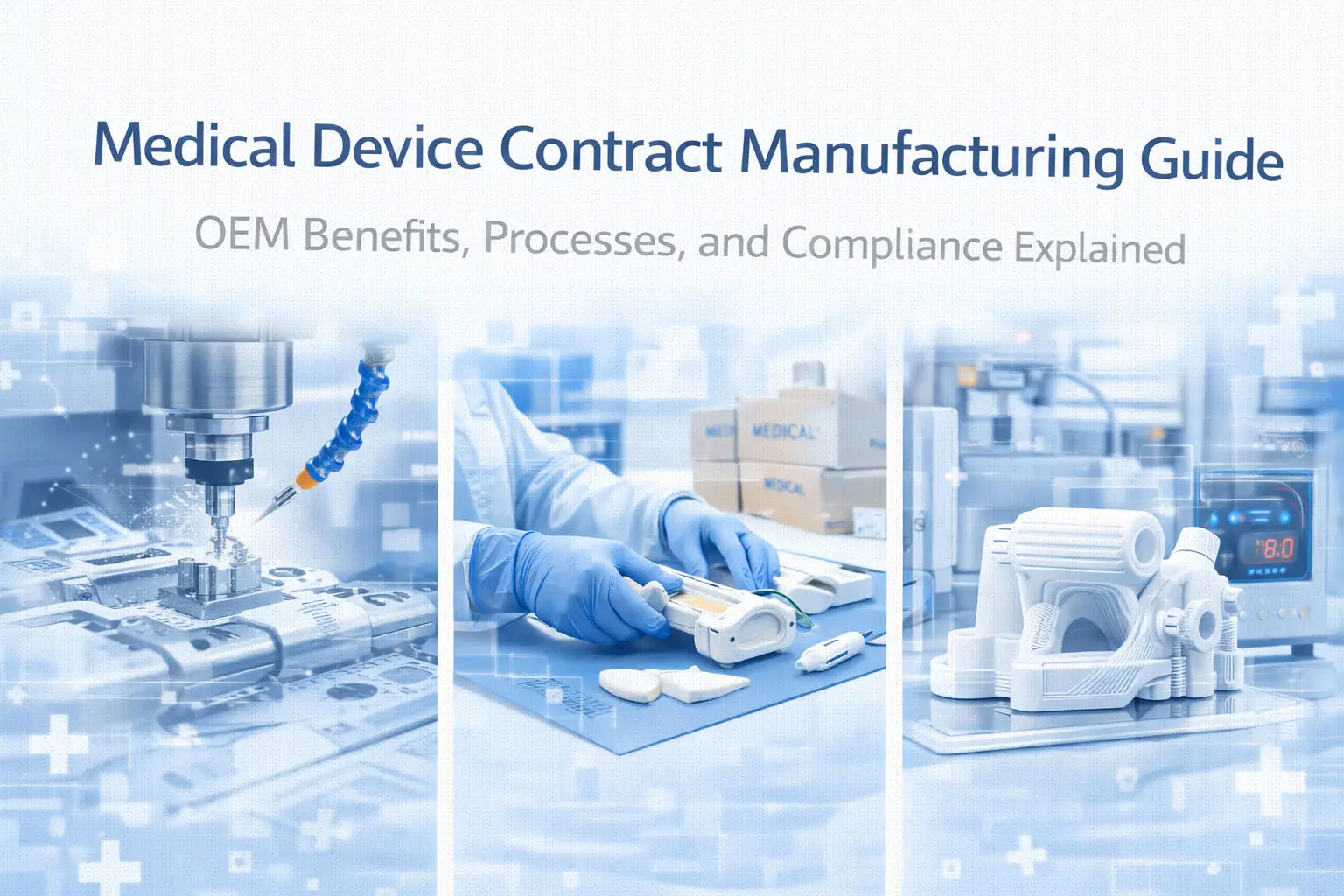
Whether you are a startup developing a new diagnostic tool or a multinational OEM scaling global supply, understanding contract manufacturing — what it means, how it works, and how to choose the right partner — is essential to product success.
This article defines medical device contract manufacturing, explores its value proposition, outlines key considerations, and offers practical guidance for navigating partnerships that support quality, compliance, and growth.
What Is Medical Device Contract Manufacturing?
Medical device contract manufacturing refers to outsourcing the production of a device or its components to a third-party manufacturer. These partners typically specialize in regulated production environments, certified quality systems, and scalable assembly lines that meet global standards such as ISO 13485, FDA Quality System Regulation (QSR), and EU Medical Device Regulation (MDR).
Contract manufacturing may include:
-
Component fabrication (plastics, metals, electronics)
-
Assembly and integration
-
Sterilization and packaging
-
Testing and inspection
-
Supply chain and logistics support
By leveraging external expertise and capacity, OEMs can focus on product design, marketing, and clinical strategy — while leaving regulated production to partners optimized for manufacturing excellence.
Why OEMs and Brands Use Contract Manufacturing
Medical device contract manufacturing offers strategic benefits that align with common industry challenges:
1. Access to Specialized Production Capabilities
Manufacturing medical devices often involves advanced processes such as:
-
Precision CNC machining
-
Injection molding of medical-grade polymers
-
Cleanroom assembly
-
Automated testing and inspection
-
Electronics integration and PCB assembly
Contract manufacturers invest in the facilities, machines, and certifications necessary to deliver consistent output — reducing the capital burden for OEMs.
2. Quality and Compliance Support
Regulatory compliance in medical device production is non-negotiable. Contract manufacturers typically operate under ISO 13485-certified quality management systems, providing:
-
Documented Standard Operating Procedures (SOPs)
-
Traceability of materials and processes
-
Validation and verification evidence
-
Audit support
-
Corrective and preventative action (CAPA) systems
A trusted partner helps ensure production lines maintain compliance with stringent requirements across market regions.
3. Scalability and Flexibility
Whether planning for small pilot runs, seasonal demand spikes, or large-scale production, contract manufacturers provide flexibility in output capacity. This scalability allows OEMs to avoid underutilized internal factories while quickly responding to market changes.
4. Cost Efficiency and Reduced Time to Market
By outsourcing manufacturing functions, companies can reduce overhead, avoid large capital investments in facilities and equipment, and accelerate product launch timelines through established production processes.
5. Global Footprint and Supply Chain Resilience
Many contract manufacturers operate facilities across multiple continents, enabling OEMs to:
-
Localize production to key markets
-
Reduce cross-border lead times
-
Mitigate supply chain risk through diversified sourcing
In today’s unpredictable supply landscape, having a geographically diversified partner network enhances continuity and responsiveness.
Key Services in Medical Device Contract Manufacturing
Contract manufacturers offer a spectrum of services tailored to device complexity and product lifecycle stage. These services include:
Design for Manufacturability (DFM) Support
Good contract partners provide early input on design to optimize:
-
Material selection
-
Tolerance specifications
-
Assembly feasibility
-
Cost and process efficiency
This minimizes late-stage design changes and streamlines production readiness.
Prototype Fabrication
Prototyping — often leveraging rapid tooling, 3D printing, and soft tooling — enables early physical validation of form, fit, and function before committing to full production tooling.
Precision Component Manufacturing
Manufacturers produce high-precision components using techniques like:
-
CNC machining
-
Laser cutting
-
Injection molding
-
Sheet metal forming
Each method requires strict process controls to meet regulatory expectations for medical use.
Assembly and Integration
Many devices combine mechanical components, electronics, and software — requiring coordinated assembly in controlled environments. Contract manufacturers operate cleanroom facilities and integrate automated processes with inspection checkpoints to ensure product integrity.
Sterilization and Packaging
For sterile products, contract partners may coordinate or manage sterilization processes (e.g., gamma, ethylene oxide) and final packaging designed for regulatory labeling, barrier performance, and shelf life requirements.
Final Testing and Inspection
Device performance must be verified before shipment. Contract manufacturers perform:
-
Functional testing
-
Dimensional inspection
-
Performance validation
-
Packaging integrity testing
Comprehensive inspection protocols help ensure only compliant products reach customers.
Supply Chain and Logistics
Beyond manufacturing, many partners help with:
-
Component sourcing
-
Inventory management
-
Shipment consolidation
-
Regulatory documentation support
This reduces administrative burden for OEMs and strengthens fulfillment reliability.
Choosing the Right Contract Manufacturing Partner
Selecting a medical device contract manufacturer is a strategic decision with long-term implications. Here are key factors to consider:
1. Quality System Maturity
Verify that the partner maintains robust quality systems (e.g., ISO 13485) and welcomes external audits. A mature QMS ensures:
-
Traceability
-
Change control
-
CAPA processes
-
Document integrity
2. Regulatory Experience
For global market access, partners must understand region-specific expectations — including FDA QSR, EU MDR, CMDCAS/SOR, and NMPA requirements. Their experience with submissions and audits accelerates approval readiness.
3. Technical Capabilities
Match your product’s technical complexity to the manufacturer’s strengths. For example:
-
Electronics heavy devices require PCB assembly experience.
-
Implantable products demand precision metallurgical processes.
Request capability matrices and examples of past work.
4. Scalability and Capacity
Consider future growth when evaluating partners. Ensure they can scale from pilot runs to high-volume production without compromising quality or timelines.
5. Communication and Transparency
Effective communication — including proactive reporting, access to production data, and structured project updates — is essential for project alignment and risk mitigation.
Common Contract Manufacturing Models
Medical device OEMs engage with partners under various contractual arrangements:
1. Turnkey Manufacturing
The contract partner handles the entire production process — from incoming materials to finished device delivery.
2. Partial Outsourcing
The partner focuses on specific sections of the workflow (e.g., component fabrication or assembly) while the OEM maintains overall control.
3. Co-Development Partnerships
For early-stage products, partners engage in design support and prototyping before transitioning to full production.
Each model offers different levels of involvement and risk sharing.
Risks and Mitigation Strategies
While contract manufacturing delivers many advantages, risks exist:
1. Quality or Compliance Gaps
If not rigorously monitored, production deviations can lead to non-conforming products.
Mitigation: Establish clear quality agreements, milestones, and audit rights.
2. Intellectual Property (IP) Security
Outsourcing increases exposure of sensitive design information.
Mitigation: Use strong NDAs, IP protection protocols, and secure data systems.
3. Supply Chain Interruptions
Global disruptions can impact material availability and delivery timelines.
Mitigation: Develop multi-source strategies and safety stock plans.
Conclusion
Medical device contract manufacturing is a strategic enabler for OEMs, providing access to specialized production, quality compliance, scalability, and global supply resilience. By partnering with experienced manufacturers, companies can concentrate on innovation, regulatory strategy, and market expansion — while benefiting from regulated production excellence.
Whether you are launching a new product or scaling an existing portfolio, understanding contract manufacturing fundamentals and aligning with the right partner is essential to delivering high-quality, compliant products to patients and healthcare providers worldwide.
Submit Your Request
Recent Posts

Tags
- Adult Diapers
- Are custom medical devices safe
- Baby Diapers
- Can respiratory anesthesia be used
- Digital Healthcare
- Do you offer customized consumables
- European Market
- How do you take care of a skin wound
- Industry Trends
- Lady Sanitary Napkins
- Medical Devices
- OEM Medical Devices
- Product Introductions
- Protective Equipment
- Under Pads
- What are custom-made medical devices
- What are diagnostic products
- What are hospital dressing products
- What are medical tube catheters
- What are some common protective equipment
- What are the appropriate applications for hospital dressing products
- What are the appropriate uses for protective equipment
- What is a gynecological examination
- What is a medical consumable
- What is an anesthesia kit
- What is an OEM in medical devices
- what is an wound skin care
- what is can disposable ultrasonic diagnostic
- What is good manufacturing medical devices
- What is hospital-grade protective equipment
- what is medical equipments hospital furniture
- What is medical sterilization wrapping
- What is rehabilitation equipment device
- What medical consumables do you supply
- Where can I find laboratory consumables wholesale
- where can I find medical protection device
- where to buy hypodermic accessories
- where to buy medical apparel
- where to buy medical consumable accessories
- where to find OEM medical device supplier
- where to find rehabilitation equipment supplier
