



Verification vs Validation in Medical Device Development: What You Need to Know


In medical device design and development, two terms you’ll hear repeatedly are verification and validation. Although they sound similar, they serve very different purposes — and confusing them can lead to serious compliance setbacks, costly redesigns, or even regulatory rejection.
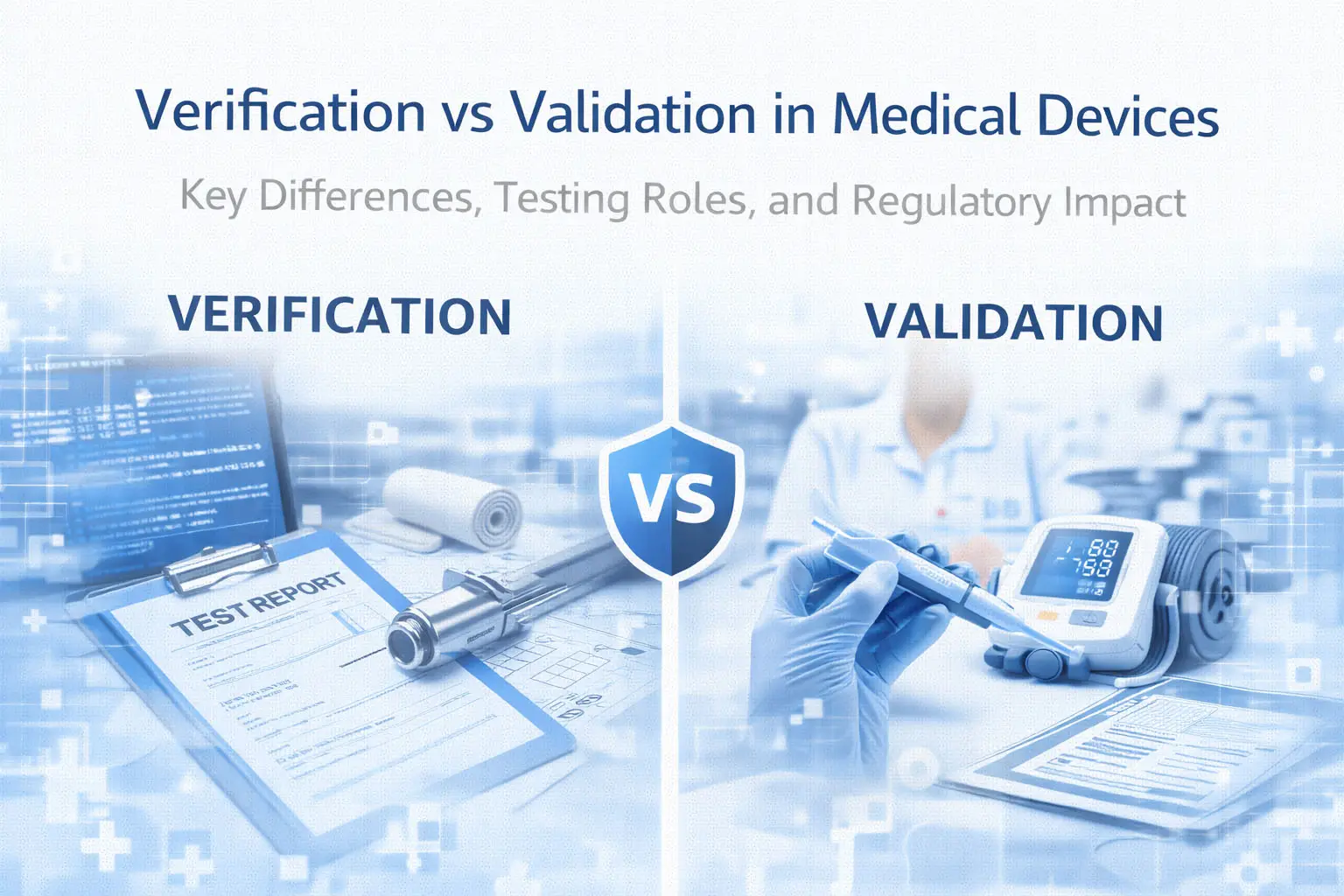
This article explains the fundamental differences between Verification (V) and Validation (V), how each fits into the medical device lifecycle, and practical guidance for applying both effectively within a Quality Management System (QMS) aligned with standards such as ISO 13485, FDA 21 CFR Part 820, and ISO 14971.
Why Both Verification and Validation Matter
Medical device development is not just about coming up with a functional prototype — it’s about building evidence that a product is safe, effective, and fit for its intended use. In regulated environments, authorities like the U.S. FDA, EU Notified Bodies, and China NMPA expect robust documentation and testing that distinguishes between verification and validation activities.
Getting these concepts right is more than academic — they define your testing strategy, documentation plan, regulatory submissions, and ultimately, your path to market.
What Is Verification?
Verification answers the question:
Did we build the product right?
In practice, verification focuses on confirming that the design outputs satisfy design inputs — in other words, that the device was built in accordance with specifications. Verification is about engineering accuracy, consistency, and adherence to requirements.
Key Characteristics of Verification
Verification:
-
Is specification-driven
-
Compares design output against predefined requirements
-
Is typically performed early and often throughout development
-
Focuses on objective evidence, usually from bench testing, simulations, and inspections
Verification activities do not rely on actual clinical use. Instead, they ensure that each design step correctly implements requirements — whether mechanical strength, electrical performance, software behavior, or dimensional tolerances.
Common Examples of Verification
Medical device verification may include:
-
Dimensional inspection of components
-
Software unit testing and code review
-
Mechanical load testing
-
Environmental stress testing (e.g., humidity, temperature)
-
Compliance checks against technical requirements
For example, if the design input specifies a device must maintain structural integrity under 10 kg of force, verification testing will confirm whether the design output meets that threshold.
What Is Validation?
Validation answers the question:
Did we build the right product?
While verification assesses compliance with specifications, validation evaluates whether the device actually meets the needs of end-users in real or simulated clinical environments.
Validation is inherently user-focused. It confirms that, when used as intended, the device achieves its clinical purpose — safely, reliably, and without unacceptable risk.
Key Characteristics of Validation
Validation:
-
Occurs later in development, after verification
-
Includes clinical context or realistic use conditions
-
Focuses on usability, performance, and user needs
-
Often requires human factors testing, simulated use, or clinical evaluations
Common Examples of Validation
Examples in medical device contexts include:
-
Usability studies with clinicians or patients
-
Simulated use tests mimicking real clinical workflows
-
Human factors engineering evaluations
-
Clinical performance studies
For instance, a blood glucose monitor might pass verification by measuring accuracy in controlled lab tests, but it may require validation to confirm that patients can use it reliably in real home environments.
Verification vs Validation — Side-by-Side
Understanding the differences is easier when compared side-by-side:
| Aspect | Verification | Validation |
|---|---|---|
| Purpose | Did we build it right? | Did we build the right thing? |
| Focus | Product specification | User needs & clinical context |
| Timing | Throughout design | After design finalization |
| Methods | Bench tests, inspections | Usability tests, clinical simulations |
| Standards | ISO 13485 Design Controls | Human factors, clinical evaluation |
| Evidence | Engineering data | User & performance data |
| Outcome | Design meets requirements | Device meets user needs |
How Verification and Validation Fit into Medical Device Development
Both verification and validation are integral to modern medical device design control frameworks (e.g., FDA QSR, ISO 13485). A typical development lifecycle includes:
-
Design Inputs — Define requirements based on user needs
-
Design Outputs — Engineering designs that implement inputs
-
Verification Activities — Confirm design outputs meet inputs
-
Design Freeze — Locking down design after verification
-
Validation Activities — Confirm final design solves the right problem
-
Regulatory Submission — Present evidence to authorities
-
Market Launch & Post-Market Surveillance — Real-world performance monitoring
Regulators expect comprehensive documentation of both verification and validation results. Verification evidence ensures engineering compliance, while validation evidence demonstrates real-world performance and user acceptability.
Verification in Practice — Key Considerations
1. Plan Early
Effective verification starts in the earliest design stages. Develop a Verification Plan that maps each design input to corresponding tests or inspection methods.
2. Use Objective Evidence
Verification must rely on measurable, documented data rather than subjective judgement. Test reports, inspection logs, and traceability matrices are critical artifacts.
3. Track Traceability
Link every design input to verification results in a Design Traceability Matrix (DTM). This demonstrates that each requirement was verified, facilitating audits and regulatory review.
Validation in Practice — Key Considerations
1. Simulate Real Use Environments
Validation should mimic real conditions as closely as possible — including lighting, noise, workflow, user stress, and clinical variability.
2. Include Representative Users
When conducting usability or human factors validation, select participants who represent actual end-users — e.g., home caregivers, clinicians, or patients.
3. Document Everything
Validation requires clear protocols, observation data, deviation reports, and analysis. Documentation is as critical as the activity itself.
4. Recognize When Clinical Data Is Needed
Some products may require formal clinical studies as part of validation — particularly those with novel technologies or high-risk indications.
Common Pitfalls and How to Avoid Them
Assuming Verification Is Enough
Verification alone does not assess real-world use. Relying solely on bench testing risks missing usability issues or unexpected failure modes.
Solution: Plan validation early and build it into the project timeline.
Skipping Usability Evaluation
Even products that technically meet specifications can fail in practice if users misinterpret instructions or struggle during operation.
Solution: Conduct human factors and usability studies before finalizing design.
Inadequate Documentation
Incomplete or inconsistent documentation can lead to regulatory delays or audit findings.
Solution: Maintain traceability and use standardized templates for verification and validation reports.
Regulatory Perspectives
U.S. FDA
The FDA’s design control requirements (21 CFR 820) explicitly call for verification and validation activities, accompanied by documented evidence. Both are reviewed during premarket submissions and inspections.
ISO 13485
ISO 13485 emphasizes robust design controls, including separate verification and validation processes with documented outcomes.
EU MDR
The EU Medical Device Regulation also expects manufacturers to demonstrate product suitability for intended use, with comprehensive evidence from both verification and validation.
Conclusion
Verification and validation — though closely related — serve distinct roles in medical device development:
-
Verification ensures you built the device right
-
Validation ensures you built the right device
Both are required to satisfy regulatory expectations, reduce risk, and deliver safe, effective medical technology that meets end-user needs.
By planning and executing verification and validation effectively, manufacturers can minimize rework, streamline regulatory submissions, and support stronger post-market performance — helping bring high-quality medical devices to patients around the world.
Submit Your Request
Recent Posts

Tags
- Adult Diapers
- Are custom medical devices safe
- Baby Diapers
- Can respiratory anesthesia be used
- Digital Healthcare
- Do you offer customized consumables
- European Market
- How do you take care of a skin wound
- Industry Trends
- Lady Sanitary Napkins
- Medical Devices
- OEM Medical Devices
- Product Introductions
- Protective Equipment
- Under Pads
- What are custom-made medical devices
- What are diagnostic products
- What are hospital dressing products
- What are medical tube catheters
- What are some common protective equipment
- What are the appropriate applications for hospital dressing products
- What are the appropriate uses for protective equipment
- What is a gynecological examination
- What is a medical consumable
- What is an anesthesia kit
- What is an OEM in medical devices
- what is an wound skin care
- what is can disposable ultrasonic diagnostic
- What is good manufacturing medical devices
- What is hospital-grade protective equipment
- what is medical equipments hospital furniture
- What is medical sterilization wrapping
- What is rehabilitation equipment device
- What medical consumables do you supply
- Where can I find laboratory consumables wholesale
- where can I find medical protection device
- where to buy hypodermic accessories
- where to buy medical apparel
- where to buy medical consumable accessories
- where to find OEM medical device supplier
- where to find rehabilitation equipment supplier
