



Class I vs Class II Medical Devices: Key Differences Every Manufacturer Should Know


Understanding how medical devices are categorized by regulatory authorities is essential for manufacturers, distributors, and OEM partners planning to enter global markets. Two of the most commonly referenced classifications are Class I and Class II, which indicate progressively higher levels of regulatory oversight based on the potential risk a device poses to patients and users.
This article explains the differences between Class I and Class II medical devices, what each classification means for regulatory pathways, and practical implications for product design, manufacturing, and market entry.
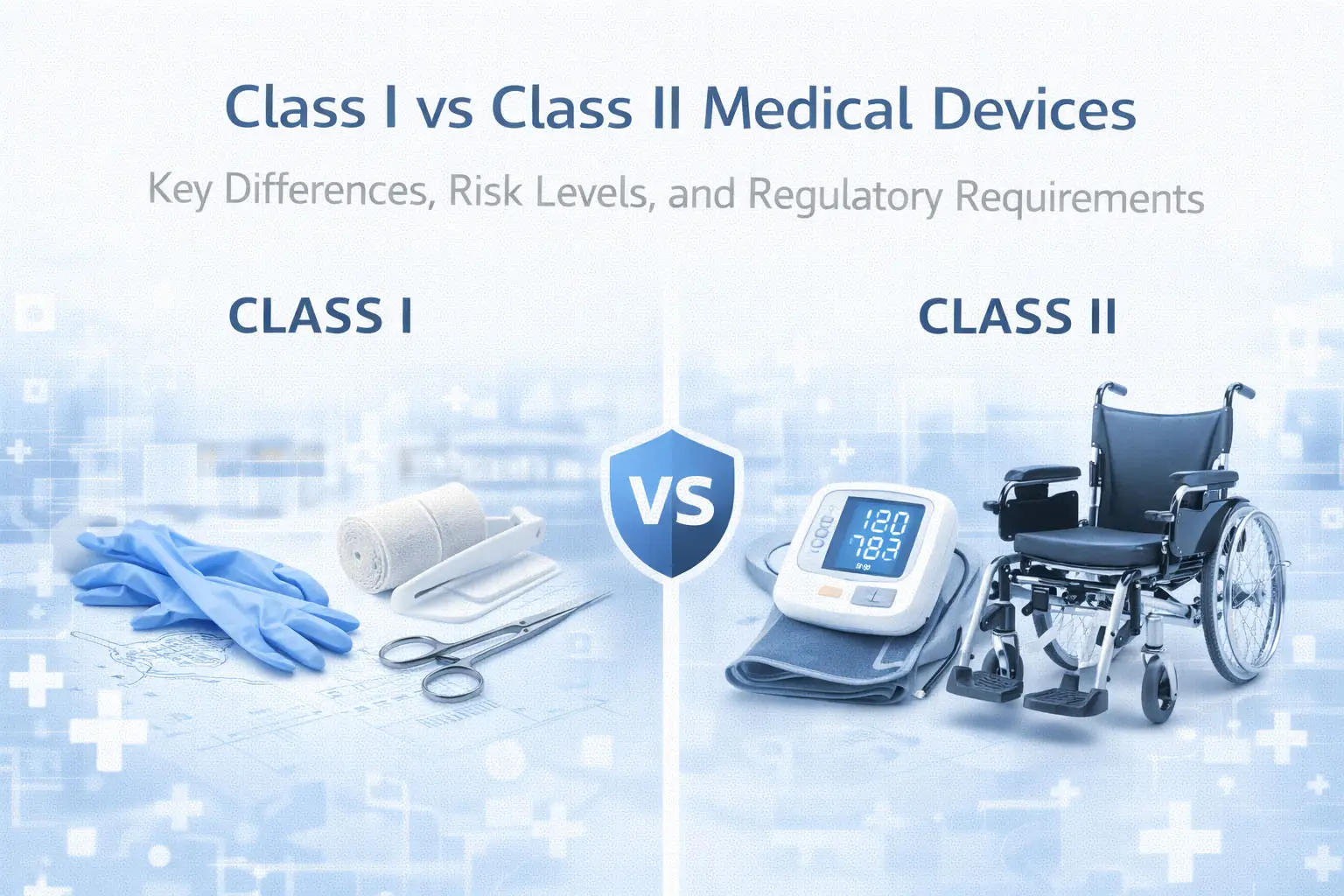
Why Device Classification Matters
Regulatory agencies such as the U.S. Food and Drug Administration (FDA) and similar bodies in other jurisdictions (e.g., EU Medical Device Regulation, China NMPA) apply classification systems to set the level of regulatory control required for medical devices. The classification impacts:
-
Regulatory submission pathways
-
Testing and documentation requirements
-
Design controls and manufacturing practices
-
Time and cost to commercialize
Understanding your device’s classification early in the development process helps you plan development activities, avoid surprises, and align compliance strategies with product risk.
What Defines Class I Medical Devices?
Class I medical devices are generally considered low risk and are subject to the least regulatory controls. These products typically pose minimal potential harm to patients when used according to their intended purpose.
General Controls
Class I devices are regulated primarily through general controls, which include:
-
Facility registration and device listing
-
Quality system regulation (QSR)
-
Labeling requirements
-
Good manufacturing practices (GMP)
These controls help ensure basic product safety and manufacturing integrity but do not require extensive premarket data.
Premarket Submission
Most Class I devices are exempt from premarket notification (510(k)) requirements with the FDA, provided they meet applicable general controls. This accelerated regulatory path allows manufacturers to bring simple devices to market more quickly.
Typical Examples of Class I Devices
Common Class I medical devices include:
-
Elastic bandages
-
Manual surgical instruments (e.g., scalpels, forceps)
-
Tongue depressors
-
Examination gloves
Because these products do not engage complex technologies or sustained patient interaction, general controls are normally sufficient to assure performance and safety.
What Defines Class II Medical Devices?
Class II medical devices represent a moderate level of risk and require additional regulatory oversight beyond general controls. This is because these devices often incorporate more complex technologies, serve critical functions, or interact with patients in ways that carry greater clinical implications.
General + Special Controls
Class II devices are governed by:
-
General controls (as with Class I)
-
Special controls, which may include:
-
Performance standards
-
Specific labeling requirements
-
Post-market surveillance
-
Bench testing and performance criteria
-
These additional requirements help ensure that device performance and risks are appropriately managed.
Premarket Notification (510(k))
Most Class II devices require a 510(k) Premarket Notification submission to the FDA. This pathway requires demonstrating that the new device is substantially equivalent to an existing legally marketed device (predicate) in terms of intended use and technological characteristics.
Typical Examples of Class II Devices
Common Class II devices include:
-
Infusion pumps
-
Powered wheelchairs
-
Blood pressure monitors
-
Diagnostic imaging accessories
Class II devices often integrate mechanical, electrical, or software systems — increasing regulatory emphasis on performance data and conformity.
Key Differences Between Class I and Class II Devices
To understand the practical implications of classification, let’s compare the major differences:
1. Risk Level
-
Class I: Low risk — devices with simple design and minimal clinical impact
-
Class II: Moderate risk — devices with greater functional complexity or clinical interaction
2. Regulatory Requirements
| Feature | Class I | Class II |
|---|---|---|
| General Controls | ✔️ | ✔️ |
| Special Controls | ❌ | ✔️ |
| 510(k) Premarket Submission | ❌ (mostly exempt) | ✔️ (required) |
| Clinical Data Submission | ❌ | Possible/Variable |
| Manufacturing Oversight | Moderate | Higher Emphasis on Validation & Performance |
3. Testing and Documentation
Class II devices often require extensive bench testing, performance validation, and sometimes clinical evidence to support claims of safety and effectiveness — all documented in regulatory submissions. Class I devices typically rely on general documentation and routine manufacturing records.
4. Time and Cost to Market
Because of the added regulatory controls and 510(k) process, Class II devices generally take longer and cost more to bring to market compared to Class I devices.
Global Differences in Device Classification
Although this article uses the FDA classification system as a primary example, many other regulatory authorities adopt similar risk-based approaches. For instance:
European Union (EU MDR)
Under the EU Medical Device Regulation (MDR), medical devices are classified as Class I, IIa, IIb, and III. While the terminology differs slightly, the principle of risk-based controls remains consistent with FDA practices.
China NMPA
China’s regulatory system also classifies devices based on risk and clinical impact, with corresponding requirements for registration, testing, and documentation.
Understanding differences across regions is critical if you plan to commercialize a device globally, as requirements for evidence, labeling, and risk controls may vary.
Design and Development Implications by Class
Your device’s classification impacts product design and documentation strategy:
Class I Implications
-
Focus on basic design controls
-
Emphasize compliance with general labeling and quality requirements
-
Simple risk assessment and management plans
-
Efficient workflows and faster iteration
Class II Implications
-
Rigorous design control protocols
-
Comprehensive risk analysis and hazard mitigation
-
Performance testing and validation plans
-
Regulatory documentation aligned with 510(k) expectations
-
Early engagement with regulatory or clinical experts
Planning these activities early in development reduces delays and improves regulatory outcomes.
Strategies for Manufacturers to Navigate Classification
If you’re developing a medical device, consider these best practices:
1. Conduct a Classification Analysis Early
Determine your device class as early as possible to inform design decisions and regulatory planning.
2. Build a Strong Risk Management Plan
Standards like ISO 14971 help structure risk analysis, control planning, and documentation — a requirement for both Class I and Class II devices.
3. Engage Regulatory Expertise
Partner with regulatory specialists or consultants to interpret classification nuances and identify optimal submission pathways.
4. Align Design with Regulatory Expectations
Design controls, usability engineering, and documentation should reflect what regulators expect for specific classes. For higher-risk devices, prepare for performance testing and validation.
5. Plan for Global Market Entry
If your customers span multiple regions, align your classification strategy with global regulatory systems — not just the FDA.
Conclusion: Turning Classification Into Strategy
Medical device classification is more than a regulatory label — it shapes the entire product lifecycle from design and testing to manufacturing, labeling, and market access. Class I and Class II devices differ significantly in risk level, regulatory burden, and development timelines, and understanding these differences empowers manufacturers to plan with precision.
For companies like OEMs, contract manufacturers, and innovators, mastering classification requirements is a strategic advantage that accelerates market entry and ensures compliance with global healthcare standards.
Submit Your Request
Recent Posts

Tags
- Adult Diapers
- Are custom medical devices safe
- Baby Diapers
- Can respiratory anesthesia be used
- Digital Healthcare
- Do you offer customized consumables
- European Market
- How do you take care of a skin wound
- Industry Trends
- Lady Sanitary Napkins
- Medical Devices
- OEM Medical Devices
- Product Introductions
- Protective Equipment
- Under Pads
- What are custom-made medical devices
- What are diagnostic products
- What are hospital dressing products
- What are medical tube catheters
- What are some common protective equipment
- What are the appropriate applications for hospital dressing products
- What are the appropriate uses for protective equipment
- What is a gynecological examination
- What is a medical consumable
- What is an anesthesia kit
- What is an OEM in medical devices
- what is an wound skin care
- what is can disposable ultrasonic diagnostic
- What is good manufacturing medical devices
- What is hospital-grade protective equipment
- what is medical equipments hospital furniture
- What is medical sterilization wrapping
- What is rehabilitation equipment device
- What medical consumables do you supply
- Where can I find laboratory consumables wholesale
- where can I find medical protection device
- where to buy hypodermic accessories
- where to buy medical apparel
- where to buy medical consumable accessories
- where to find OEM medical device supplier
- where to find rehabilitation equipment supplier
