



Medical Device Manufacturing Explained: What Every OEM and Manufacturer Must Know in 2026


An authoritative guide to the processes, standards, technologies, and regulatory fundamentals that define modern medical device manufacturing
Medical device manufacturing is a highly specialized, regulated, and quality-intensive process that produces equipment, instruments, and tools used in healthcare to diagnose, treat, monitor, or manage health conditions. Unlike typical industrial manufacturing, medical device production involves intricate design specifications, stringent regulatory oversight, and precision engineering to ensure patient safety and product effectiveness.
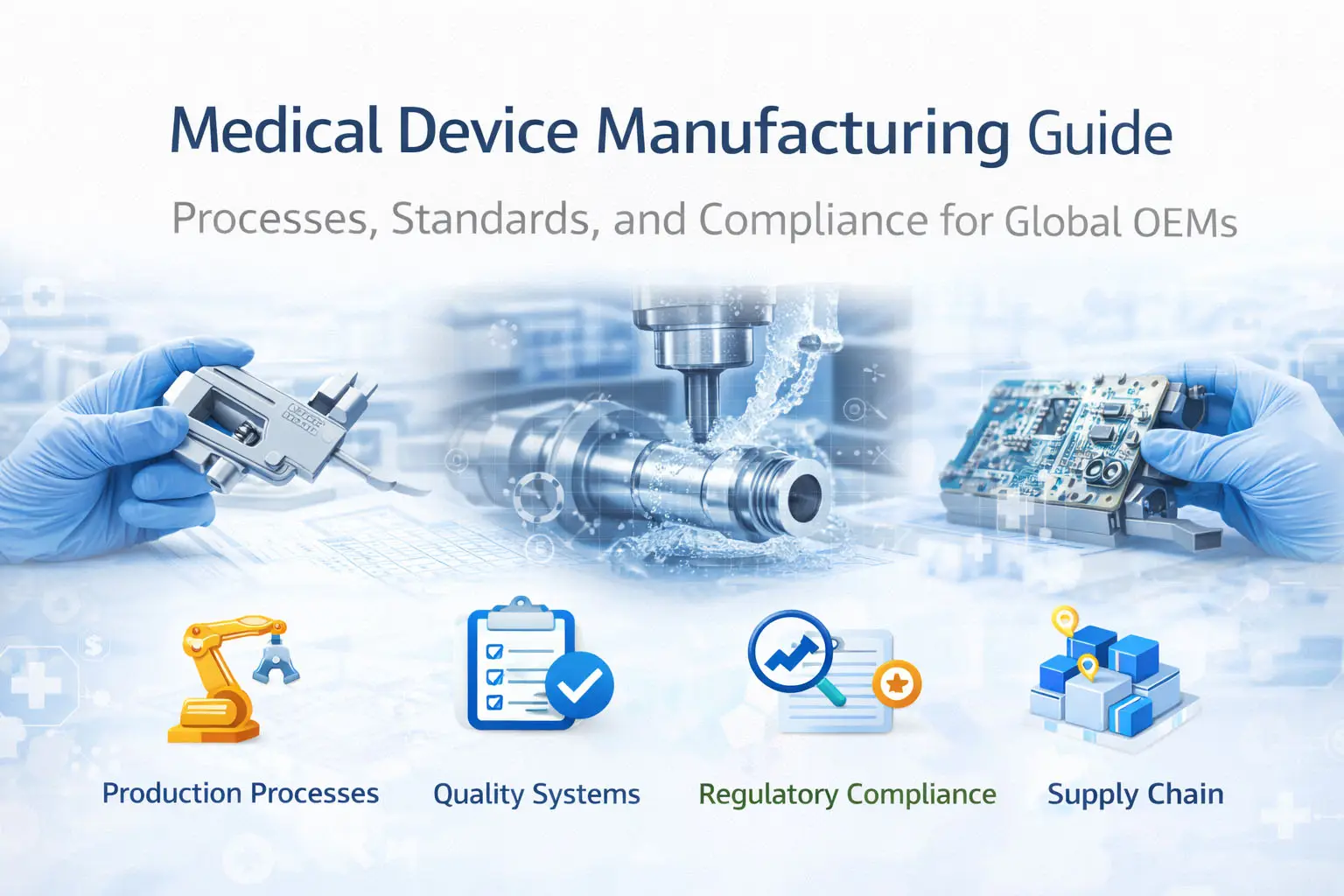
From simple disposables such as syringes to complex imaging systems and implantable technologies, every medical device has unique manufacturing requirements tailored to its risk, function, and clinical application. This guide explains what device manufacturing entails, major production methods, best practices, and compliance essentials that manufacturers and partners must understand for success.
What Is Medical Device Manufacturing?
Medical device manufacturing is defined as the end-to-end process of designing, engineering, assembling, testing, and delivering healthcare devices and instruments. These products serve countless clinical needs — from basic wound care to advanced diagnostics and surgical tools — and must meet clear regulatory and quality benchmarks before entering the market.
High complexity and life-critical applications distinguish medical manufacturing from general industrial production. Medical devices often feature multiple parts, specialized materials, precise tolerances, and integrated electronics — all of which require disciplined processes and traceability.
Key Manufacturing Processes
Medical device manufacturing spans numerous techniques, each suitable for different materials and functions. Common processes include:
Injection Molding and Precision Plastic Fabrication
Injection molding is one of the most widely used processes for producing medical-grade plastic components, such as housings, connectors, and disposable parts. By heating and injecting medical-grade polymers into molds, manufacturers achieve consistent shapes, high volumes, and tight tolerances — crucial for sterile components and repeatable performance.
This process supports materials like polyethylene, polypropylene, polycarbonate, and other medical-grade plastics resistant to sterilization processes and biocompatible environments.
Metal Fabrication & CNC Machining
Metal parts — such as structural supports, surgical instrument bodies, and implant components — are often fabricated through CNC machining, laser cutting, drilling, and milling. These methods enable high precision, tight tolerances, and repeatability, essential for products that interact with human tissue and must maintain mechanical integrity.
Assembly & Printed Circuit Board Integration
As electronics increasingly integrate into medical devices, printed circuit board assemblies (PCBAs) and intricate wiring are becoming core elements of many products. Manufacturing these assemblies involves strict quality standards due to their role in device operation and safety, particularly in diagnostic and monitoring systems.
Additive Manufacturing (3D Printing)
Additive manufacturing — or 3D printing — brings flexibility to medical device production, especially for prototype parts, customized components, and low-volume runs. It accelerates design iterations and supports geometries that traditional methods cannot easily achieve.
Human-Machine Interface (HMI) Integration
Many modern medical devices include touchscreens, displays, or operator interfaces that require careful selection, programming, and ergonomic design. HMIs are integrated during assembly and must be tested for reliability and usability under clinical conditions.
Regulatory Compliance and Quality Systems
Unlike most industrial products, medical devices are tightly regulated to ensure safety and effectiveness. Manufacturers must implement robust quality management systems (QMS) that govern every step of the manufacturing process.
ISO 13485 – International Quality Standard
ISO 13485 specifies requirements for a quality management system for medical device production. It provides a framework to ensure consistent design, development, manufacturing, and delivery of safe medical devices accepted in global markets.
FDA Quality System Regulation (QSR)
In the U.S., medical device manufacturing must comply with the FDA Quality System Regulation (21 CFR Part 820), which emphasizes design controls, recordkeeping, process validation, and traceability. These systems ensure that production processes are controlled and products are safe for clinical use.
Quality Assurance & Validation
Verification and quality assurance are integral to manufacturing. Medical devices must undergo rigorous testing to demonstrate that they meet performance specifications and regulatory requirements. Typical checks include:
• Dimensional and tolerance inspections
• Functional and performance testing
• Sterilization validation
• Biocompatibility and durability tests
Manufacturers often employ statistical process control and automated inspection technologies to detect defects early and maintain consistent production quality.
Documentation and Traceability
Medical device manufacturing demands thorough documentation at every stage — from design history files and raw material traceability to batch records and test results. Traceability allows manufacturers and regulators to track products through their lifecycle, facilitating recalls, audits, and compliance reviews.
Such documentation is also essential for regulatory submissions, quality audits, and post-market surveillance, aligning with both risk-based compliance and international best practices.
Supply Chain Considerations
Modern medical device manufacturing is supported by global supply chains. From precision components to specialized electronics, many parts are sourced internationally. Strong supply chain management ensures:
• Continuity of supply
• Quality consistency
• Compliance with regulatory standards
Global sourcing can create resilience, but also requires strict oversight and qualification of suppliers to meet medical quality standards.
Automation and Digital Manufacturing
Increasingly, medical device manufacturers are integrating automation, robotics, and digital systems into production. These systems improve precision, reduce manual variability, and support real-time monitoring of processes. Advanced Manufacturing Execution Systems (MES) help streamline workflows and ensure end-to-end traceability — a crucial factor in highly regulated production environments.
Future Trends in Medical Device Manufacturing
Looking ahead, several trends are shaping the future of medical manufacturing:
Advanced Materials
New materials such as bioresorbable polymers, advanced alloys, and antimicrobial coatings are expanding the functional capabilities of devices while improving patient outcomes.
Personalization
Tailored medical solutions — including patient-specific implants and custom diagnostic tools — are becoming more feasible with digital design and additive manufacturing technologies.
Data and Connectivity
Connected devices that integrate with digital health platforms and cloud systems are driving new value in diagnostics, monitoring, and remote care.
Conclusion
Medical device manufacturing is a complex, multidisciplinary discipline that combines precision engineering, regulatory compliance, quality systems, and advanced technologies. From customized surgical tools to high-tech electronics and integrated devices, every process component must satisfy strict standards to protect patient safety and enhance clinical performance.
For OEMs, suppliers, and healthcare manufacturers, understanding these fundamentals — and implementing proactive quality and compliance strategies — is essential to delivering products that meet global market expectations and regulatory requirements.
Submit Your Request
Recent Posts

Tags
- Adult Diapers
- Are custom medical devices safe
- Baby Diapers
- Can respiratory anesthesia be used
- Digital Healthcare
- Do you offer customized consumables
- European Market
- How do you take care of a skin wound
- Industry Trends
- Lady Sanitary Napkins
- Medical Devices
- OEM Medical Devices
- Product Introductions
- Protective Equipment
- Under Pads
- What are custom-made medical devices
- What are diagnostic products
- What are hospital dressing products
- What are medical tube catheters
- What are some common protective equipment
- What are the appropriate applications for hospital dressing products
- What are the appropriate uses for protective equipment
- What is a gynecological examination
- What is a medical consumable
- What is an anesthesia kit
- What is an OEM in medical devices
- what is an wound skin care
- what is can disposable ultrasonic diagnostic
- What is good manufacturing medical devices
- What is hospital-grade protective equipment
- what is medical equipments hospital furniture
- What is medical sterilization wrapping
- What is rehabilitation equipment device
- What medical consumables do you supply
- Where can I find laboratory consumables wholesale
- where can I find medical protection device
- where to buy hypodermic accessories
- where to buy medical apparel
- where to buy medical consumable accessories
- where to find OEM medical device supplier
- where to find rehabilitation equipment supplier
