



Medical Device Industry Statistics 2026: Market Size, Growth Trends & Key Insights


An authoritative overview of the global medical device industry — its scale, trends, regional dynamics, and future growth drivers
The medical device industry continues to be one of the most resilient and rapidly evolving sectors in global healthcare. Fueled by aging populations, rising chronic disease rates, technological advances, and healthcare digitalization, medical device demand has seen strong growth across diagnostics, therapeutic technologies, and surgical instruments.
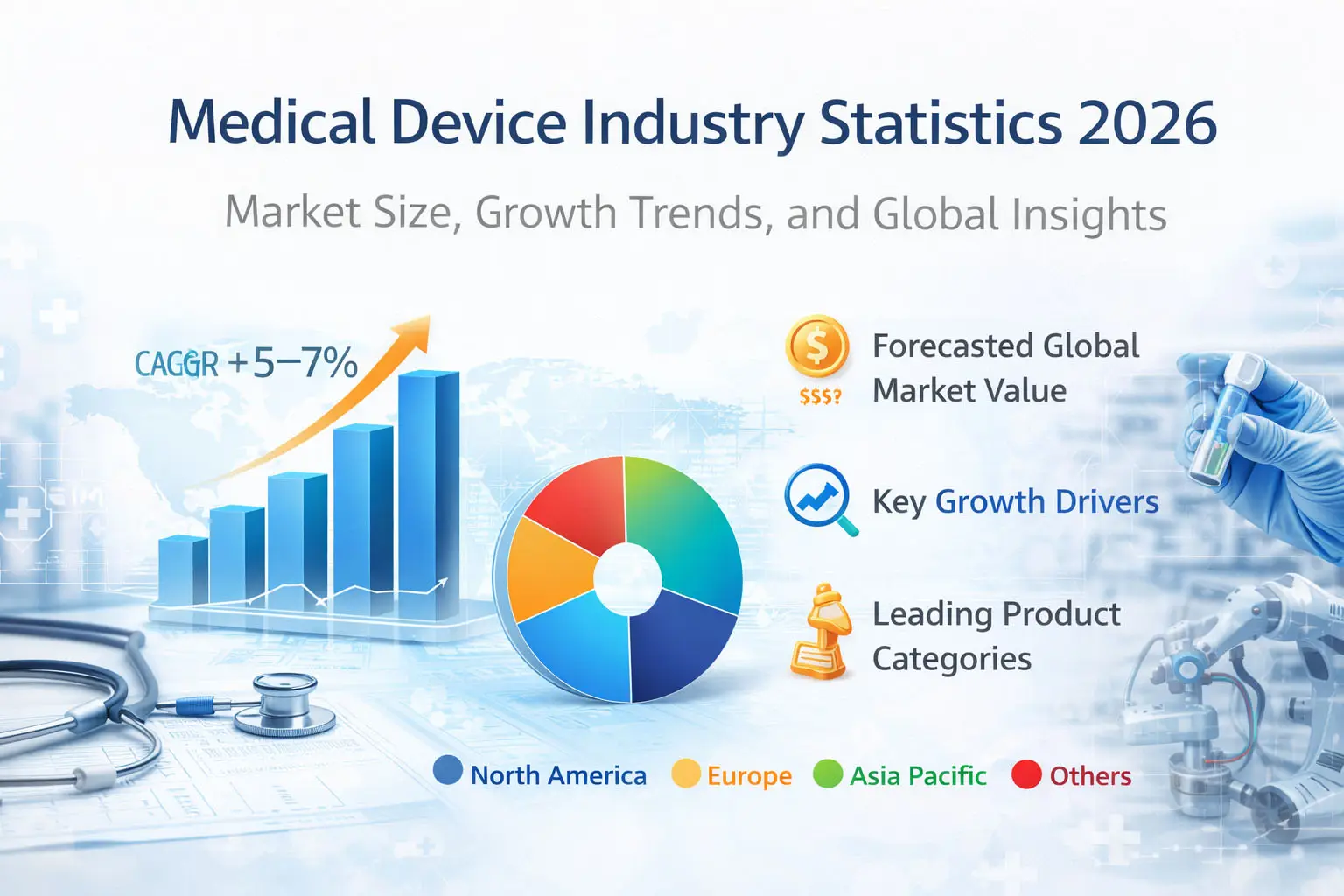
For manufacturers, suppliers, and OEM partners, understanding the latest industry statistics — including market size, country-level insights, and leading subsectors — is essential to strategic planning, R&D investment, and global market entry.
In this article, we explore key statistics and trends that define the medical device landscape in 2026 and beyond.
Global Market Size and Growth
The global medical device market has been expanding steadily over the past decade. From wearable health monitors to advanced imaging systems and implantable technologies, almost every segment is projected to grow in the mid- to high-single digits annually.
Current Market Value
As of the latest available data:
• The global medical device market is valued at hundreds of billions of USD annually, with continued expansion expected through 2030.
• Growth is driven by increased healthcare spending, technological innovation, and aging populations worldwide.
Annual growth rates vary by region and product category, but overall industry forecasts show compound annual growth rates (CAGR) in the 5–7% range, reflecting robust sector health despite economic uncertainties.
Regional Market Insights
Medical device industry growth is unevenly distributed across global regions. Differences in healthcare systems, regulatory environments, and spending patterns influence where demand rises fastest.
North America
North America — particularly the United States — remains the largest medical device market in the world. Key factors include:
• High per-capita healthcare expenditure
• Established payer systems
• Strong clinical infrastructure
• Rapid uptake of new technologies
The U.S. market alone accounts for a significant share of global device sales, including implants, diagnostics, surgical tools, and digital health solutions. Regulatory clarity from the FDA also gives manufacturers predictable pathways for market entry.
Europe
Europe is another major region, with demand driven by public healthcare systems and strong government reimbursement frameworks. Countries like Germany, France, the U.K., and Italy feature prominently due to aging populations and high utilization of diagnostic and therapeutic technologies.
European markets tend to prioritize cost-effective and evidence-backed innovations, which creates opportunities for manufacturers with strong clinical data and health economic evidence.
Asia Pacific
The Asia Pacific region is one of the fastest-growing markets, propelled by expanding healthcare infrastructure, rising middle-class demand, and increased chronic disease prevalence. China, India, Japan, and South Korea are key contributors.
In China, ongoing reforms in medical insurance coverage and local manufacturing incentives have accelerated device adoption across hospitals and clinics. Emerging economies in Southeast Asia and Central Asia also show rising investment in medical technologies.
Latin America and Middle East/Africa
Markets in Latin America and the Middle East & Africa are smaller by comparison but exhibit growth potential. Government initiatives to improve healthcare access, increased public-private partnerships, and disease burden reduction programs create upward pressure on device demand.
Leading Product Categories
Medical device industry growth is not uniform across all categories. Some segments show stronger expansion due to specific clinical and demographic drivers.
Diagnostic Imaging and Monitoring Equipment
Diagnostics — especially imaging technologies like MRI, CT, ultrasound, and point-of-care testing devices — remain key growth areas. Aging populations with chronic conditions such as cardiovascular disease and cancer have increased the need for early disease detection and monitoring.
Point-of-care (POC) diagnostics, driven by innovation in digital sensors and data connectivity, also see adoption in outpatient settings and remote care models.
Surgical Instruments and Robotics
Advanced surgical tools, minimally invasive systems, and robotic surgery platforms are redefining operating room capabilities. Growth in this segment reflects the demand for precision, shorter hospital stays, and improved patient outcomes.
Wearable & Connected Health Devices
Wearable health monitors, continuous glucose monitors, and connected sensors that integrate with mobile platforms are among the fastest-growing categories. Consumer-led health tracking combined with clinical applications creates dual demand from patients and providers.
Implantable Devices
Cardiovascular implants, orthopedic prosthetics, and neuromodulation systems continue to grow as implantable technologies evolve with better biocompatibility and longer service life. Research-intensive investment in these areas supports sustained growth.
Innovation & Technology Trends
Technology is one of the most transformational forces reshaping the medical device industry today.
Artificial Intelligence and Machine Learning
AI and machine learning algorithms are being integrated into diagnostics, radiology workflows, and device data analytics. These technologies can enhance accuracy, streamline interpretation, and support personalized care pathways.
3D Printing and Rapid Prototyping
Additive manufacturing — especially 3D printing of medical components — accelerates design iteration and customization. Medical OEMs use rapid prototyping to compress development timelines, test new concepts, and produce complex geometries not feasible with traditional manufacturing.
Digital Health and Telemedicine Integration
Digital health platforms, patient engagement tools, and telemedicine integration are driving demand for connected devices that can transmit data securely and integrate with electronic health records (EHR).
Material Science Advances
New materials — from bioresorbable polymers to advanced alloys — are enabling safer, more durable, and more biocompatible devices. Materials science directly influences device performance and regulatory acceptance.
Workforce & Talent Statistics
As medical device manufacturing becomes more complex, workforce skills are shifting. Key insights include:
• Increased demand for engineers with expertise in software, data analytics, and systems integration
• Growth in interdisciplinary teams combining clinical, regulatory, and design expertise
• Importance of quality and compliance professionals to navigate international regulations
Manufacturers with strong internal training and talent development programs are better positioned to adapt to evolving requirements and technological change.
Regulatory Landscape & Submission Trends
Regulatory requirements vary widely, but recent trends show convergence around risk-based frameworks and post-market surveillance. In major markets:
• FDA (U.S.) continues to refine device classification and evidence expectations
• EU MDR places stronger emphasis on clinical data and quality management systems
• China’s NMPA streamlines approval pathways while targeting higher local innovation
Manufacturers increasingly invest in regulatory intelligence and early strategy planning to reduce time to market and improve approval predictability.
Market Challenges & Growth Drivers
Despite solid growth, the industry faces several challenges:
Supply Chain Disruptions
Global supply chain issues — including material shortages and logistics constraints — have impacted production and delivery cycles. Many manufacturers are adopting localized sourcing and diversified supply networks to enhance resilience.
Cost Pressures & Reimbursement Policies
Healthcare payers in mature markets are increasingly focused on cost-effectiveness, requiring stronger evidence for new therapies and technologies. Manufacturers need robust health economic data to support pricing and reimbursement discussions.
Cybersecurity and Data Privacy
Connected medical devices bring new cybersecurity and privacy challenges. Compliance with evolving security standards — such as those required in the U.S., EU, and Asia — is now fundamental for device approval and market trust.
Future Outlook to 2030
Looking forward, the medical device industry is expected to maintain positive growth momentum. Key future drivers include:
• Aging global population and chronic disease burden
• Expansion of home-based and remote care technologies
• Increased adoption of AI, digital biomarkers, and predictive analytics
• Greater emphasis on personalized and precision therapies
These trends not only expand the addressable market for medical devices but also create opportunities for differentiated innovation and higher-value solutions.
Conclusion: Strategic Implications for OEMs
Understanding the latest medical device industry statistics equips manufacturers and OEM partners with insights essential for growth and competitiveness. Market dynamics, technology shifts, and regulatory complexity together define where opportunities and risks lie.
For companies like Greetmed, leveraging data-driven strategies, investing in innovation, and aligning with global regulatory best practices will be critical to successfully navigating the next decade of healthcare transformation.
Submit Your Request
Recent Posts


Tags
- Adult Diapers
- Are custom medical devices safe
- Baby Diapers
- Can respiratory anesthesia be used
- Digital Healthcare
- Do you offer customized consumables
- European Market
- How do you take care of a skin wound
- Industry Trends
- Lady Sanitary Napkins
- Medical Devices
- OEM Medical Devices
- Product Introductions
- Protective Equipment
- Under Pads
- What are custom-made medical devices
- What are diagnostic products
- What are hospital dressing products
- What are medical tube catheters
- What are some common protective equipment
- What are the appropriate applications for hospital dressing products
- What are the appropriate uses for protective equipment
- What is a gynecological examination
- What is a medical consumable
- What is an anesthesia kit
- What is an OEM in medical devices
- what is an wound skin care
- what is can disposable ultrasonic diagnostic
- What is good manufacturing medical devices
- What is hospital-grade protective equipment
- what is medical equipments hospital furniture
- What is medical sterilization wrapping
- What is rehabilitation equipment device
- What medical consumables do you supply
- Where can I find laboratory consumables wholesale
- where can I find medical protection device
- where to buy hypodermic accessories
- where to buy medical apparel
- where to buy medical consumable accessories
- where to find OEM medical device supplier
- where to find rehabilitation equipment supplier
