



High Pressure Syringe Connection Accessories: Y/T/Low Selection Guide


Tubing Accessories are essential to safely and effectively apply contrast in diagnostic imaging and therapies. Connection Tubing are the links between the High Pressure Syringe Systems and the patient, carrying pressurized contrast and saline. The choice of Y-Type Tubing, T-Type Tubing, and Low-Pressure Connector Tubing can impede workflow, safety, and ultimately, image quality.
Here we detail the types of connection tubing, their associated clinical applications, and selection criteria to assist imaging departments in making better and informed choices.
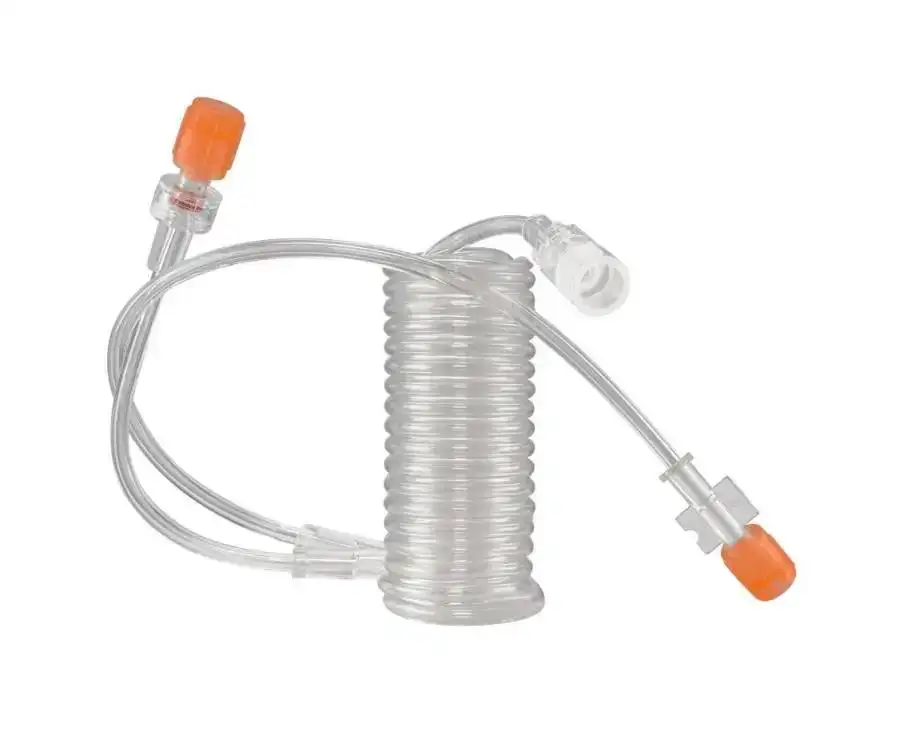
Why High-Pressure Injection System Connection Tubing Matters
Connection Tubing is a transport medium, but not in the traditional sense, because it must be efficient in flow and sterile under high pressure. Connection Tubing has a distinction of being either single or multi-lumen in relation to the accessories of the Syringe System. Multi-lumen connection tubing is further classified as either Y-Type or T-Type Tubing.
Connection tubing is responsible for:
• Transporting high pressure flow of contrast media from the High Pressure Syringe to the patient
• Maintaining pressure integrity and stability
• Sealing against disconnections and minimizing the risk of air embolisms
• Switching from one medium to the other in dual syringe systems
Different imaging systems demand different requirements of connection tubing. High Pressure Syringes for CT and MRI systems are designed for tubing rated at 300-350 psi. Turbo scans require even higher rated tubing. Most interventional angiographic systems and DSA procedures require tubing rated at 900-1,200 psi, with reinforced designs.
Y-Type Connector Tubing: The Dual-Syringe Standard
Y-Type connector tubing is the most common type of dual-head High Pressure Syringe Systems. As the name implies, the Y-Types connector incorporates a junction with three ports, whereby two separate pathways converge with a single patient line.
Main applications:
• Dual-syringe CT injectors (e.g., MEDRAD STELLANT Dual Shot)
• MRI systems with 65ml / 115ml dual configuration (e.g., MEDRAD SOLARIS & SPECTRIS)
• Procedures that require an alternation of contrast and saline with the connectors staying in-line
Common specifications in GT211 series:
• GT211-100100C: 115ml / 65ml with 255cm Y-Type connect tubing
• GT211-10060A: 65ml / 65ml with 255cm Y-Type connect tubing
• GT211-100200B2: 200ml / 200ml for MEDRAD STELLANT Dual Shot
Length options:
• 150cm Y-Type tubing: Compact CT suites with the injector positioned close to the patient
• 255cm Y-Type tubing: Larger suites with the injector positioned farther away from the scanning table
Check valves:
• Single check valve: Adequate for most routine imaging
• Double check valve: Valve redundancy is ideal for higher volume contrast injections (greater than 50ml) and higher risk patients
Greetmed GT211 Series Y-Type Connector Tubing has been designed with a 300 PSI pressure rating and is manufactured with 150cm and 255cm length options for CT and MRI dual-head injectors.
T-Type Connector Tubing: A Multi-Pathway Alternative
In contrast to Y-Type Tubing, T-Type Connector Tubing has a different branching structure. T-Type Tubing has a T-shaped piping pattern because it has a perpendicular branch instead of a Y-branch.
Main features:
• Incorporates a side branch that is perpendicular to the primary flow branch.
• Tailored to specific injection systems and workflows.
• Most suitable for designs which differentiate the primary and secondary fluid branches.
Typical use:
• Compatible with MEDRAD MARKV MCT PLUS CT
• Compatible with IMAXEON Salient and MEDRAD VISTRON CT
• Offered in T-Type and TF-Type in single and multi-lumen.
GT211 Series T-Type Tubing:
• GT211-10060B: 60 ml syringe with T-Type for MEDRAD MARKV MCT PLUS CT.
• GT211-100100B: 100 ml syringe for MCT PLUS CT and IMAXEON Salient.
• GT211-100200F: 190 ml for MEDRAD VISTRON CT and MEDRAD ENVISION CT.
Low-Pressure Connector Tubing
Not all contrast delivery systems need to utilize High Pressure rated Tubing. In case of a moderate pressure system, the key factors may be the cost, flexibility and easy handling of the Tubing. Low-Pressure Connector Tubing can meet these requirements.
Common uses include:
• MRI with slow flow rates
• Ultrasound contrast
• When the HS operates below 300 psi
Differences from high-pressure tubing:
• Lower pressure ratings R typically below 300 psi
• Can use different materials and wall thickness
• Most often flexible and easier to route
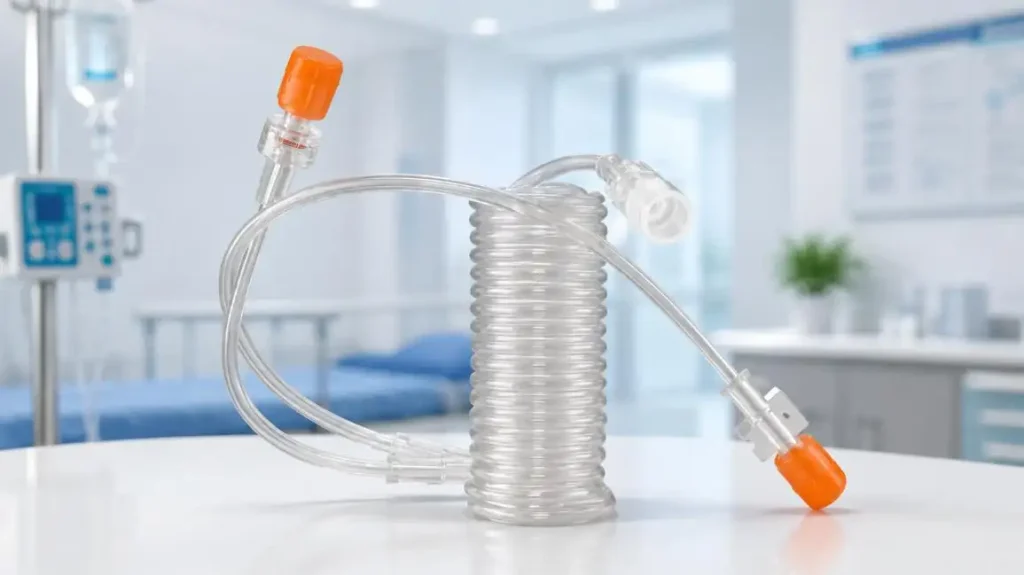
�� Use caution: when used for CT contrast injections, tubing rated below 300 psi is capable of an unpredictable system failure of ruptures and micro leaks at peak flow. Newer CTs demand 300 psi as the minimum to quickly achieve the desired bolus. Always ensure the tubing can withstand the same pressure as the injector.
Factors to Consider When Choosing Connection Tubing
When selecting connection tubing as part of syringe accessories, you will need to take the following into account:
1. Compatibility to the injector platform
Select the correct tubing type to the correct model of injector. For example:
• For MEDRAD SOLARIS & SPECTRIS, use 255 cm Y-Type with 65 ml/115 ml syringes
• For MEDRAD STELLANT Single Shot use 200 ml with 150 cm CT connect tubing
• For MEDRAD STELLANT Dual Shot use 200 ml/200 ml with Y-Type tubing
• For MEDRAD MARKV MCT PLUS CT use 60 ml or 100 ml with T-Type syringes
2. Pressure rating
•For CT/MRI the standard is 300 psi
•For DSA/angiography the standard is 900–1,200 psi requiring reinforced materials
•Always check the connection tube maximum pressure rating
3. Tubing length
•150 cm tubing is usually optimal for standard applications
•255 cm tubing is useful for larger or dual room applications
4. Check valve configuration
•Single check valves are typical
•Double check valves are used for higher risk applications
5. Sterility and regulatory compliance
•Look for Ethylene Oxide (EO) sterilization and certification as sterile and pyrogen free
•Check compliance to ISO 80369-7 to prevent misconnections
•Also check for FDA 510(k) and CE designation
Greetmed's Engineering Solutions for Connection Tubing
Greetmed's GT211 series of syringe accessories emphasizes clinical utility with precision manufacturing. Greetmed does not view syringes, tubing and spikes as separate entities. Rather they are viewed as a single integrated fluid pathway.
Advantages of Greetmed GT211 Series Tubing
•300 PSI Pressure Rating: Satisfies the minimum standard for contemporary CT contrast injection systems for flow stability at maximum system pressures.
•Kink Resistant: Maintains lumen patency during patient movement.
•Clear Walls: Due to its construction, tubing permits detection of any bubbles and evaluation of free flow prior to the injection process.
•Luer-Lock Connectors: Guarantees connection will not leak no matter the amount of tension applied.
•Platform Agnostic: Full compatibility with the major injector systems is designed to enhance the ease of procurement and availability while addressing compatibility issues.
•Length Options: Available in tubing length options of 150cm and 255cm.
•Single and Double Check Valve Options: Provides selection for different degrees of backflow protection.
Closing Words
When selecting High Pressure Syringe connection tubing (Y-Type, T-Type, or Low-Pressure), consider the effect on safety and image quality and the effect on the workflow. The Y-Type is ideal for dual-syringe CT/MRI, where switching of contrast and saline is done in a rapid manner. The T-Type is designed for particular types of injectors, while the Low-Pressure tubing is designed for low-demand applications. Besides the technical characteristics, think about the practical component of how easy the setup is and how well the system integrates with the injectors. The GT211 Series from Greetmed features 300 PSI tubing with check-valve options and is designed for a wide range of compatibility. Different types of tubing provide the means for departments to centralize the inventory of Syringe Accessories and achieve a higher level of safety in contrast delivery.
FAQs
Q: What differentiates Y-Type from T-Type tubing?
A: Y-Type assemblies have Y-shaped junctions and T-Type assemblies have perpendicular junctions. Y-Type assemblies are most frequently used in dual-syringe CT/MRI systems, and T-Type assemblies are used in injectors like MEDRAD MARKV MCT PLUS.
Q: What's the pressure rating I should look for with CT injections?
A: For CT and MRI standard pressure, tubing should be rated at 300 psi. For interventional angiography, a rating of 900–1,200 psi is needed.
Q: What length should I choose, 150cm or 255cm?
A: 150cm is sufficient for compact areas with the injector located close to the patient. 255cm is suitable for larger areas where the injector is positioned even further from the patient.
Q: Do these connection tubings work with MEDRAD injectors?
A: Yes. GT211 series connection tubing is designed to work with MEDRAD SOLARIS, SPECTRIS, STELLANT, MARKV MCT PLUS, VISTRON CT, ENVISION CT, and IMAXEON Salient Systems.
Q: What is the difference between "single check valve" and "double check valve"?
A: A single check valve allows flow in only one direction with no backflow. A double check valve adds a second system of check valve. This is recommended for large volume injections with a higher risk patient.
Submit Your Request
Recent Posts

Tags
- Adult Diapers
- Are custom medical devices safe
- Baby Diapers
- Can respiratory anesthesia be used
- Digital Healthcare
- Do you offer customized consumables
- European Market
- How do you take care of a skin wound
- Industry Trends
- Lady Sanitary Napkins
- Medical Devices
- OEM Medical Devices
- Product Introductions
- Protective Equipment
- Under Pads
- What are custom-made medical devices
- What are diagnostic products
- What are hospital dressing products
- What are medical tube catheters
- What are some common protective equipment
- What are the appropriate applications for hospital dressing products
- What are the appropriate uses for protective equipment
- What is a gynecological examination
- What is a medical consumable
- What is an anesthesia kit
- What is an OEM in medical devices
- what is an wound skin care
- what is can disposable ultrasonic diagnostic
- What is good manufacturing medical devices
- What is hospital-grade protective equipment
- what is medical equipments hospital furniture
- What is medical sterilization wrapping
- What is rehabilitation equipment device
- What medical consumables do you supply
- Where can I find laboratory consumables wholesale
- where can I find medical protection device
- where to buy hypodermic accessories
- where to buy medical apparel
- where to buy medical consumable accessories
- where to find OEM medical device supplier
- where to find rehabilitation equipment supplier
