



Hemodialysis Catheter Kit: A Complete Component Breakdown


A hemodialysis catheter kit is a sterile, single-use, bundled set of devices designed to establish temporary vascular access for hemodialysis, typically integrating the catheter body with insertion, fixation, flushing, and basic dressing components in one standardized package. For clinicians, the difference between a smooth procedure and a complicated one often comes down to whether the catheter kits they use are well-integrated. Mismatched components remain one of the top causes of delays in procedures, increased infection risk, and contamination.
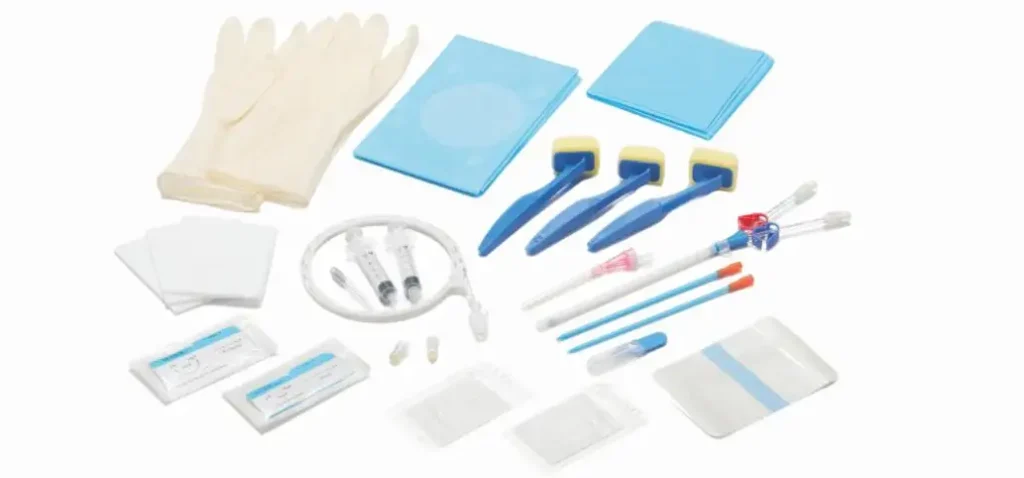
This article provides a complete visual and functional breakdown of the Hemodialysis Catheter Kit GT212-01 from Greetmed—walking through every component, its purpose, and the technical design advantages that make this kit a practical choice for short-term dialysis access.
The Core Principle: Technical Integration Over Component Count
A well-designed Catheter kit contains well-integrated engineered assemblies from guide wire to sterile drape. Mismatch of components is a challenge with GT212-01 but the technical integration challenge is designed into the product. We specify, test, and manufacture every single component to work seamlessly with each other.
Integration vs parts:
• Guide wire stiffness can make catheter placement more difficult and more dangerous.
• Not having a dilator that matches the size with the vessel can cause injury to the vessel and dilation can fail.
• Drapes that are inadequate break the sterile field and increases risk of infection.
Thanks to Greetmed's pre-validated technical integration, the risk is removed by having every component functionally compatible.
Component-by-Component Breakdown
1. The Hemodialysis Catheter (2-11.5Fr × 13cm / 15cm / 20cm)
The catheter is the centerpiece of any catheter kits. The GT212-01 uses medical-grade polyurethane (TPU)—a material chosen for two clinically essential behaviors that seem contradictory.
Material engineering advantages:
• Room temperature rigidity: The catheter maintains sufficient stiffness for percutaneous insertion without buckling, even through tough subcutaneous tissue.
• Body temperature auto-softening: Once placed (at 37°C), the catheter becomes more pliable, reducing vessel wall irritation and patient discomfort during dwell. Here for comparison are some properties of polyurethane as compared to silicone.
• Scientific Hole Cavity Design: This gives excellent stiffness to prevent kinking with patient movement. Additionally, it helps reduce turbulent flow and pressure drops.
• Bloodflow rate consistency: This allows for flow rates above 300 mL/min and a minimal negative impact on arterial pressure. This leads to fewer flow alarms and a decreased treatment time.
• Designed for short-term use: Ideal for ≤30 days, this is justifiable for the case of Acute Kidney Injury for temporary access while the AV fistula is maturing or for Inpatient Hemodialysis.
Available size configurations:
• 2-8.5Fr × 13cm
• 2-8.5Fr × 15cm
• 2-11.5Fr × 13cm
• 2-11.5Fr × 15cm
• 2-11.5Fr × 20cm
2. Guide Wire (0.035″ / 3560, 3.3mm & 3.8mm)
The successful placement of a hemodialysis catheter begins with the guide wire.
Key design features:
• Nickel-titanium alloy core: Excellent control of torque combined with great flexibility.
• Hydrophilic coating: lessens friction to decrease trauma to the vessels.
• Dual diameter options: 3.3mm and 3.8mm offer flexibility to vessel diameters.
3. Y-Type Needle (18G)
The first point of access to the vascular system.
Design advantages:
• Precision tip: Makes venipuncture easier and allows clean venipucture and less cored tissue with less damage to the endothelium.
• Y-Adapter design: Allows user to inject contrast or conduct pressure measurement prior to wire insertion.
4. Dilator Set (3.3mm & 3.8mm)
Used to prepare the vessels and tissues for the tract where the catheter is going to be inserted.
• Engineering Precision
• Mathematical symmetry of guide wire and dilator taper angle: There is no step off effect injury.
• Radiopaque tip: Shows the current position of the dilator during fluoroscopy.
5. Suture needles with thread (3 pieces)
• Used for securing the catheter after insertion.
6. Disposable Sterile Rubber Surgical Gloves (1 pair)
• Helps to ensure aseptic technique is followed.
7. Disinfection Brush (3 pieces, 7.58 curved)
• Post insertion of the catheter, it decreases skin flora and the chances of infection.
8. Medical Gauze (3 pieces, 10cm × 8cm × 8 layers)
• Purpose: Dressing a wound that absorbs small amounts of blood post and during the procedure.
9. Aperture Drape & Treatment Drape (60cm × 60cm × 10cm)
• Purpose: A drape that aids in the establishment and maintenance of a sterile field at the site of the aperture. This drape is one of the key control measures for infection in a dialysis situation, and is compliant with CDC recommendations.
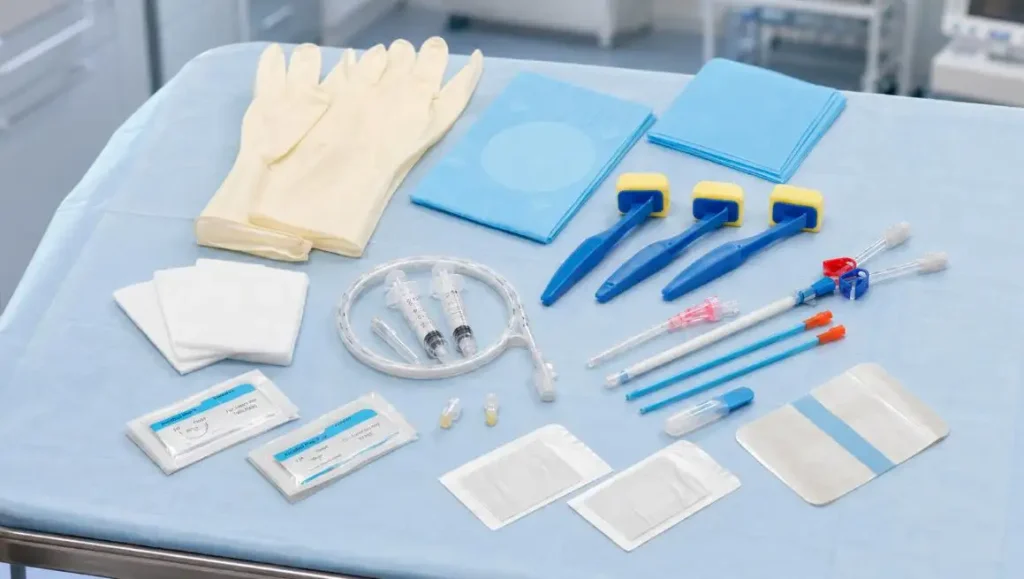
10. Disposable Sterile Syringe (5ml Luer-lock, 5ml Slip-tip)
• Uses: Flushing catheter lumens, blood aspiration, and the injection of local anesthetics.
11. Disposable Sterile Injection Needle (7G)
• Uses: Injection of local anesthetics and/or medication.
12. Surgical Scalpel
• Uses: Incising skin to allow catheter placement.
13. Dressing Pad (5cm x 7cm) & Surgical Drape Film (13cm x 9cm)
• Uses: Securing dressing coverings over the site after catheter insertion.
14. Heparin Cap (2 pieces)
• Uses: Securing catheter lumens closed between dialysis sessions to maintain patency and to prevent thrombus formation in the catheter.
15. Wrapping Cloth (75cm x 90cm)
• Uses: Wrapping the entire kit contents to maintain sterility until the moment of use.
Flow Design: Engineering That Reduces Resistance
Concerns with flow performance are one of the key factors in the selection of dialysis access products. In the GT212-01, incorporated flow design of the catheter uses a scientific hole cavity, a specific arrangement of lumen structure and holes.
Low Resistance Design Benefits
Flow is improved as a design with low friction also has low resistance.
Flow behaviors are improved, because low friction design minimizes the issues of negative pressure such as erratic flow, unreliable flow alarms, and reduces the amount of troubleshooting.
• Improving flow: This concept allows for a closer approximation of the intended flow behavior during typical dialysis.
• Rigidity vs. Flow: This design attends to rigidity to avoid kinking and friction flow.
What Benefits are Gained from a Complete Kit?
The advantages a complete convenience kit in hemodialysis kits provide after presenting a sterile, integrated, and complete system include:
• Reduced Preparation Time: There is no need to buy modules separately.
• Decreased Risks of Infection: Components will remain safe and sterile in a sealed system.
• Improved Workflow: Components of the kits behave in a manner that results in a predictable flow.
• Simplified Inventory: One SKU (stock-keeping unit) is required as opposed to multiple SKUs.
Clinical Applications
The GT212-01 is perfect for short-term indwelling (>30 days) and is ideal for:
• Emergent dialysis due to acute kidney injury
• Temporary access to a dialysis during the maturation of a vascular access AV fistula
• Inpatient dialysis during a hospital stay
• Temporary access to a long-term solution
As a clinician and as a procurement professional, having knowledge and understanding of catheter components enables you to select the best option for patient outcomes and clinical efficiency. The GT212-01 exemplifies the seamless integration of design and function from each component of a catheter kit from the guide wire to the preparation drapes.
FAQs
Q: Why is polyurethane favored over silicone in this kit?
A: Silicone becomes more compliant when body temperature rises, whereas polyurethane keeps its rigid structure at room temperature, which aids in catheter insertion, and becomes compliant at body temperature.
Q: How does one determine the appropriate catheter size (Fr and length)?
A: This depends on the patient's anatomy and the catheter insertion site. The kit provides options for this at 8.5Fr and 11.5Fr with 13, 15, and 20 cm length options.
Q: Is the guide wire part of the kit?
A: A 0.035″ guide wire is part of the kit and is provided in two vessel matching diameters of 3.3mm and 3.8mm.
Q: Are all the components necessary to perform a complete insertion procedure part of the kit?
A: Yes. The kit has everything from gloves, drapes, and a scalpel, to syringes, sutures and heparin caps. There is nothing else required.
Q: Is the kit sterile and ready for use out of the box?
A: Yes, all the items in the kit are sterile and ready for single use.
Submit Your Request
Recent Posts

Tags
- Adult Diapers
- Are custom medical devices safe
- Baby Diapers
- Can respiratory anesthesia be used
- Digital Healthcare
- Do you offer customized consumables
- European Market
- How do you take care of a skin wound
- Industry Trends
- Lady Sanitary Napkins
- Medical Devices
- OEM Medical Devices
- Product Introductions
- Protective Equipment
- Under Pads
- What are custom-made medical devices
- What are diagnostic products
- What are hospital dressing products
- What are medical tube catheters
- What are some common protective equipment
- What are the appropriate applications for hospital dressing products
- What are the appropriate uses for protective equipment
- What is a gynecological examination
- What is a medical consumable
- What is an anesthesia kit
- What is an OEM in medical devices
- what is an wound skin care
- what is can disposable ultrasonic diagnostic
- What is good manufacturing medical devices
- What is hospital-grade protective equipment
- what is medical equipments hospital furniture
- What is medical sterilization wrapping
- What is rehabilitation equipment device
- What medical consumables do you supply
- Where can I find laboratory consumables wholesale
- where can I find medical protection device
- where to buy hypodermic accessories
- where to buy medical apparel
- where to buy medical consumable accessories
- where to find OEM medical device supplier
- where to find rehabilitation equipment supplier
