



CVC Kit: What's Inside, Sterility Basics, and Safe Workflow


CVC Kit is one of the most widely used sterile procedure sets for central venous access, because it brings multiple critical components into one controlled, ready-to-use workflow. From Greetmed's manufacturing perspective, the goal is simple: help clinical teams and buyers reduce variation, protect sterility, and make daily operation more repeatable across wards, shifts, and sites.
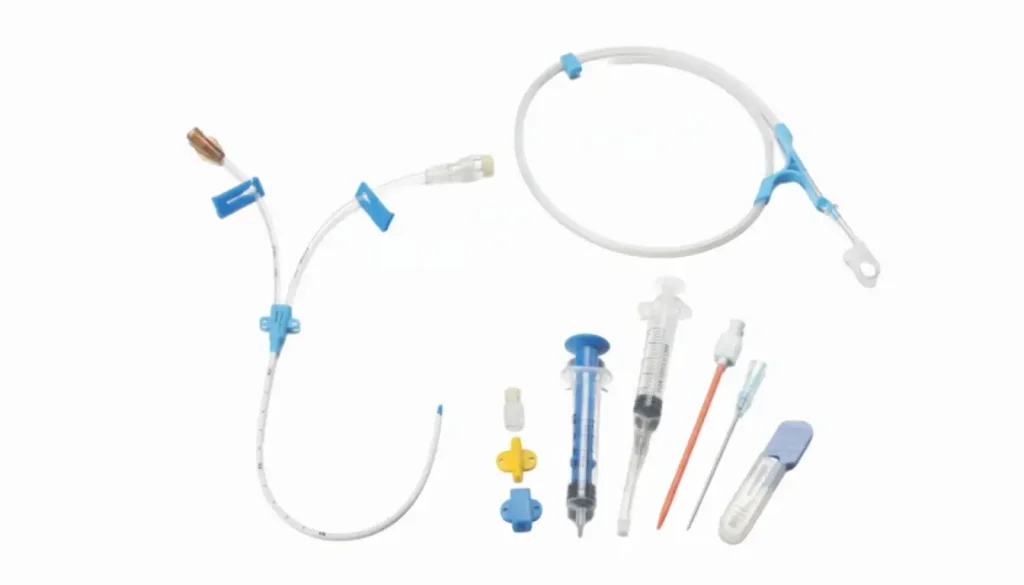
1) What a CVC Kit Does and Why "Set Thinking" Matters
A Central Venous Catheter is not a single item in real practice. It is a sequence: puncture, guidewire placement, track preparation, catheter insertion, fixation, and secure closure. If even one step is slowed down by unclear labeling or unstable connection, the whole workflow becomes harder to standardize.
A well-designed CVC Kit supports a "set logic": every component is selected to match the procedure flow, and every connection point is designed to reduce avoidable errors. For distributors and hospitals, this matters because standardized sets simplify training, purchasing, and inventory management. You are not just buying parts. You are buying repeatability.
2) What's Inside a Standard CVC Kit
Different tenders and protocols may request different combinations, but a standard Greetmed CVC Kit package typically includes the core items needed to complete the access pathway:
✓ Catheter (1 pc): the main central line component
✓ Guide Wire (1 pc): supports safe catheter placement through a controlled path
✓ Dilator (1 pc): helps prepare the track for smooth advancement
✓ Introducer Needle / Y-Shaped Needle (0/1 pc): depends on procedure preference
✓ Catheter Clamp (1 pc): supports temporary flow control and secure management
✓ Rigid Fastener (1 pc): supports fixation and stability during handling
✓ Blue Introducer Syringe (0/1 pc): optional per kit structure
✓ Heparin Cap (1/2/3 pcs): quantity depends on lumen design and routine
✓ Stanch Clip (1/2/3 pcs): supports line organization and daily management
✓ Syringe (1/2 pcs): practical for flushing and preparation routines
✓ Scalpel (1 pc) and Injection Needle (1 pc): supports standard procedural steps
As a buyer, the most practical question is not "How many pieces are included?" but "Does this CVC Kit match our workflow and training habits?" A good set mirrors what your clinicians already do, so the kit supports them instead of forcing them to adapt.
3) Catheter Material and Visibility: Safety Is Often in the Details
The catheter itself is where design choices directly affect clinical confidence. Greetmed's catheter design focuses on safety and handling clarity.
First, latex-free material reduces allergy-related risk and supports broader patient safety requirements. Second, excellent radiopacity improves visibility under imaging, helping clinicians confirm position with more confidence during and after insertion. Better visibility reduces the "guessing moments" that slow procedures.
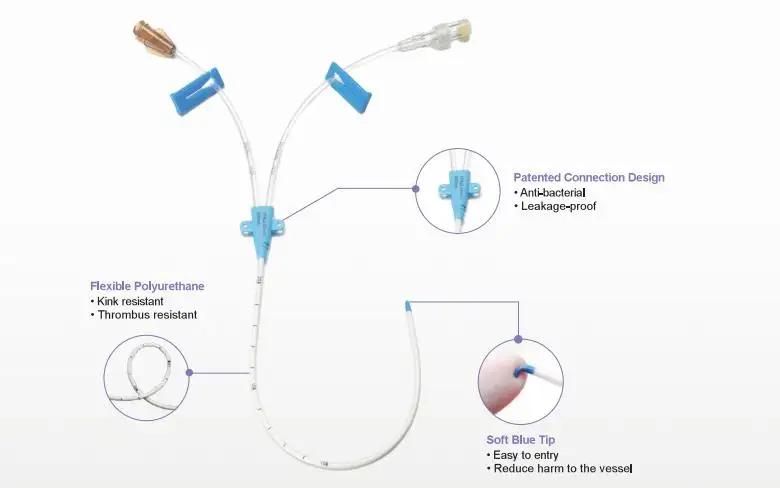
The catheter also uses a soft blue tip, designed to support easier entry while reducing vessel harm. In practice, smoother entry can mean fewer repeated adjustments at the puncture point. That supports a more stable experience for both clinicians and patients.
4) Connection and Extension Management: Preventing Leakage and Avoidable Exposure
Many catheter issues do not start at the catheter body. They start at the connector, extension, and daily handling points. That is why the CVC Kit design must treat connection security as a workflow feature, not just a mechanical feature.
Greetmed uses a patented connector design that is smooth and firm. For buyers, this translates into practical outcomes: fewer connection-related disruptions, reduced leakage risk, and lower chance of shedding during routine handling. In daily catheter management, stable connectors protect staff time and protect patient safety.
Extension lines matter as well. Transparent extension tubes improve visual checks, while detachable clamps and printed marks help teams maintain the catheter away from the insertion site. This supports cleaner management and can reduce accidental tugging or contact at the most sensitive area. It also helps reduce the risk of air embolism, because the workflow becomes clearer and easier to control when the line is organized and clamped correctly.
5) Guidewire Performance and "Anti-Kink" Control in Real Procedures
A guidewire must support controlled advancement, especially when the clinical situation is not perfect. In a CVC Kit, the guidewire is not just an accessory. It is the route that determines whether placement feels smooth or stressful.
The anti-kink guidewire with increased flexibility is designed to resist unwanted bending while still supporting controlled navigation. For procurement teams, the benefit is less variation between operators. For clinicians, the benefit is a more predictable feel and fewer interruptions during advancement. When guidewire behavior is stable, the entire access pathway becomes easier to teach, repeat, and audit.
6) Sterility Basics and a Safe Workflow Buyers Can Standardize
Sterility is not only about packaging. It is about how the set supports a clean workflow once it is opened. A CVC Kit should reduce "extra handling" and unnecessary movement, because every additional action increases the chance of contamination or procedural delay.
A practical safe workflow mindset for teams and buyers looks like this:
✓ Standardize the kit structure across sites when possible, so training and stocking stay aligned
✓ Use printed marks and clamps to keep management away from the insertion site
✓ Rely on imaging visibility (radiopaque catheter) to support confirmation steps
✓ Treat connection security as a sterility support point, because leakage and disconnections create avoidable exposure risk
When a kit is designed around real clinical sequences, it supports safer execution and smoother handovers between shifts.
CTA (Call-to-Action)
If you are sourcing a CVC Kit for a 2026 tender, distributor catalog, or hospital standardization project, contact Greetmed with your target catheter type, preferred lumen and accessory quantities (such as heparin cap and stanch clip counts), and your workflow priorities (imaging visibility, connector security, extension management). We will recommend a workable CVC Kit setup, explain the design logic that reduces variation in daily use, and provide a clear quotation plan for dependable supply.
Submit Your Request
Recent Posts

Tags
- Adult Diapers
- Are custom medical devices safe
- Baby Diapers
- Can respiratory anesthesia be used
- Digital Healthcare
- Do you offer customized consumables
- European Market
- How do you take care of a skin wound
- Industry Trends
- Lady Sanitary Napkins
- Medical Devices
- OEM Medical Devices
- Product Introductions
- Protective Equipment
- Under Pads
- What are custom-made medical devices
- What are diagnostic products
- What are hospital dressing products
- What are medical tube catheters
- What are some common protective equipment
- What are the appropriate applications for hospital dressing products
- What are the appropriate uses for protective equipment
- What is a gynecological examination
- What is a medical consumable
- What is an anesthesia kit
- What is an OEM in medical devices
- what is an wound skin care
- what is can disposable ultrasonic diagnostic
- What is good manufacturing medical devices
- What is hospital-grade protective equipment
- what is medical equipments hospital furniture
- What is medical sterilization wrapping
- What is rehabilitation equipment device
- What medical consumables do you supply
- Where can I find laboratory consumables wholesale
- where can I find medical protection device
- where to buy hypodermic accessories
- where to buy medical apparel
- where to buy medical consumable accessories
- where to find OEM medical device supplier
- where to find rehabilitation equipment supplier
