



What is Medical Extrusion? The Science of Precision Life-Saving Components


Imagine a surgeon navigating a catheter thinner than a strand of spaghetti through a labyrinth of arteries to reach a patient's heart. This level of life-critical precision isn't just a feat of medical skill; it's a miracle of manufacturing. The process behind it is medical extrusion.
Medical extrusion is a high-precision manufacturing process used to create continuous profiles—most commonly hollow tubes—from medical-grade polymers. While the basic concept of extrusion exists in everything from pasta making to window frames, the medical version is a hyper-refined science. It's governed by microns, cleanroom environments, and the strictest regulatory standards on Earth.
The Fundamental Process: From Pellet to Patient
At its core, medical extrusion is a thermal and mechanical transformation. It begins with raw plastic resin and ends with a high-performance medical component.
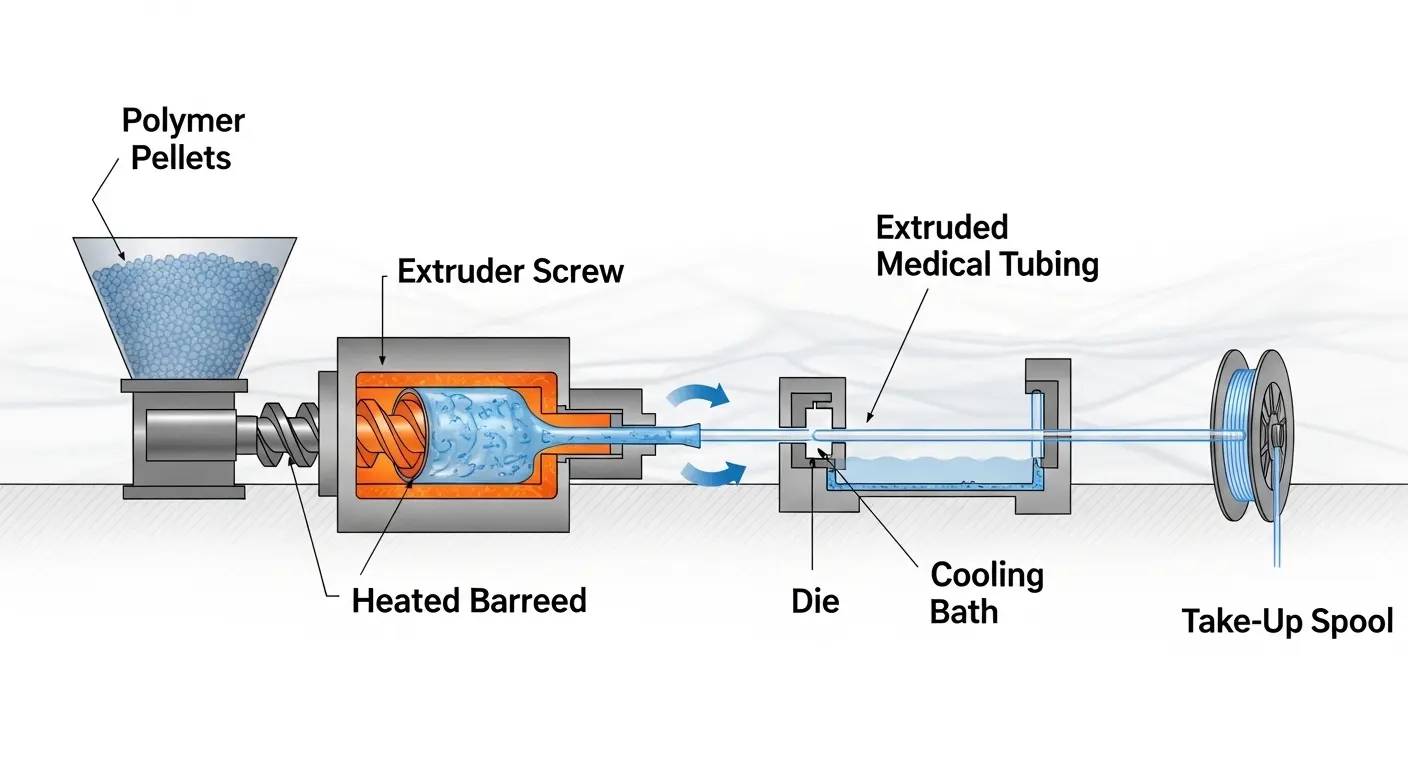
1. Resin Preparation and Feeding
Everything starts with the material. Many medical polymers, such as Pebax®, Nylon 12, or TPU, are hygroscopic, meaning they act like a sponge for moisture in the air. If you put damp resin into an extruder, the water turns to steam, creating tiny bubbles (voids) in the tube wall.
To prevent this, resins are baked in desiccant dryers for several hours. Once dry, the pellets are fed into the Hopper, which uses gravity to drop the material into the throat of the extruder.
2. The Extruder: Melting and Pumping
The extruder is a heated barrel containing a rotating precision screw. As the screw turns, it performs three critical functions:
- Conveying: Moving the solid pellets forward.
- Plasticizing (Melting): Using friction and external heat to turn the pellets into a uniform, molten state.
- Metering: Stabilizing the pressure to ensure the molten plastic is pumped toward the die at a perfectly consistent rate.
3. The Die and Tip (The Shaping Tools)
The Die Head is where the magic happens. This tool determines the final dimensions of the tube.
- The Die shapes the outer diameter (OD).
- The Tip (or mandrel) creates the inner diameter (ID).
In medical applications, we use a Drawdown Ratio (DDR). We extrude the tube slightly larger than needed and stretch it as it cools. This aligns the polymer chains, making the tube significantly stronger and more resistant to kinking.
4. Quenching, Sizing, and Pulling
Once the hot plastic leaves the die, it enters a Vacuum Sizing Tank filled with chilled water. A vacuum pulls the outside of the tube against a metal sizer to "lock in" the shape, while the water "quenches" the plastic into a solid state. A Puller—typically two rotating belts—provides the constant tension needed to draw the tube through the line at a synchronized speed.
Specialized Types of Medical Extrusion
As medical devices evolve, simple tubes are often no longer enough. The industry has developed specialized forms of extrusion to meet complex clinical needs:
- Co-Extrusion (Multi-Layer): Using multiple extruders to create a tube with different properties on the inside and outside. For example, a catheter might have a slick PTFE liner on the inside for device delivery and a soft Pebax® jacket on the outside for patient comfort.
- Multi-Lumen Extrusion: Creating a single tube with several internal channels (lumens). This allows a doctor to deliver medication, inflate a balloon, and monitor blood pressure simultaneously through one device.
- Micro-Extrusion: The frontier of miniaturization. This produces tubing for neurovascular surgery with diameters as small as 0.1mm—thinner than a human hair.
Common Materials Used in Medical Extrusion
The choice of polymer defines the "compliance" or flexibility of the device.
| Material | Key Property | Typical Use |
| PVC | Flexible, clear, cost-effective | IV lines, respiratory tubes |
| PEBAX® | High strength-to-weight ratio | Catheter shafts, balloon parisons |
| TPU | Excellent biocompatibility | Vascular access, long-term implants |
| PTFE / FEP | Ultra-low friction (slick) | Catheter liners, protective sheaths |
| PEEK | Extreme rigidity and strength | Specialty stents, orthopedic tools |
Medical vs. Industrial: The Quality Divide
You cannot manufacture medical tubing in a standard factory. There are three major differences that define the medical grade:
- Cleanroom Environments: Medical extrusion happens in ISO Class 7 or 8 Cleanrooms. Air is filtered to remove particulates. A single speck of dust landing on a molten catheter can create a stress point that causes the tube to burst inside a patient.
- In-Line Metrology: Modern lines use Laser Micrometers and Ultrasonic Gauges. These measure the tube thousands of times per second. If the wall thickness drifts by even 0.005mm, the system automatically adjusts the machine to compensate.
- Statistical Process Control (SPC): While industrial tubing might allow for 5% variation, medical extrusion requires a high Cpk (Process Capability Index). This ensures that 99.99%+ of the product is within the exact specified tolerance.
The Future of Medical Extrusion (2026 Trends)
In 2026, the industry is moving toward Extrusion 4.0. This involves integrating Artificial Intelligence (AI) into the production line to predict material inconsistencies before they result in scrap. We are also seeing a surge in Bio-attributed Polymers, reducing the carbon footprint of medical disposables without sacrificing performance.
Medical extrusion remains the "invisible hero" of healthcare. Whether it's a simple IV line or a complex brain-access catheter, the precision of the extruded tube is the foundation of patient safety.
Submit Your Request
Recent Posts

Tags
- Adult Diapers
- Are custom medical devices safe
- Baby Diapers
- Can respiratory anesthesia be used
- Digital Healthcare
- Do you offer customized consumables
- European Market
- How do you take care of a skin wound
- Industry Trends
- Lady Sanitary Napkins
- Medical Devices
- OEM Medical Devices
- Product Introductions
- Protective Equipment
- Under Pads
- What are custom-made medical devices
- What are diagnostic products
- What are hospital dressing products
- What are medical tube catheters
- What are some common protective equipment
- What are the appropriate applications for hospital dressing products
- What are the appropriate uses for protective equipment
- What is a gynecological examination
- What is a medical consumable
- What is an anesthesia kit
- What is an OEM in medical devices
- what is an wound skin care
- what is can disposable ultrasonic diagnostic
- What is good manufacturing medical devices
- What is hospital-grade protective equipment
- what is medical equipments hospital furniture
- What is medical sterilization wrapping
- What is rehabilitation equipment device
- What medical consumables do you supply
- Where can I find laboratory consumables wholesale
- where can I find medical protection device
- where to buy hypodermic accessories
- where to buy medical apparel
- where to buy medical consumable accessories
- where to find OEM medical device supplier
- where to find rehabilitation equipment supplier
