



What Clinicians Should Know: Disposable Medical Clothing Materials 2026


Disposable Medical Clothing is more than a box on the storeroom shelf; it is a frontline barrier that should never get in the way of care. When the room is warm, the case is long, and fluid exposure is uncertain, the right material choice prevents strike-through, limits heat stress, and preserves movement. This practical guide is written for clinicians, nurse leaders, and procurement teams who want clarity on materials, labels, and fit-for-purpose performance in 2026.
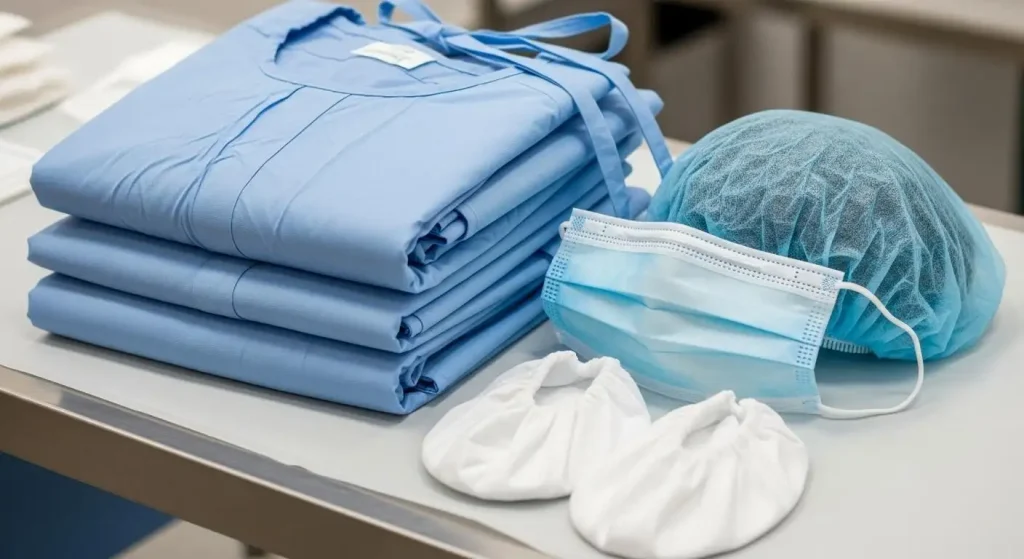
This guide will help you:
•Match materials to clinical risk without over- or under-specifying
•Read 2026 labels and standards with confidence
•Balance comfort, breathability, and barrier performance for real workflows
•Implement procurement trials and controls that stick across sites
Material Landscape: SMS, Film-Laminate, and Spunlace
Material drives both safety and comfort, and three families dominate Disposable Medical Clothing today. Each offers a distinct balance of breathability, barrier, and feel.
SMS and SMMS (polypropylene) are the workhorses for isolation wear and many surgical gowns. Typical weights of 35 to 65 gsm deliver strength from spunbond layers and filtration from the meltblown core. In practice, this means low linting for clean fields and a barrier that holds up under routine splashes and moderate fluid exposure. Manufacturers often reinforce high-splash zones at the torso and sleeves, concentrating protection where it matters while keeping the rest of the garment breathable. For endoscopy, general surgery, and long dressing changes with intermittent contact, SMS and SMMS provide a dependable balance that clinicians can wear for hours without excessive heat burden.
Microporous film-laminates step up the barrier. A polyethylene or polypropylene film bonded to a nonwoven backing resists liquid under pressure and reduces strike-through when suction, irrigation, or sustained contact is likely. Comfort depends on moisture vapor transmission rate (MVTR), a measure of how well sweat vapor escapes through the material. For extended wear, many teams target MVTR above 3,000 g/m²/24 h to limit heat buildup. In the orthopedic OR with power tools, trauma resuscitations with high splash potential, or labor and delivery with prolonged fluid contact, film-laminates deliver the headroom you need, provided you select high-MVTR variants to keep clinicians functional throughout the case.
Spunlace (hydroentangled) nonwovens offer a soft, textile-like hand and drape that patients and staff notice immediately. These are excellent for low-risk coats, cover gowns, and patient apparel where breathability and comfort are priorities over maximum barrier. Specialty finishes can tailor performance: antistatic treatments for device handling, alcohol repellency for repeated surface contact, or colorfastness for clear role identification. Use them where they shine, and resist the temptation to over-specify barrier you do not need.
Reading 2026 Labels and Standards for Disposable Medical Clothing
Labels should make selection safer, not harder. Standards connect clinical risk to measurable performance, and they are your shortcut to choosing Disposable Medical Clothing that fits the case.
•AAMI PB70 Levels: Levels 1 through 4 classify barrier strength for gowns and drapes. Level 3 covers moderate splashes without prolonged pressure or likely viral challenge. Level 4, validated by ASTM F1671/ISO 16604, is for high-risk procedures with sustained fluid contact/pressure. Require lot-level test reports.
•EN 13795: Check cleanliness, wet/dry microbial penetration (ISO 22610/22612), and tensile/tear strength. Opt for High Performance where abrasion/fluid loads are higher; align reinforcements to actual splash zones.
•Tests: AATCC 127 (hydrostatic), AATCC 42 (impact), ASTM F1670 (synthetic blood) prior to viral surrogate testing. Lot-to-lot data shows process stability; a single certificate from years ago is not enough.
•Sterilization And Packaging: For sterile items, confirm the sterilization method (ethylene oxide or gamma), validated shelf life, and packaging integrity under your storage conditions. The right barrier can be undermined by a compromised pouch or excessive handling that sheds particulates into the field.
Global health bodies continue to highlight the scale of healthcare-associated infections, affecting millions of patients each year. Verified barriers in Disposable Medical Clothing are one part of a layered defense that supports aseptic practice.
Comfort Versus Protection: Designing for Real Workflows
Comfort is a safety factor. Heat stress and movement limits, often worsened by weak closures, raise fatigue and slow response. Specify garments that meet barrier targets while preserving mobility and thermal comfort.
SMS/SMMS serve extended cases with intermittent fluids. Where splash or pressure is likely, select microporous laminates with high MVTR to curb heat during prolonged wear. Low linting protects optics and the sterile zone, while antistatic finishes improve device handling and reduce nuisance shocks in oxygen-rich settings.
Ergonomic details matter: raglan sleeves for overhead reach, secure neck closures that do not pull when you turn, well-fitted collars for consistent coverage, and adjustable cuffs that stay sealed under gloves. When materials and design align, clinicians can focus on the patient, not the garment.
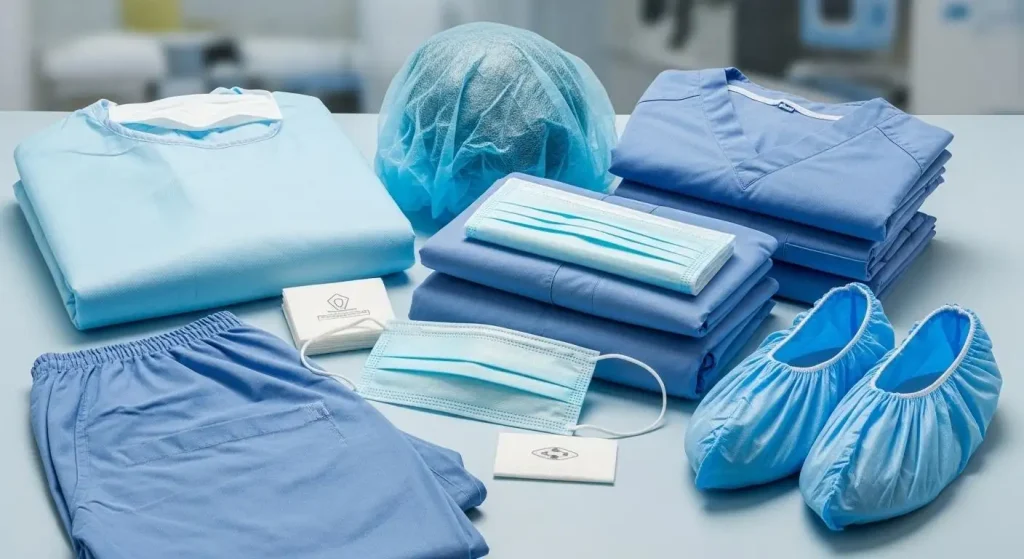
Turning Features into Clinical Value With Disposable Medical Clothing
Features are only meaningful when they improve care, reduce risk, or simplify work. Make science practical by defining outcomes you can verify-protection that holds, comfort that lasts, and workflows that stay clean.
•Align risk with evidence: Specify AAMI PB70 Level 3 and 4, and insist on viral penetration proof (ASTM F1671 or ISO 16604) for Level 4. Doing so cuts barrier failures and smooths audits.
•Support human performance: High-MVTR SMS and film laminates help teams manage heat through long procedures, sustaining focus without giving up protection.
•Keep the field pristine: Low-lint fabrics protect optics; antistatic finishes improve instrument control and reduce micro-sparks that break concentration.
•Build trust in supply: Clear sizing, color-coded packaging, and multi-site availability make stocking predictable and reduce last-minute substitutions.
•Make compliance effortless: Use datasheets that clearly state standards, test methods, sterilization, and shelf life for fast governance checks.
Operationalize Standards:
•Map pathway risk and set default gown levels; show exceptions prominently.
•Run side-by-side wear trials on two or more material families; record comfort, breathability, sleeve/cuff integrity, movement, and coverage.
•Validate AAMI PB70 and EN 13795 certifications; include Level 4 viral penetration data; verify sterilization and shelf life; confirm labels match what’s received.
•Monitor lot consistency using AATCC 127/42 sampling and field feedback; escalate deviations before they reach high-risk areas; visualize trends on a simple dashboard.
Act now: With rising workloads and more complex, unpredictable exposure, reliable, evidence-based selection has never mattered more. Heat stress and labeling variability continue to challenge frontline teams. Disposable Medical Clothing must deliver consistent barrier performance, low linting, and ergonomic coverage without adding fatigue. A practical approach is to reserve microporous film-laminates with MVTR above 3,000 g/m²/24 h for prolonged, high-exposure cases; specify SMS or SMMS around 35 to 65 gsm for balanced use; and add antistatic finishes where device handling and oxygen concentrations warrant it. Align garments with AAMI PB70 and EN 13795, and confirm performance via AATCC 127, AATCC 42, ASTM F1670, and ASTM F1671 or ISO 16604. This closes the gap between label and reality and gives clinicians confidence in every shift.
Call to Action
Advance infection control and clinician comfort now. Request Disposable Medical Clothing samples and full datasheets, and engage clinical specialists to map garment levels to your procedures. Set up a wear-trial protocol, capture performance data, and finalize a compliant, cost-effective formulary for 2026 and beyond. When material choice and workflow design come together, patients and clinicians both win.
Submit Your Request
Recent Posts


Tags
- Adult Diapers
- Are custom medical devices safe
- Baby Diapers
- Can respiratory anesthesia be used
- Digital Healthcare
- Do you offer customized consumables
- European Market
- How do you take care of a skin wound
- Industry Trends
- Lady Sanitary Napkins
- Medical Devices
- OEM Medical Devices
- Product Introductions
- Protective Equipment
- Under Pads
- What are custom-made medical devices
- What are diagnostic products
- What are hospital dressing products
- What are medical tube catheters
- What are some common protective equipment
- What are the appropriate applications for hospital dressing products
- What are the appropriate uses for protective equipment
- What is a gynecological examination
- What is a medical consumable
- What is an anesthesia kit
- What is an OEM in medical devices
- what is an wound skin care
- what is can disposable ultrasonic diagnostic
- What is good manufacturing medical devices
- What is hospital-grade protective equipment
- what is medical equipments hospital furniture
- What is medical sterilization wrapping
- What is rehabilitation equipment device
- What medical consumables do you supply
- Where can I find laboratory consumables wholesale
- where can I find medical protection device
- where to buy hypodermic accessories
- where to buy medical apparel
- where to buy medical consumable accessories
- where to find OEM medical device supplier
- where to find rehabilitation equipment supplier
